
Are you confused by eBike classes? Choosing the wrong one can lead to ordering bikes you can't legally sell. Understanding the difference is critical for your business's success.
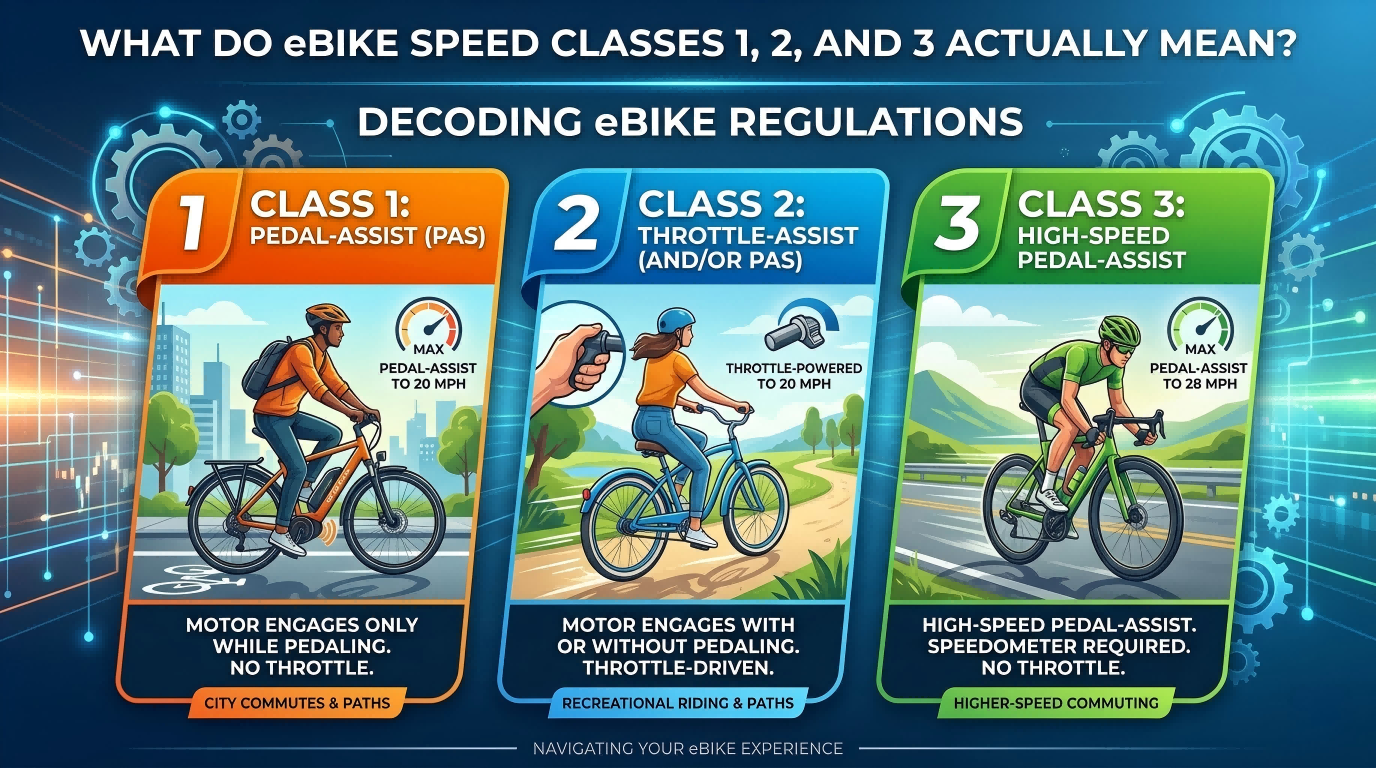
The three main US eBike classifications define how the motor assists you. Class 1 is pedal-assist only up to 20 mph. Class 2 has a throttle and assists up to 20 mph. Class 3 is pedal-assist only up to 28 mph.1
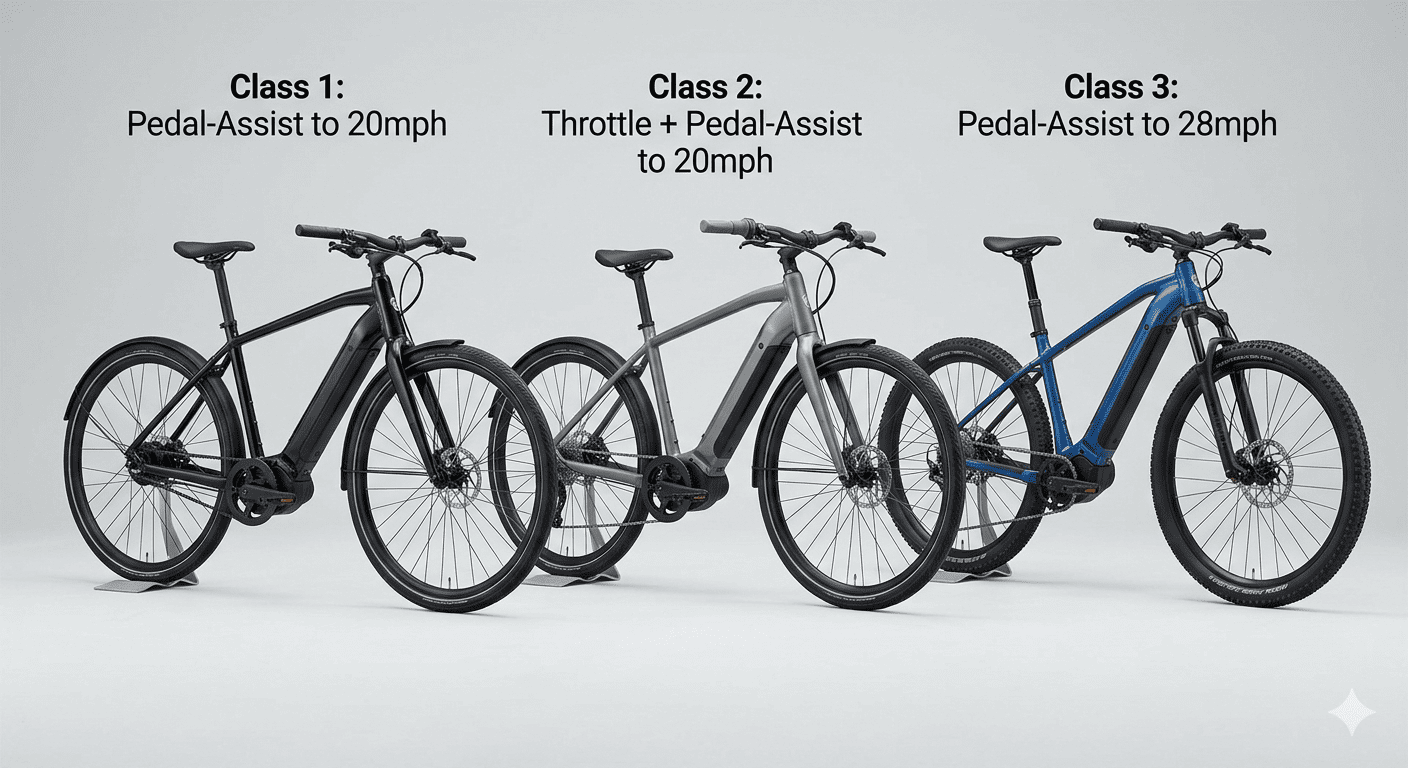
Over my 15 years in eBike manufacturing, I've seen many buyers make costly mistakes because they misunderstand these classes. They are not just settings you can flip between. They are distinct legal and engineering standards that shape the entire design of the bike, from the motor controller to the brakes.2 Getting this right from the start is the difference between a successful product launch and a warehouse full of non-compliant inventory. Let's break down what these classes really mean for you as a buyer.
Does a Class 3 eBike Just Have a More Powerful Motor?
You might think a Class 3 bike needs a bigger motor to be faster. This assumption can lead you to spec the wrong components and overspend. The truth lies in the tuning.
No, a Class 3 eBike doesn't always need a more powerful motor than a Class 1 or 2. The classification is determined by the speed at which motor assistance cuts off (28 mph), which is achieved through specific controller programming and sensor tuning, not just raw power.
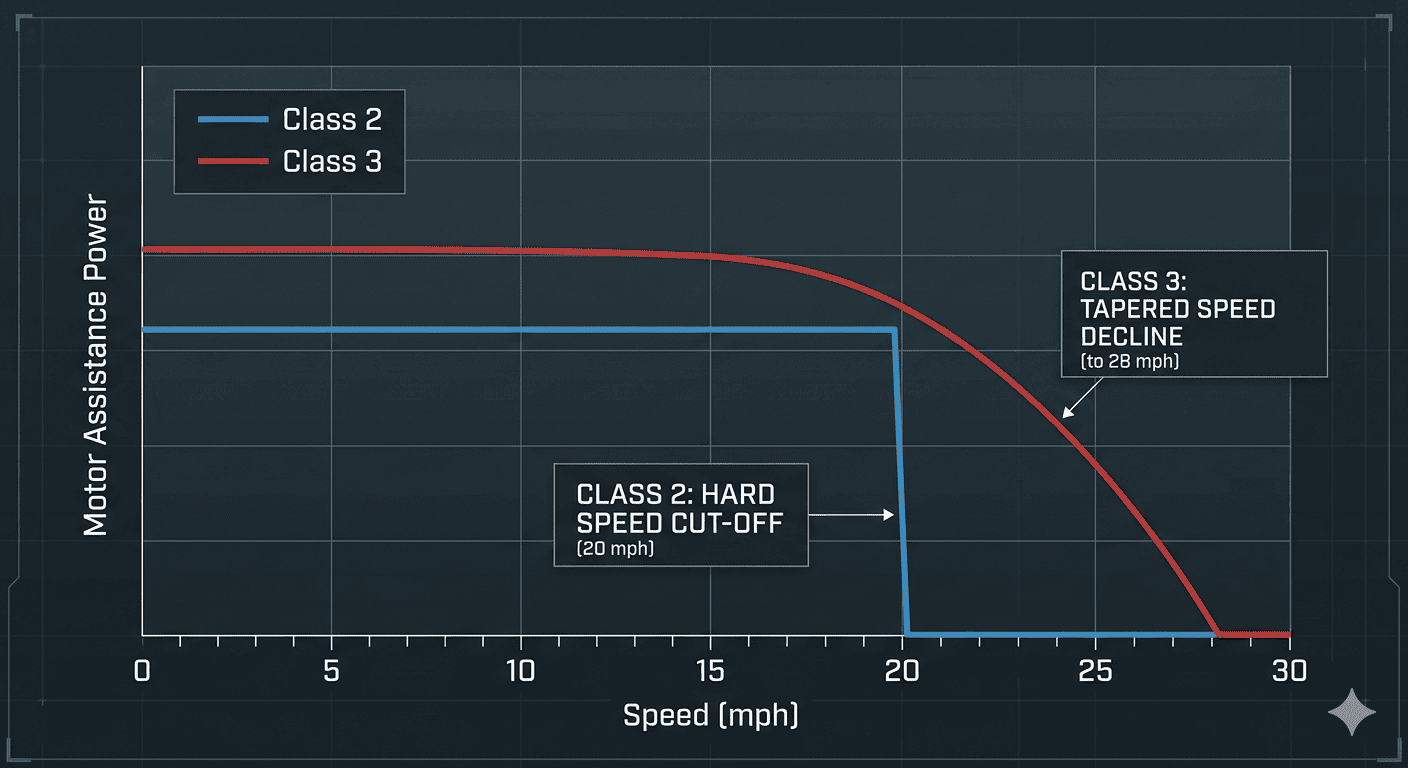
In our client projects, we frequently clarify this point. Buyers see a "750W" label on a motor and assume it can be used for any class. But the "class" is a result of system design, not just one component's peak power. A motor's nominal wattage is its continuous power rating, but how that power is delivered is managed by the controller.3 For a Class 3 bike, we program the controller to provide pedal assistance up to 28 mph. For a Class 2 bike with the exact same motor, we program the controller to cut off assistance at 20 mph. The engineering focus for Class 3 is ensuring the torque curve provides smooth, stable support at higher speeds, which requires different software logic and often more refined sensor input.
| Feature | Class 2 Tuning (750W Motor) | Class 3 Tuning (750W Motor) |
|---|---|---|
| Max Assisted Speed | 20 mph | 28 mph |
| Assist Type | Pedal-assist and/or Throttle | Pedal-assist only |
| Controller Logic | Cuts power sharply at 20 mph | Tapers power smoothly towards 28 mph |
| Primary Goal | All-purpose use, path compliance | Higher speed commuting, road use |
So, when you specify an order, don't just ask for a "750W motor." Instead, define the class you need. We then build and certify the entire system—motor, controller, and sensors—to meet that specific legal and performance standard.
Can You Sell a US Class 2 eBike in Europe?
You have a best-selling Class 2 eBike in the US. You assume you can bring this success to the EU market. This assumption can lead to your entire shipment being rejected by customs.
No, a standard US Class 2 eBike is illegal for sale as a bicycle in the European Union. EU regulations (EN15194) cap motors at 250W continuous power and 25 km/h (approx. 15.5 mph) pedal-assist only.4 Throttles, a key feature of Class 2, are not allowed.5
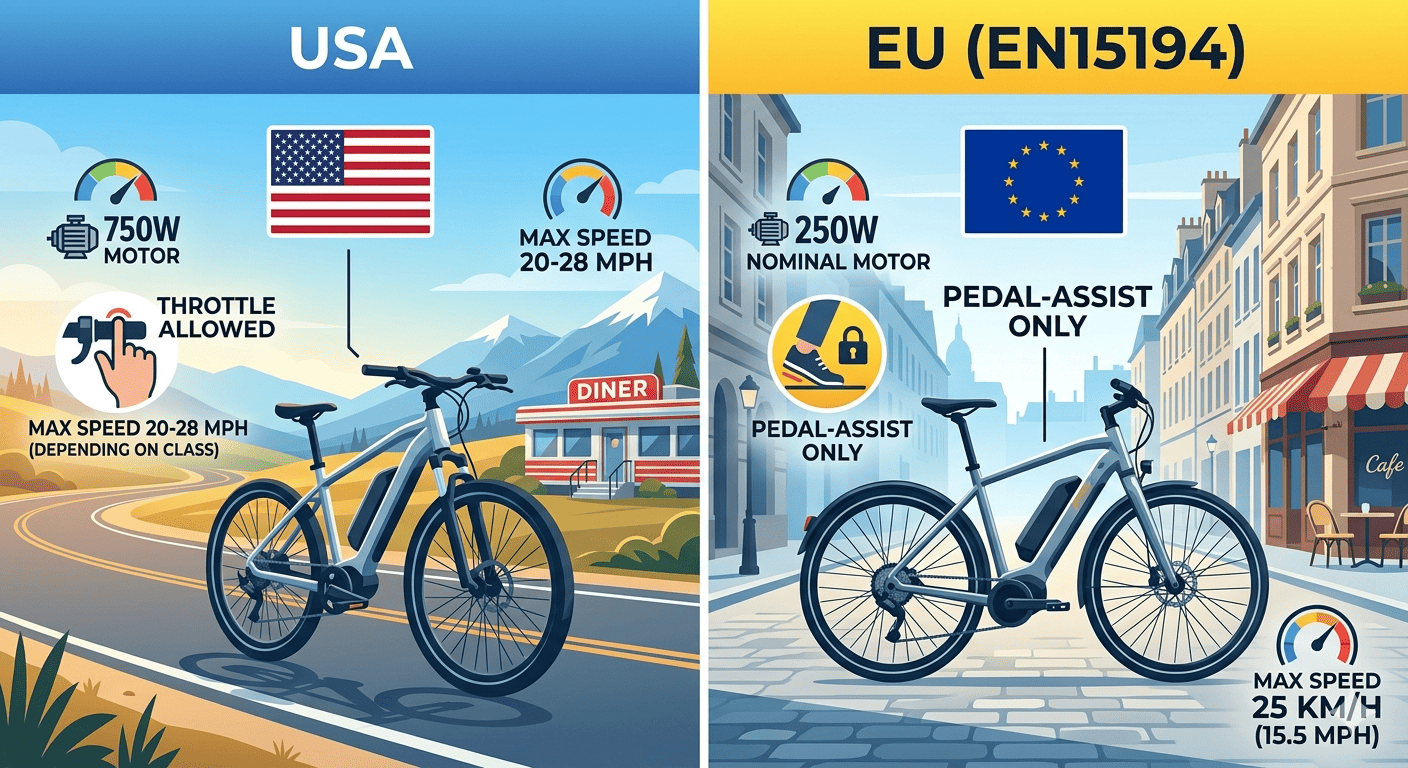
I once had a client who wanted to place a large order for their successful US Class 2 model, with only a different power plug for the EU market. We had to stop the process and explain that this would create a product that was illegal to sell there. The two regulatory worlds are fundamentally different. A US Class 2 bike is defined by its speed (20 mph) and its throttle. An EU-compliant pedelec is defined by its limited power (250W), lower speed cutoff (25 km/h), and lack of a throttle. They are not interchangeable. Trying to sell a US-spec bike in Europe without a complete redesign is a recipe for disaster. It requires a new bill of materials (BOM), different motor and controller settings, and a separate certification process under EN15194.
| Specification | US Class 2 | EU Pedelec (EN15194) |
|---|---|---|
| Throttle | Yes, allowed | No, not allowed |
| Max Speed | 20 mph (~32 km/h) | 25 km/h (~15.5 mph) |
| Max Motor Power | Not federally regulated (often 750W) | 250W continuous |
| Certification | Self-certified or third-party (CPSC) | Mandatory EN15194 |
For our clients targeting both markets, we develop two distinct versions of the bike from the ground up. It's an investment, but it’s the only way to operate legally and successfully across continents.
Can You Just Use Software to Switch Between eBike Classes?
You want to simplify inventory. You imagine ordering one bike model and using a software menu to set it as Class 1, 2, or 3 for different markets. This approach will fail certification every time.
This is a dangerous misconception. Certified eBikes cannot be switched between classes via software. Each class has specific hardware, software, and safety integrations that are tested and locked in as a complete system during certification. A switchable bike would not pass.
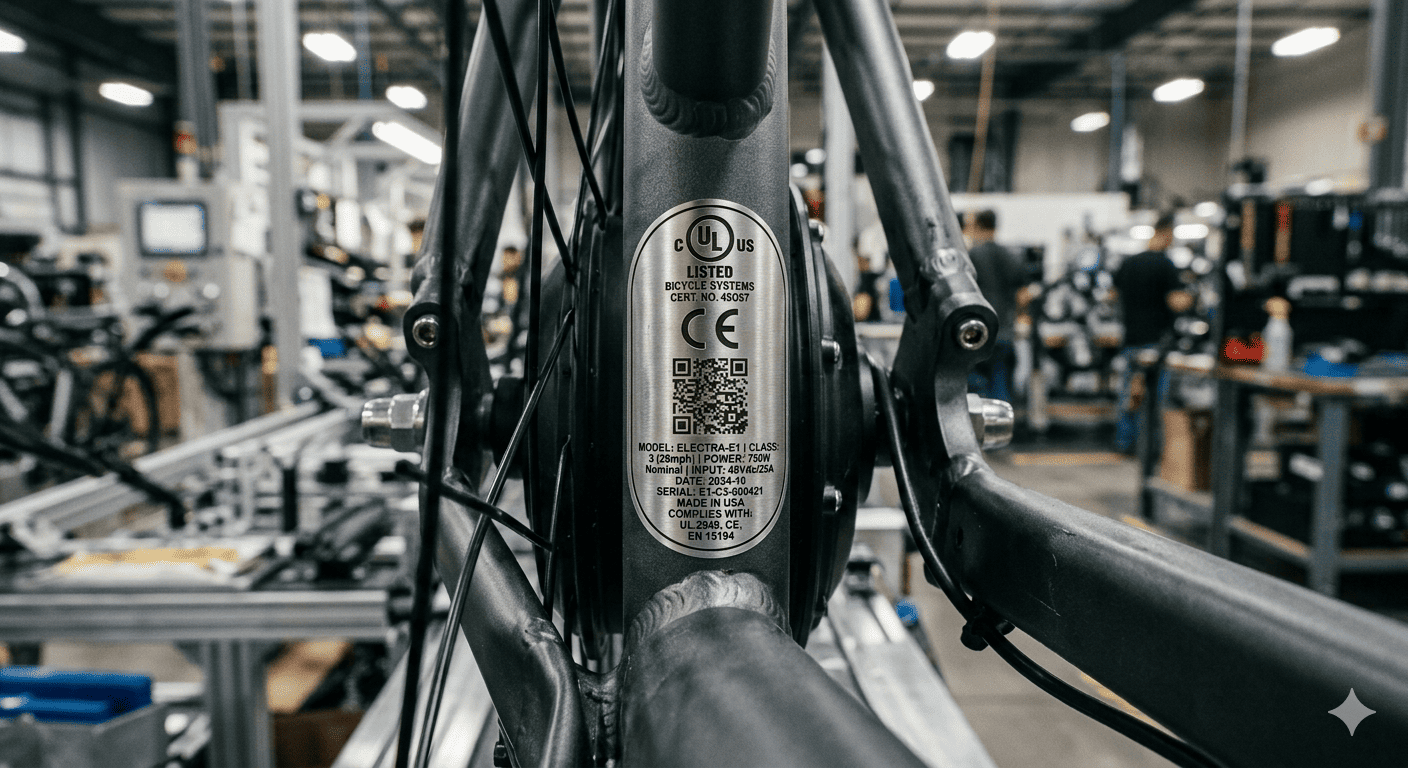
From a manufacturer's perspective, the idea of "one BOM, three firmware builds" is a non-starter. Certification bodies test for exactly this kind of modification.6 They need to ensure the bike's safety features match its performance capabilities and that it cannot be easily altered by the end user into a non-compliant state. For instance, a Class 3 bike is engineered to be stable and safe at 28 mph. This means it requires brakes with more stopping power and tires with a higher speed rating7 than a Class 1 bike that only goes up to 20 mph. The controller logic is also different. A Class 3 controller needs to smoothly manage motor output at high speeds, while a Class 1 controller is much simpler.8 If we provided a software switch, a user could enable Class 3 speeds on a bike with Class 1 brakes. That's a huge safety liability and an instant certification failure. Building a compliant eBike means designing, building, and testing it for one specific class.
Is a Class 3 eBike Legal Everywhere in the US?
You've decided to stock Class 3 eBikes to attract performance-focused customers. But your buyers might find they can't ride them on their local bike paths, leading to frustration and returns.
No, Class 3 eBikes are not universally permitted on all bicycle infrastructure in the United States. While they have a federal definition, many states, counties, and cities have their own rules that may restrict them from multi-use paths or require a license.9
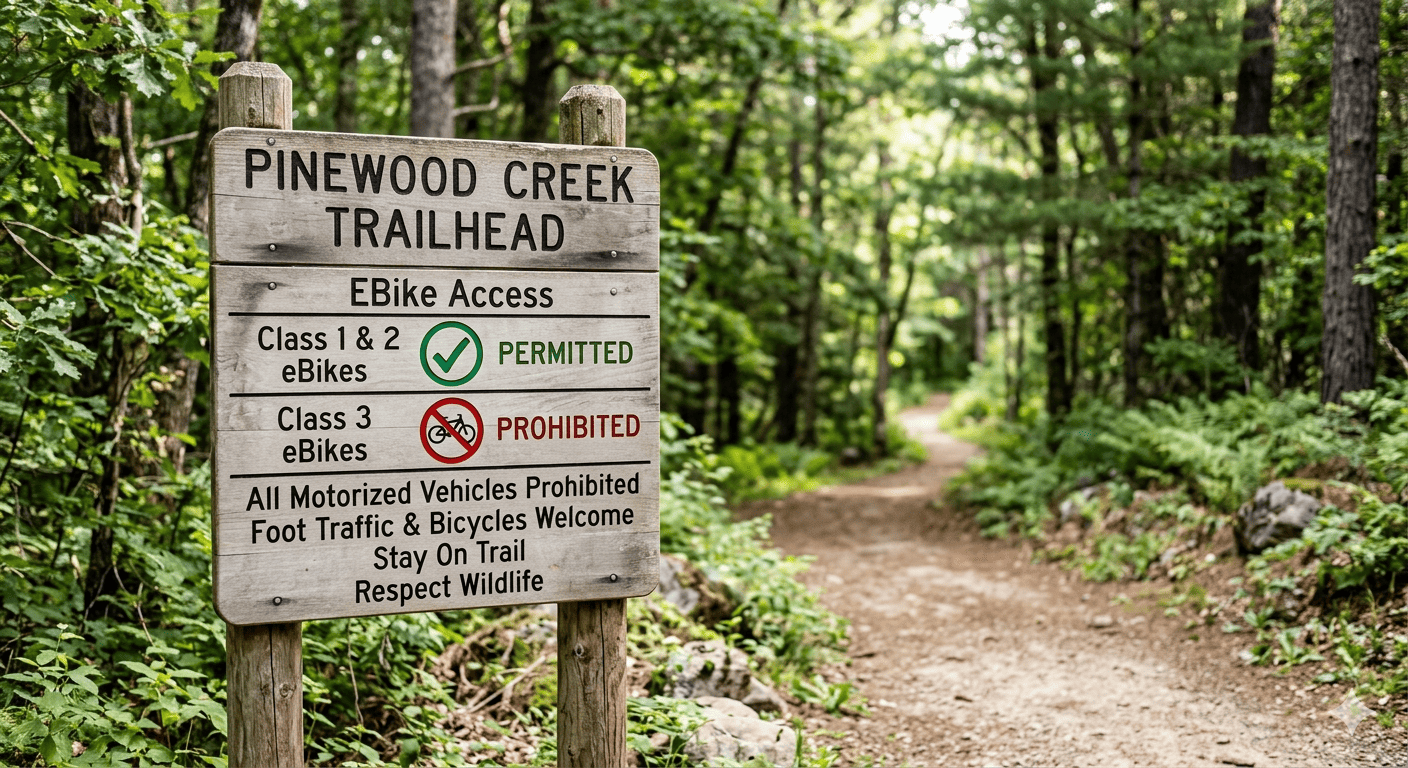
As a manufacturer, our job is to build a bike that meets the federal definition of a Class 3 eBike10. However, the responsibility falls on the brand or distributor to understand the patchwork of local laws where the bikes will be sold and ridden. For example, some states treat Class 3 eBikes like bicycles, giving them broad access. Other states or individual cities might ban them from any path shared with pedestrians11 and cyclists, relegating them to on-road bike lanes only. I've seen projects where a national distributor had to create different marketing materials and guidance for their dealers in California versus those in another state with stricter rules. Before placing a large order for Class 3 bikes, it is essential for you to research the regulations in your specific sales territories. This ensures your customers will have a positive experience and that you are selling a product that is practical for their daily use.
Conclusion
eBike classes are fixed legal and engineering standards, not just speed settings. Understanding these details is vital for sourcing and selling compliant bikes that meet your market's specific needs.
"Electric Bicycles - Regulations.gov", https://www.regulations.gov/document/CPSC-2024-0008-0001. ↩
"[PDF] Summary of Electric and Non- Powered Bicycle Standards", https://www.cpsc.gov/s3fs-public/Electric-and-Non-Powered-Bicycle-Standards-Summary-Report.pdf?VersionId=rZGs9tSONCKqT8AEaJJMZd_S1nDJpKEW. ↩
"Power rating - Wikipedia", https://en.wikipedia.org/wiki/Power_rating. ↩
"Electric bicycle laws - Wikipedia", https://en.wikipedia.org/wiki/Electric_bicycle_laws. ↩
"Electric bicycle laws - Wikipedia", https://en.wikipedia.org/wiki/Electric_bicycle_laws. ↩
"E-bikes in Michigan", https://www.michigan.gov/dnr/things-to-do/hike-and-bike/ebikes. ↩
"Improving the Bicycle – Illumin Magazine - USC Viterbi School of ...", https://illumin.usc.edu/improving-the-bicycle/. ↩
"Position and Speed Control of Brushless DC Motors Using ... - PMC", https://pmc.ncbi.nlm.nih.gov/articles/PMC3231115/. ↩
"E-bikes in Michigan", https://www.michigan.gov/dnr/things-to-do/hike-and-bike/ebikes. ↩
"[PDF] Summary of Electric and Non- Powered Bicycle Standards", https://www.cpsc.gov/s3fs-public/Electric-and-Non-Powered-Bicycle-Standards-Summary-Report.pdf?VersionId=rZGs9tSONCKqT8AEaJJMZd_S1nDJpKEW. ↩
"Electric Mountain Bikes in Utah", https://recreation.utah.gov/electric-mountain-bikes-in-utah/. ↩