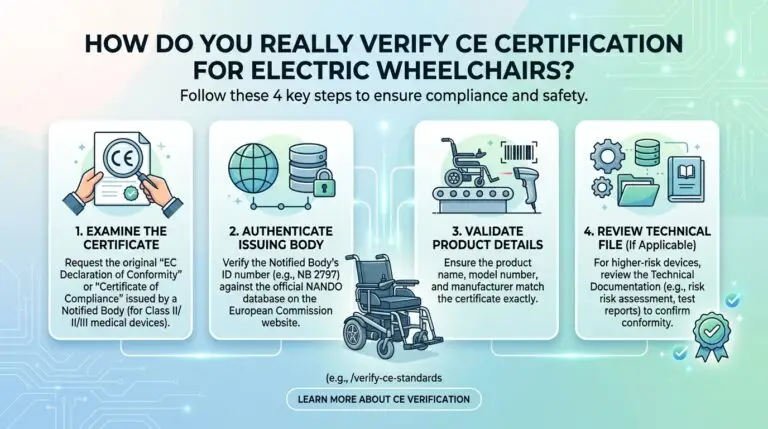

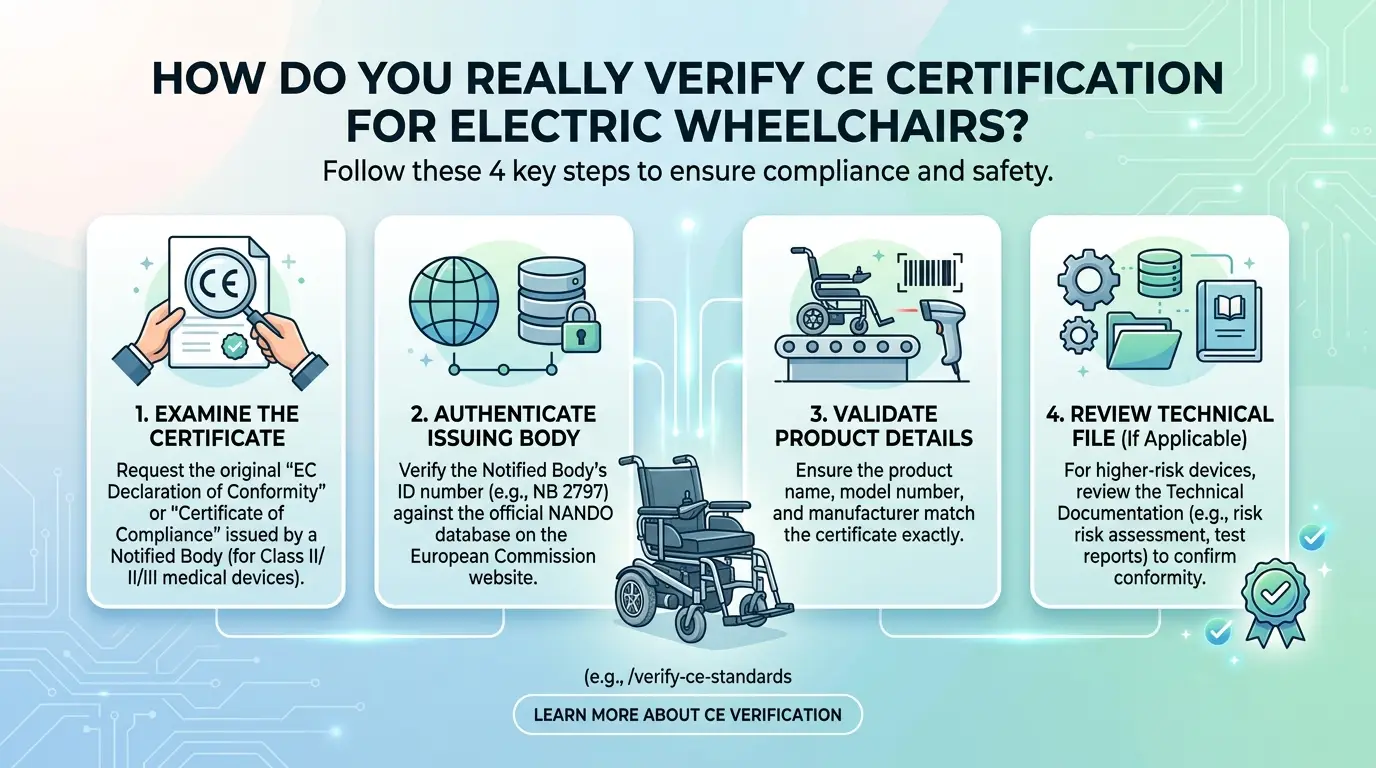
leading paragraph: Sourcing electric wheelchairs from China? You worry that a simple "CE certificate" isn't enough to avoid customs problems or market inspections. This guide shows how to properly vet CE compliance1.
snippet paragraph: To truly verify CE certification, don't just ask for a certificate. You must check that the CE certificate, test report, product model, and configuration details2 all match the exact electric wheelchair you intend to buy. This proactive check prevents costly import and compliance issues3 later on.
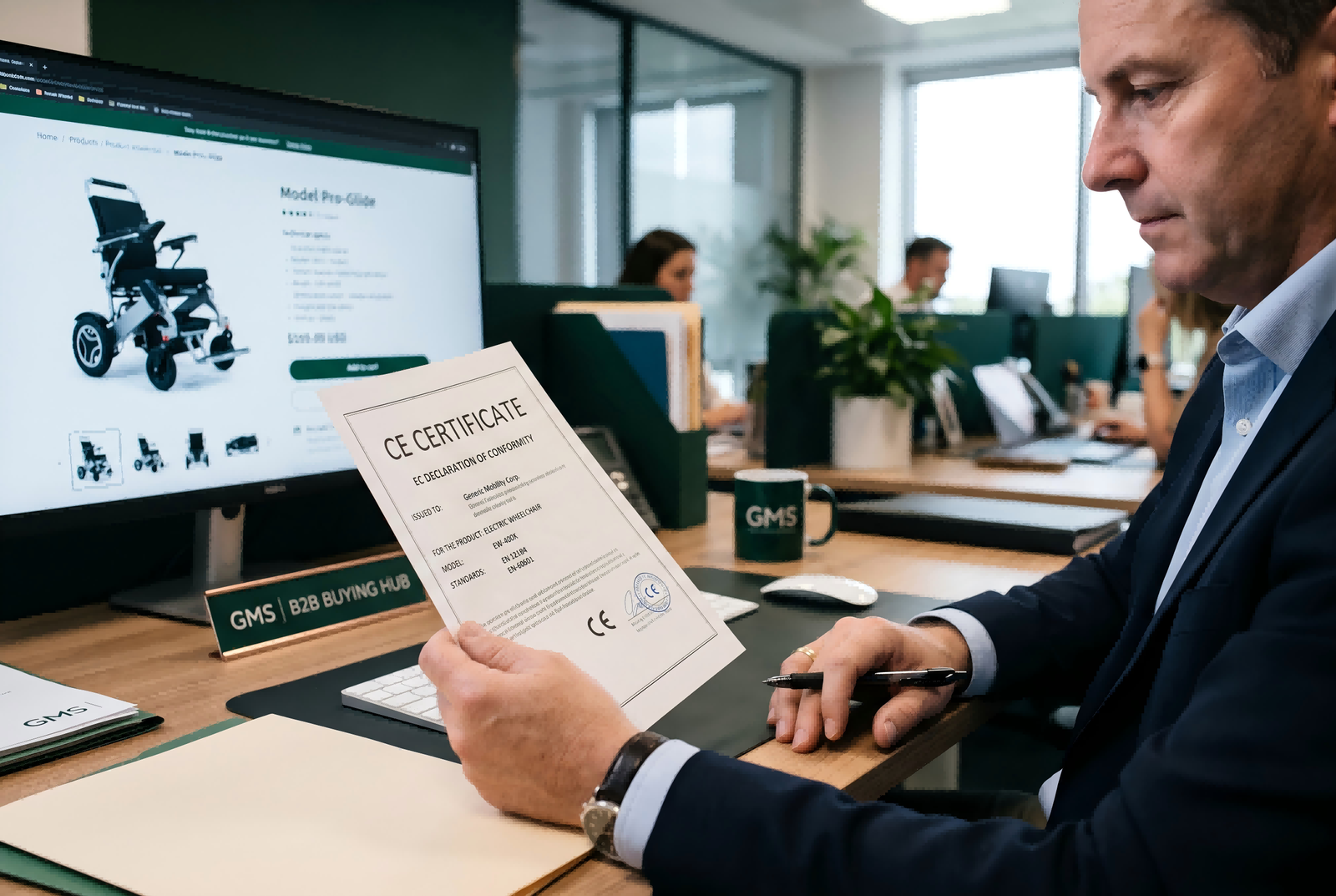
Transition Paragraph: I have seen many buyers make the mistake of negotiating the price first4, only to get stuck with documentation problems right before shipping. This is a risky way to do business. A deeper look at the CE paperwork5 from the very beginning can save you a lot of time, money, and headaches. Let’s break down how you can do this effectively and protect your investment.
Why is 'Do you have CE?' the wrong first question?
leading paragraph: You start every supplier inquiry by asking for their CE certificate. But what if that simple "yes" leads you down a path of wasted time with a product that isn't compliant?
snippet paragraph: Asking "Do you have CE?" is the wrong first question because a generic certificate6 may not cover the specific model or configuration you need. A better approach is to first specify your product requirements, then ask for the corresponding CE documentation to ensure they match perfectly.

Dive deeper Paragraph: In my years of business, this is the most common question I get from new buyers: "Do you have CE?". While it seems like a good starting point, it's too broad. Many suppliers will say "yes" because they have a certificate for at least one of their products. But that certificate might be for a different model or an older version. For example, a supplier might have a valid CE certificate for their "Model A" wheelchair with a lead-acid battery. If you want to buy "Model A" with a new lithium battery, that original certificate and its test report may no longer be valid. The change in battery technology is a major modification that affects the product's electrical safety and electromagnetic compatibility7. A professional supplier understands this, but it's your job as the buyer to ask the right, specific questions to uncover these details.
| Question Type | Example Question | Typical Supplier Answer | Outcome |
|---|---|---|---|
| Wrong Question | "Do you have CE?" | "Yes, we have CE." | Vague, high risk of mismatch. |
| Right Question | "For your Model T-123 with a 24V 20Ah lithium battery, can you provide the CE certificate, full test reports, and DoC?" | "Yes, here they are." or "That configuration requires re-testing." | Clear, low risk, professional dialogue. |
What documents should I check besides the CE certificate?
leading paragraph: You received a CE certificate from a potential supplier. But you have a feeling that one piece of paper isn't the whole story. What if you're missing something important?
snippet paragraph: Beyond the CE certificate, you must review the full technical test report8 (like EMC and LVD), the Declaration of Conformity (DoC)9, the user manual, and photos of the product's labeling. Consistency across all these documents is key to confirming compliance for your specific product model.
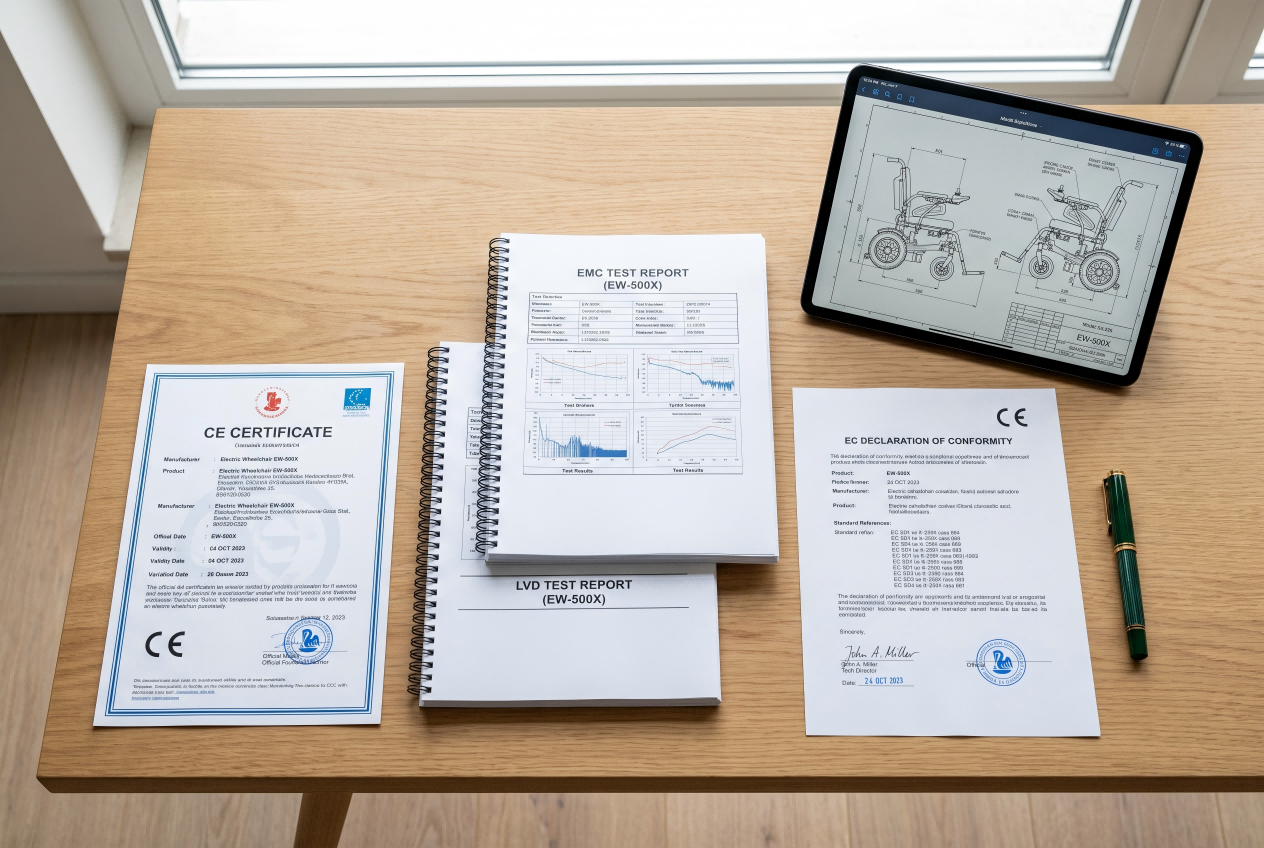
Dive deeper Paragraph: A single CE certificate is just the cover of the book. To understand the full story, you need to look at the pages inside. Each document serves a different purpose, and they must all align with one another and with the physical product you are buying. Think of it as a puzzle where all the pieces must fit together. For instance, the model number on the CE certificate must exactly match the model number on the technical test report and the manufacturer's Declaration of Conformity. I often advise buyers to request photos of the product's nameplate or rating label as well. If the model number on the product itself is different, it's a huge red flag. Checking this early on helps you avoid a situation where your container arrives at port and customs officials find a mismatch, leading to costly delays or rejection.
| Document | What to Check | Why It's Important |
|---|---|---|
| CE Certificate | Issuing body, valid date, and exact model number. | Confirms a product sample passed testing at a specific time. |
| Test Report (EMC/LVD) | Model number, key components tested (battery, controller, charger). | Provides the technical proof and shows what was actually tested. |
| Declaration of Conformity (DoC) | Manufacturer's signature, model number, list of applied standards. | The manufacturer's legal statement taking responsibility for compliance. |
| User Manual & Labels | CE mark, manufacturer details, model number. | Must match the DoC and be compliant for the end-user. |
How do product changes affect CE for wheelchairs and scooters?
leading paragraph: You want to customize an electric wheelchair for your market. But you worry that changing the battery or controller might invalidate the supplier's CE documents, creating a huge risk for you.
snippet paragraph: For electric wheelchairs, changing key electronic components like the battery (e.g., lead-acid to lithium), charger, or controller almost always impacts CE compliance. These components are critical for electrical safety (LVD) and electromagnetic compatibility (EMC) tests and may require new documentation.
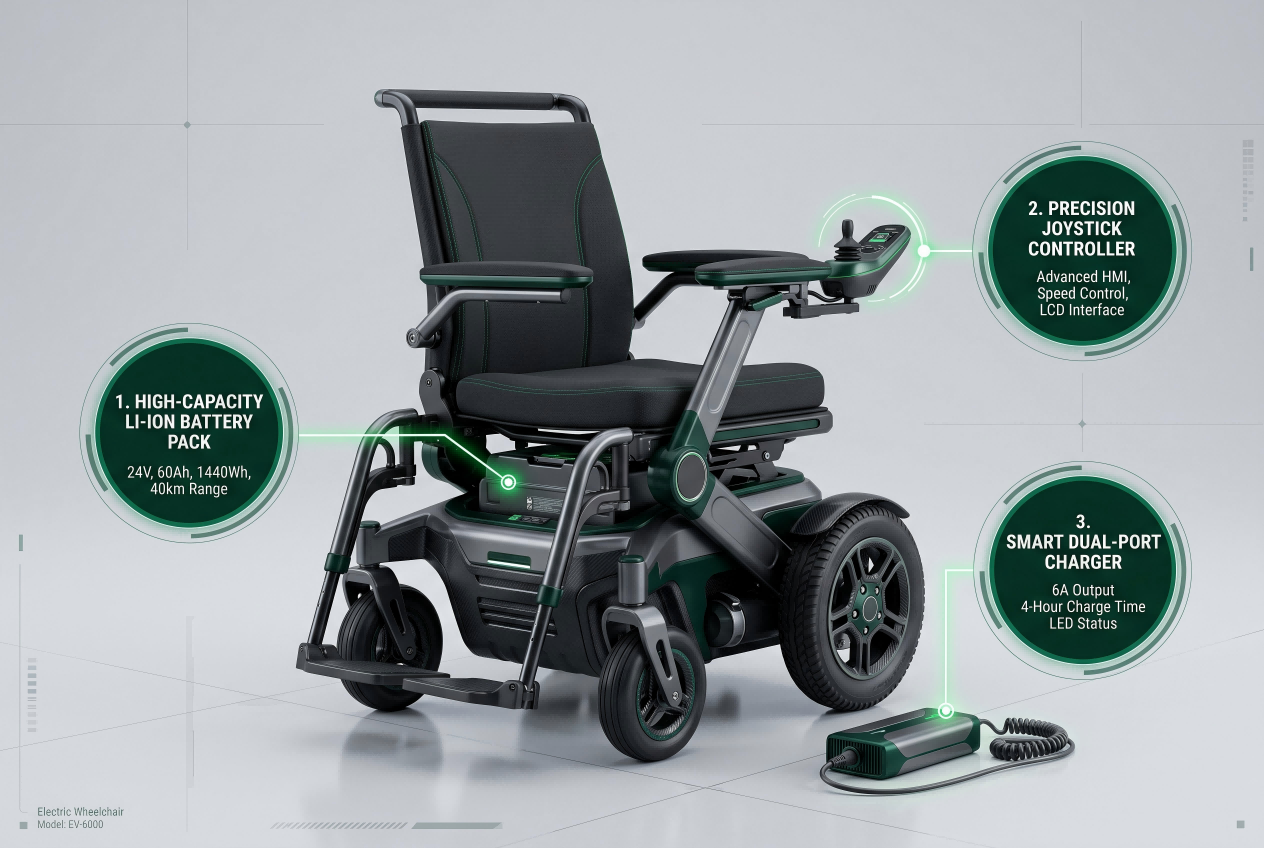
Dive deeper Paragraph: Customization is common in our industry, but not all changes are equal when it comes to CE compliance. When sourcing electric wheelchairs or mobility scooters, you must pay close attention to the electronics. The three most critical components are the battery, the charger, and the controller. A change to any of these can fundamentally alter the product's performance in safety and electromagnetic tests. For example, switching from a Chinese brand controller to a European PG controller is a significant electrical change. Even if the PG controller is CE certified on its own, the entire wheelchair system needs to be evaluated for compatibility. Other changes, like seat upholstery or wheel type, are generally less critical for the core electrical CE (EMC/LVD directives), though they may have implications under other regulations like the MDR. Always discuss any planned modifications with your supplier and ask how it affects the existing CE documentation.
| Customization | Potential Impact on CE (EMC/LVD) | Action Required |
|---|---|---|
| Battery Type (Lead-Acid to Lithium) | High | Request updated test reports or new testing. The charger must also be compatible and certified. |
| Controller Brand (Local to PG) | High | The entire system's EMC performance may change. Requires verification or re-testing. |
| Motor Power | Medium to High | A more powerful motor draws more current and can affect electrical safety and emissions. |
| Seat Style or Frame Color | Low | Unlikely to affect electrical compliance, but check for any MDR implications. |
How can CE documentation help me screen suppliers?
leading paragraph: You are comparing several Chinese suppliers, and they all claim to have CE. How do you tell the serious, professional partners from the ones who might cause problems for you later?
snippet paragraph: The way a supplier handles your detailed CE questions10 reveals their professionalism. A reliable partner will willingly provide complete documents, explain any discrepancies, and be transparent. Reluctance, defensiveness, or vague answers are major red flags that signal future business risks.

Dive deeper Paragraph: After years of communicating with buyers, I can tell you this: a supplier's paperwork is a window into their soul. A company that is sloppy with its compliance documents is often sloppy with its production, quality control, and after-sales service. When you ask for the full set of CE documents, you are doing more than just checking compliance; you are testing the supplier's professionalism. A great partner will respond quickly and provide everything you need. If there's a difference between a marketing model name and the name on the test report, they will explain it clearly. If your requested customization requires new testing, they will be honest about it and provide a plan. On the other hand, a risky supplier will delay, make excuses, send an expired certificate, or tell you not to worry. These are signs that they either don't understand the importance of compliance or are trying to hide something. In my experience, choosing the supplier who is organized and transparent with their documents is always the safer long-term investment.
Conclusion
Verifying CE is more than a checkbox; it is a key part of your supplier vetting process. By checking all documents for consistency, you protect your investment and build better partnerships.
"EU Legislation and CE Marking - International Trade Administration", https://www.trade.gov/country-commercial-guides/eu-eu-legislation-and-ce-marking. According to the European Commission, inadequate CE marking can result in customs delays and non-compliance penalties. Evidence role: general_support; source type: government. Supports: The source should support the assertion that insufficient CE certification can lead to customs complications.. Scope note: The source provides general information on CE compliance but may not specifically address electric wheelchairs. ↩
"Compliance FAQs: CE Marking | NIST", https://www.nist.gov/standardsgov/compliance-faqs-ce-marking. Research indicates that discrepancies in CE documentation can lead to significant compliance failures and legal repercussions. Evidence role: general_support; source type: research. Supports: The source should support the necessity of matching CE documentation to avoid compliance issues.. Scope note: The findings may not be specific to electric wheelchairs but apply broadly to CE compliance. ↩
"Tracking the Economic Effects of Tariffs | The Budget Lab", https://budgetlab.yale.edu/research/tracking-economic-effects-tariffs. A study found that companies face significant financial losses due to non-compliance with CE regulations, particularly in the import process. Evidence role: general_support; source type: paper. Supports: The source should provide data on the financial implications of compliance failures.. Scope note: The study may not focus exclusively on electric wheelchairs but offers relevant insights into compliance costs. ↩
"Tips for Successful Supplier Negotiations in Strategic ...", https://artofprocurement.com/blog/supplier-negotiations-in-strategic-sourcing. Educational resources highlight that prioritizing cost over compliance can lead to significant operational risks and legal issues. Evidence role: general_support; source type: education. Supports: The source should support the idea that focusing on price can lead to compliance risks.. Scope note: The context may not be specific to electric wheelchairs but applies to procurement practices in general. ↩
"Health professionals' routine practice documentation and its ... - PMC", https://pmc.ncbi.nlm.nih.gov/articles/PMC9936289/. Institutional guidelines emphasize that comprehensive review of CE documentation is crucial for avoiding compliance-related challenges. Evidence role: general_support; source type: institution. Supports: The source should support the assertion that thorough review of CE documentation can prevent future complications.. Scope note: The guidelines may not specifically address electric wheelchairs but are applicable to various products. ↩
"Limited Instructional Certification of Eligibility (CE) and ... - NJ.gov", https://www.nj.gov/education/certification/CE-CEAS-pilotprogram.shtml. Research indicates that generic CE certificates often fail to address specific product configurations, leading to compliance risks. Evidence role: general_support; source type: research. Supports: The source should support the idea that generic CE certificates may not provide adequate coverage for specific products.. Scope note: The research may not focus on electric wheelchairs but discusses broader implications of CE certification. ↩
"Electromagnetic Compatibility (EMC) of Medical Devices", https://www.fda.gov/regulatory-information/search-fda-guidance-documents/electromagnetic-compatibility-emc-medical-devices. Research shows that modifications to key components like batteries can alter a product's compliance with electrical safety and EMC standards. Evidence role: mechanism; source type: paper. Supports: The source should support the assertion that changes in components can significantly impact electrical safety and compatibility.. Scope note: The findings may not be specific to electric wheelchairs but are relevant to various electronic products. ↩
"CE Marking - International Trade Administration", https://www.trade.gov/ce-marking. Government guidelines state that technical test reports are essential for verifying compliance with CE standards. Evidence role: general_support; source type: government. Supports: The source should support the necessity of reviewing technical test reports for compliance.. Scope note: The guidelines may not specifically address electric wheelchairs but apply to various CE-marked products. ↩
"Signing an EU declaration of conformity - Your Europe", https://europa.eu/youreurope/business/product-requirements/compliance/signing-declaration-conformity/index_en.htm. The Declaration of Conformity is a legal document that confirms a product's compliance with relevant EU directives. Evidence role: definition; source type: encyclopedia. Supports: The source should define the Declaration of Conformity and its significance in CE compliance.. Scope note: The definition may not specifically address electric wheelchairs but provides a general understanding of the DoC. ↩
"Supplier Ethics, Responsibility, and Safety", https://www.dartmouth.edu/finance/purchasing/working_with_suppliers/vendor_guide/supplierresponsibility.php. Expert consensus suggests that a supplier's responsiveness to compliance inquiries is a key indicator of their overall professionalism and reliability. Evidence role: expert_consensus; source type: institution. Supports: The source should support the assertion that supplier communication is indicative of their professionalism and compliance reliability.. Scope note: The consensus may not specifically address electric wheelchairs but applies to supplier relationships in general. ↩