
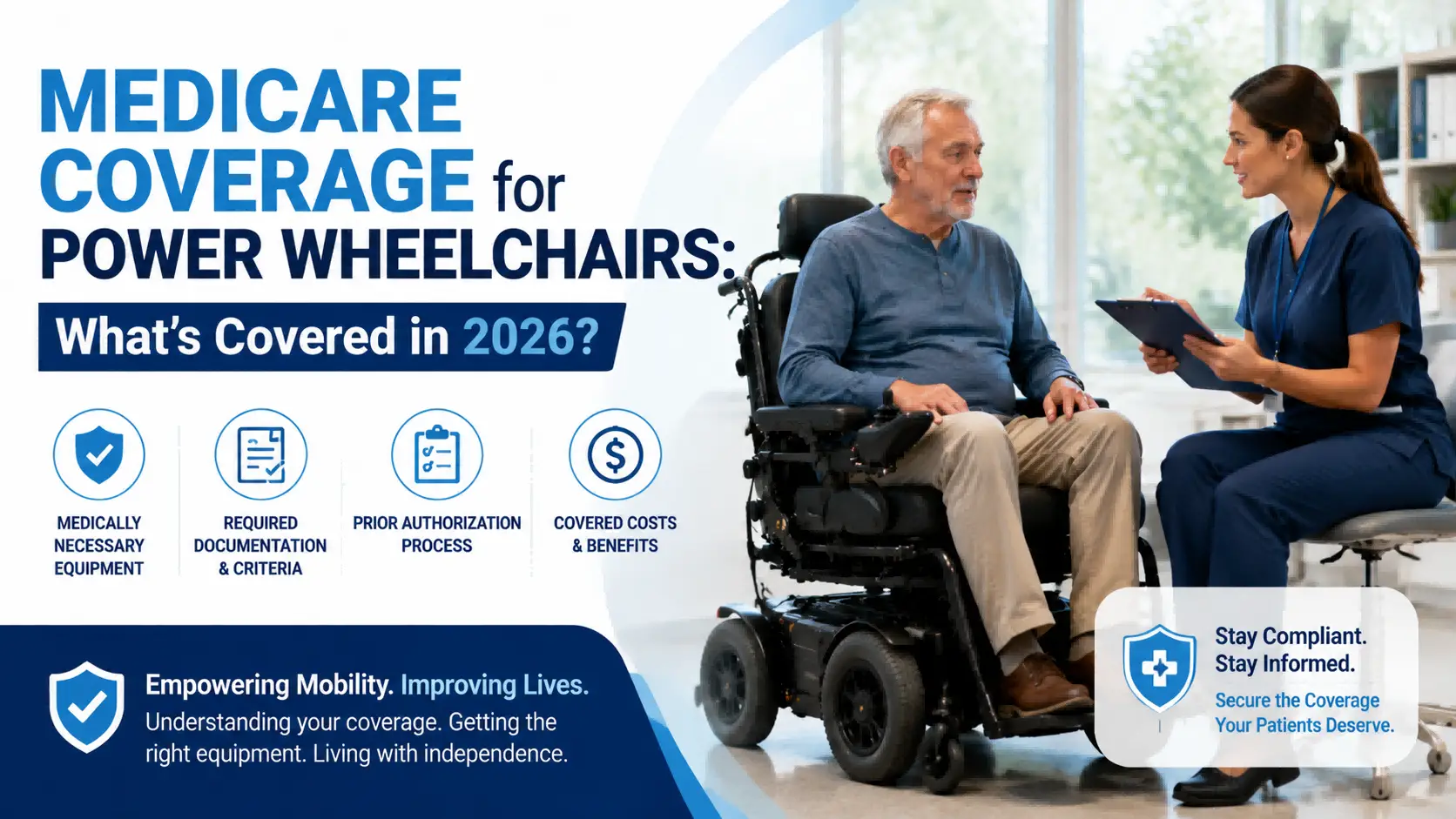
Struggling with denials for power wheelchair claims? You’re not alone. Many DME suppliers and clinics are finding that what used to be a straightforward process is now a maze of paperwork and frustrating rejections. This cycle costs time, drains resources, and delays patient care. To secure Medicare coverage for power wheelchairs in 2026, you must shift your focus from diagnosis alone to a detailed, evidence-based workflow that proves medical necessity at every step.
In 2026, Medicare coverage for power wheelchairs is not granted based on a patient's diagnosis or a simple prescription.1 Instead, approval hinges on three key elements: robust medical necessity documentation detailing in-home functional limitations, correct HCPCS code-to-scenario matching that aligns the device to the patient's specific tasks, and successfully navigating the Prior Authorization (PA) process as a structured workflow checkpoint.

Successfully securing reimbursement is a game of details. A simple diagnosis isn't enough; you need to paint a clear, evidence-backed picture of why a power wheelchair is the only suitable option for the patient's mobility needs within their home. Let’s dive into the specific documentation, coding strategies, and workflow tips that I've seen turn denials into approvals.
How Do You Prove Medical Necessity for a Power Wheelchair?
Facing a denial letter that just says "medical necessity insufficient"? It's a vague and frustrating roadblock. The problem is that the term "medical necessity" is often misunderstood, leading to documentation that fails to connect the patient's condition to their functional inability to perform daily tasks at home.
To prove medical necessity, you must provide objective documentation that the patient has a mobility limitation that significantly impairs their ability to participate in Mobility-Related Activities of Daily Living (MRADLs) inside their home.2 This involves detailing why lesser equipment like a cane, walker, or manual wheelchair is not a safe or effective solution.
In my experience as a workflow compliance supporter, the difference between a denial and an approval often comes down to the granularity of the supporting notes. Medicare reviewers are not in the patient’s home; your documentation must take them there.3 It needs to build an undeniable case that the patient’s mobility needs can only be met with a power mobility device, and specifically, a power wheelchair.
H3: Documenting Activities of Daily Living (ADLs) Inside the Home
The foundation of any successful claim is a detailed account of the patient's functional limitations with respect to MRADLs. These are tasks like toileting, feeding, dressing, grooming, and bathing. Your documentation, particularly the face-to-face (F2F) examination notes, must explicitly state what the patient cannot do safely and in a timely manner using their current equipment.
For example, instead of writing "Patient has difficulty with mobility," a stronger note would be: "Patient is unable to safely transport themselves from the bedroom to the bathroom to use the toilet. Using a walker over this 30-foot distance, which includes a carpet-to-tile transition, results in balance loss and has led to two near-falls in the past month. They cannot self-propel a manual wheelchair due to severe upper extremity weakness (MMT 2/5 in bilateral shoulders)."
This level of detail connects the clinical diagnosis (e.g., shoulder weakness) to a specific functional deficit (inability to self-propel) within a specific environment (the home), directly justifying the need for a powered solution.
H3: The Critical Role of the Home Assessment
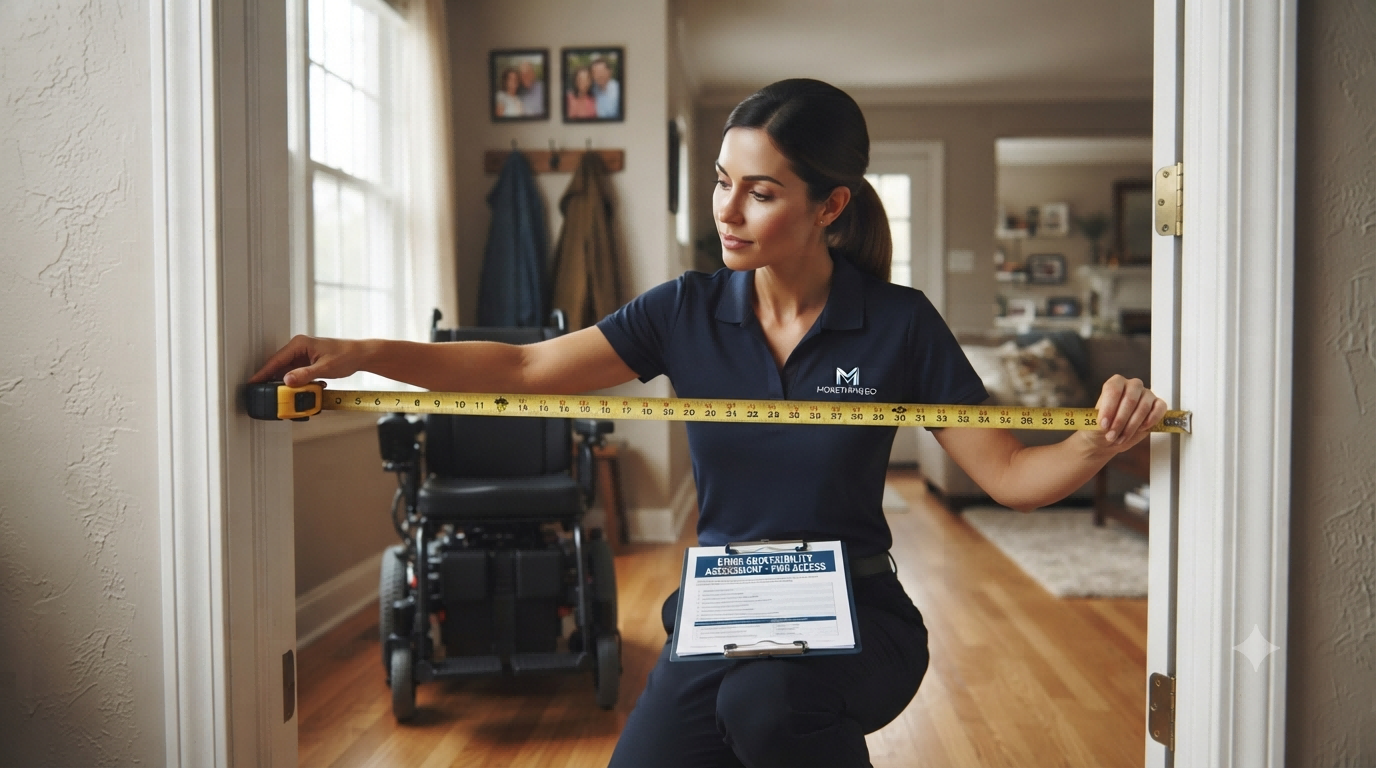
A home assessment, whether conducted in person or via a detailed interview and patient-supplied photos/videos, is invaluable.4 It provides objective evidence to support the F2F evaluation. You must document environmental barriers that preclude the use of a scooter (Power Operated Vehicle or POV) or manual wheelchair.
| Environmental Factor | What to Document | Why It Matters for a PWC |
|---|---|---|
| Doorway Widths | Measure all relevant interior doorways (bedroom, bathroom). | Narrow doorways may prevent POV use, justifying a more maneuverable PWC. |
| Turning Space | Note the turning radius in hallways and key rooms. | A tight turning radius (e.g., in a small bathroom) is a primary justification for a PWC over a less nimble POV. |
| Floor Surfaces | Document flooring types (carpet, tile, wood) and thresholds. | High-pile carpet or significant thresholds can stop a POV but may be navigable by a PWC with a more robust drive train. |
| Layout/Clutter | Describe the general layout and any fixed obstacles. | A cluttered or complex home layout often requires the precise, joystick-controlled maneuverability of a PWC. |
I once worked on a case that was initially denied. The patient needed to access a commode in their bedroom. By adding a simple note with a diagram showing that the space between the bed and the wall was only 32 inches—too narrow for a POV to turn into—we successfully appealed the decision. The home assessment provided the objective data that proved a PWC was medically necessary for that specific MRADL.
H3: Why Isn't a Manual Wheelchair or Cane Sufficient?
Your documentation must systematically rule out lesser equipment. For every piece of mobility assistive equipment (MAFE) below a PWC, you must explain why it is insufficient.
- Cane/Walker: Document why the patient cannot maintain balance, bear weight, or has a condition (e.g., severe respiratory disease) that makes ambulation with a walker non-functional for MRADL distances within the home.
- Manual Wheelchair: Justify why the patient cannot self-propel. This could be due to upper extremity weakness, limited range of motion, cardiovascular conditions, or the need to have a hand free for other tasks (like carrying items). Also, document if there is no willing and able caregiver available to assist with a manual chair at all times.
- POV/Scooter: Explain why the patient does not have the postural stability or trunk control to safely operate a tiller-based system.5 Document if the home environment's turning radius, as discussed above, prevents its use for in-home MRADLs.
By building this hierarchical justification, you leave no room for a reviewer to question whether a simpler device would suffice.
Does Medicare Coverage for Power Wheelchairs Depend on the Right Code?
You’ve compiled perfect medical necessity documentation, but the claim is still denied. Why? The culprit is often a mismatch between the patient's documented needs and the HCPCS code you selected. Submitting the right code isn't just an administrative task; it's the part of the story that tells Medicare which device you believe is medically necessary.
Yes, Medicare coverage for power wheelchairs is critically dependent on selecting the correct HCPCS code. Choosing a code for a device that doesn't align with the functional needs and home environment detailed in your documentation is one of the fastest routes to a denial and subsequent audit.
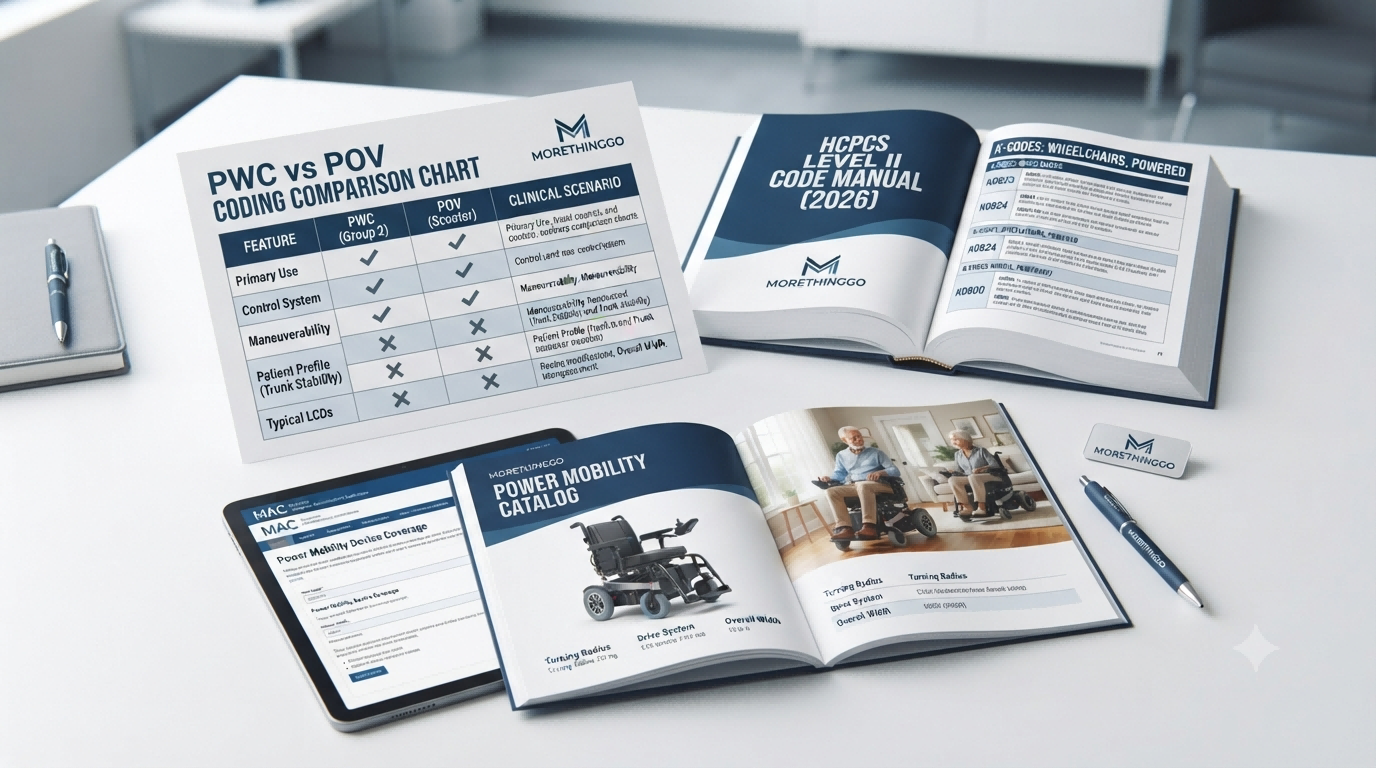
The key is to understand that Medicare categorizes power mobility devices based on their intended use and capabilities. A scooter is not a power wheelchair, and a standard power wheelchair is not a complex rehab technology (CRT) chair. Getting this right from the start saves immense rework.
H3: PWC vs. POV: A Critical Distinction
The most common coding error I see is confusing Power Operated Vehicles (POVs, or scooters) with Power Wheelchairs (PWCs). While both are power mobility devices, Medicare has very different criteria for them.
| Feature | Power Operated Vehicle (POV) / Scooter | Power Wheelchair (PWC) |
|---|---|---|
| Primary Use | Primarily designed for outdoor use; used for some in-home tasks. | Primarily designed for in-home use and performing MRADLs. |
| Control System | Tiller-based steering. | Joystick-based steering. |
| Maneuverability | Larger turning radius. | Smaller turning radius, more maneuverable in tight spaces. |
| Patient Profile | Can safely transfer, has good trunk stability, can operate tiller. | May need joystick for control, may have postural instability, needs to perform tasks from the chair. |
A claim will be denied if you request a PWC (e.g., K0823) but the documentation only describes a patient who wants to get to their mailbox and has a wide-open home layout. Conversely, if your notes detail a patient with poor trunk control who needs to navigate a narrow bathroom doorway, coding for a POV (e.g., K0800) will result in a denial because the device doesn't match the documented need.
I recently helped a supplier fix a denial for a patient with multiple sclerosis. The original claim was for a POV, but it was denied because the F2F notes described significant fatigue and poor trunk stability, making a tiller unsafe. The notes also mentioned a very small apartment. We refiled with an updated evaluation recommending a Group 2 PWC (K0823), highlighting the need for joystick control and a tight turning radius. The claim was approved.
H3: Mapping Functional Needs to HCPCS Groups (Group 2 vs. Group 3/CRT)
Within PWCs, the distinctions are just as important. Most claims will be for Group 2 PWCs. These are the standard, non-expandable electronic chairs intended for patients who need a powered mobility solution in the home.
Group 3 PWCs and above fall into the category of Complex Rehab Technology (CRT). These are for patients with significant, progressive neurological or musculoskeletal conditions (e.g., ALS, spinal cord injury, late-stage MS). These chairs have advanced features like power tilt, recline, and alternative drive controls that must be justified separately and require the involvement of a RESNA-certified Assistive Technology Professional (ATP).
Never code for a Group 3 chair unless the patient meets the specific, stringent criteria and you have the required ATP evaluation.6 Attempting to "up-code" to get more features will trigger an automatic denial and could flag your organization for an audit.
H3: Local Coverage Determinations (LCDs) and MAC Variability
Finally, always remember that Medicare policy is not monolithic. Your regional Medicare Administrative Contractor (MAC) publishes Local Coverage Determinations (LCDs) that provide specific rules and interpretations.7 What is standard practice in one jurisdiction may be different in another.
Before submitting any claim, you must check the current LCD for power mobility devices from your MAC. It will contain specific guidance on documentation, required forms, and which HCPCS codes are preferred for certain scenarios. Do not assume that what worked in a neighboring state will work for you. Verifying local rules is a non-negotiable step in a compliant workflow.
Is Prior Authorization a Roadblock or a Workflow Tool?
The phrase "Prior Authorization" often causes a collective groan among DME staff. It feels like another bureaucratic hurdle designed to slow you down. While it does add a step, I encourage my clients to reframe it: PA is not a roadblock; it's a workflow checkpoint that can prevent back-end denials.
Think of Prior Authorization (PA) as a pre-screening process. It gives you a chance to get Medicare's feedback before you deliver an expensive piece of equipment. When handled correctly, it transforms a potential risk into a predictable part of your revenue cycle and is a mandatory step for securing Medicare coverage for power wheelchairs.

A successful PA submission confirms that, based on the documentation you've provided, the device appears medically necessary. It doesn't guarantee payment if other factors are wrong (like eligibility), but it drastically reduces the risk of a post-delivery medical necessity denial.
H3: When is Prior Authorization Required in 2026?
As of 2026, Prior Authorization is a mandatory requirement for most power mobility devices.8 The specific list is maintained by CMS, but you should operate under the assumption that virtually all standard PWCs and POVs require it. Specifically, the PA program applies to a list of HCPCS codes that includes the most commonly used power wheelchair and scooter codes. You must check the most current CMS list, but it generally includes:
- Group 1 PWCs (e.g., K0813-K0816)
- Group 2 PWCs (e.g., K0820-K0829)
- Most standard POVs (e.g., K0800-K0802)
Attempting to deliver a device from this list without an affirmative PA decision is a direct path to a non-payment. The PA process must be completed and an affirmative decision received before the item is delivered to the patient.
H3: The Essential Prior Authorization Packet Checklist
A stalled PA is almost always due to a missing document. Your request packet must be complete and correct on the first submission. Use this as your guide:
- The Prior Authorization Request Form: The cover sheet for your submission.
- The Detailed Written Order (DWO): This must be obtained before you submit the claim (and PA request). It must be signed and dated by the treating practitioner, include all necessary patient and device details, and be generated from the F2F exam findings.
- The Face-to-Face (F2F) Examination Notes: This is the core of your medical necessity argument. It must be conducted by the physician or other qualified practitioner and detail the patient's mobility needs in the home, as we've discussed. Crucially, the date of the DWO must align with the F2F visit. A common denial reason is a DWO dated before the F2F exam was even completed.
- Functional Assessment: This could be part of the F2F or a separate evaluation by a physical or occupational therapist. It includes objective measures (e.g., gait speed, range of motion, manual muscle tests).
- Home Assessment: The documentation proving the home environment supports the need for a PWC over a POV or manual chair.
I worked with a supplier whose PA requests were consistently being returned. The issue was simple: the F2F was done on Day 1, but the doctor wasn't signing the DWO until Day 10. The PA reviewers saw the DWO as preceding a complete evaluation. We fixed their workflow to have the practitioner review the completed F2F notes and sign the DWO on the same day, which resolved the issue immediately.
H3: Timing and Sequencing: Getting It Right the First Time
The order of operations is critical. A misstep in timing can invalidate your entire submission.
- Patient Identification & F2F Exam: The process begins with the practitioner's F2F evaluation of the patient's mobility needs.
- DWO & Supporting Docs: Based on the F2F, the practitioner creates the DWO. You, the supplier, gather the F2F notes, any PT/OT notes, and the home assessment.
- Submit for Prior Authorization: Assemble the complete packet and submit it to the appropriate contractor.
- Receive Affirmative PA Decision: Do not proceed until you have a written affirmative decision.
- Deliver the Device: Only after receiving the PA approval can you deliver the equipment.
- Submit Final Claim: Submit the final claim for payment with the PA confirmation number.
By treating PA as a structured checklist and not an obstacle, you build compliance and predictability into your workflow, ensuring you get paid for the vital equipment you provide.
Frequently Asked Questions
What is the single biggest reason for power wheelchair claim denials?
The most common reason for denial is insufficient medical necessity documentation.9 This usually means the F2F exam notes fail to concretely explain why the patient cannot perform Mobility-Related Activities of Daily Living (MRADLs) in their home with less complex equipment like a walker or manual wheelchair.
Can a patient get Medicare coverage for a power wheelchair just for outdoor use?
No. Medicare's primary criterion is medical necessity within the home. The device must be required for the patient to perform or participate in MRADLs inside their house. While the patient can use the device outdoors, outdoor use alone is not a sufficient justification for coverage.
What's the difference between a Detailed Written Order (DWO) and a standard prescription?
A standard prescription might just say "power wheelchair." A DWO is a much more comprehensive document required by Medicare. It must include the patient's name, a detailed description of the item (including all options/accessories), the treating practitioner's signature and date, and be generated from a recent, corresponding face-to-face evaluation.
How long does the Medicare prior authorization process typically take?
Once a complete PA request is submitted, Medicare Administrative Contractors (MACs) are generally required to make a decision within 10 business days. If the documentation is incomplete, they will reject the request, and the clock resets once you resubmit with the corrected information, causing significant delays.
Conclusion
Securing Medicare coverage for power wheelchairs in 2026 demands a meticulous and proactive approach. It's no longer about simply submitting a prescription. Success is built on three pillars: ironclad medical necessity documentation focused on in-home MRADLs, precise code-to-scenario matching that aligns the device with the documented functional need, and treating the Prior Authorization process as a critical workflow checkpoint. By mastering these areas, you can significantly reduce denial rates, shorten your revenue cycle, and most importantly, get your patients the mobility equipment they desperately need without delay.
As a B2B supplier, we at MorethingGO understand that our partners on the front lines—the DME providers and clinics—face immense regulatory pressure. Your success depends on both high-quality, reliable equipment and a supply chain partner who understands the nuances of your market. If you are a DME supplier or international purchaser seeking a partner who appreciates the importance of product compliance and provides professional QC and buyer services to strengthen your business, MorethingGO is here to help. Contact us to learn how we can support your mission.
"LCD - Power Mobility Devices (L33789)", https://www.cms.gov/medicare-coverage-database/view/lcd.aspx?lcdid=33789. According to the Centers for Medicare & Medicaid Services (CMS), Medicare coverage for power wheelchairs requires detailed documentation of medical necessity, appropriate HCPCS coding, and prior authorization approval. These criteria are outlined in Medicare's Local Coverage Determinations (LCDs) for power mobility devices. Evidence role: general_support; source type: government. Supports: Medicare's specific requirements for power wheelchair coverage, including medical necessity documentation, HCPCS code matching, and prior authorization.. Scope note: The citation may reflect current guidelines but could vary by Medicare Administrative Contractor (MAC) region. ↩
"Power Wheelchair Coverage Overview", https://www.cms.gov/files/document/powerwheelchairpdf. CMS defines medical necessity for power wheelchairs as requiring documentation of mobility limitations that prevent the patient from performing Mobility-Related Activities of Daily Living (MRADLs) within their home environment. Evidence role: definition; source type: government. Supports: Medicare's definition of medical necessity and its application to MRADLs for power wheelchair coverage.. Scope note: The definition may vary slightly depending on the specific LCDs issued by regional MACs. ↩
"Power Mobility Devices", https://www.cms.gov/Outreach-and-Education/Medicare-Learning-Network-MLN/MLNProducts/Downloads/PMD_DocCvg_FactSheet_ICN905063-text-only.pdf. CMS guidelines indicate that Medicare reviewers assess claims based on submitted documentation, including home assessments, without conducting in-person home visits. Evidence role: mechanism; source type: government. Supports: Medicare reviewers rely on documentation rather than home visits to evaluate claims for power wheelchairs.. Scope note: This process may be subject to change or exceptions in specific cases. ↩
"Power Wheelchair Coverage Overview", https://www.cms.gov/files/document/powerwheelchairpdf. CMS documentation guidelines for power mobility devices emphasize the need for detailed home assessments, which may include patient-supplied photos or videos to illustrate environmental barriers. Evidence role: general_support; source type: government. Supports: The importance of home assessments, including patient-supplied photos/videos, in Medicare claims for power wheelchairs.. Scope note: Specific MACs may have additional requirements or restrictions on the use of patient-supplied materials. ↩
"Power Mobility Devices", https://www.cms.gov/Outreach-and-Education/Medicare-Learning-Network-MLN/MLNProducts/Downloads/PMD_DocCvg_FactSheet_ICN905063-text-only.pdf. CMS guidelines specify that patients must demonstrate insufficient postural stability or trunk control to justify the medical necessity of a power wheelchair over a scooter. Evidence role: mechanism; source type: government. Supports: Medicare's criteria for distinguishing power wheelchairs from scooters based on postural stability and trunk control.. Scope note: Criteria may vary slightly depending on the specific LCDs issued by regional MACs. ↩
"Group 3 Power Wheelchairs for Prior Authorization", https://www.cms.gov/Research-Statistics-Data-and-Systems/Monitoring-Programs/Medicare-FFS-Compliance-Programs/DMEPOS/Downloads/Open-Door-Forum-Coverage-for-Group-3-Power-Wheelchairs.pdf. CMS guidelines for Complex Rehab Technology specify that Group 3 power wheelchairs require detailed medical necessity documentation and an evaluation by a RESNA-certified Assistive Technology Professional (ATP). Evidence role: expert_consensus; source type: government. Supports: Medicare's stringent criteria for Group 3 power wheelchairs and the necessity of ATP evaluations.. Scope note: Specific requirements may vary by MAC region and patient condition. ↩
"LCD - Power Mobility Devices (L33789)", https://www.cms.gov/medicare-coverage-database/view/lcd.aspx?lcdid=33789. CMS states that Local Coverage Determinations (LCDs) issued by Medicare Administrative Contractors (MACs) provide region-specific rules and interpretations for power mobility device coverage. Evidence role: historical_context; source type: government. Supports: The role of Local Coverage Determinations (LCDs) in defining Medicare coverage rules for power mobility devices.. Scope note: LCDs are subject to updates and may vary significantly between MAC regions. ↩
"Power Mobility Devices", https://www.cms.gov/Outreach-and-Education/Medicare-Learning-Network-MLN/MLNProducts/Downloads/PMD_DocCvg_FactSheet_ICN905063-text-only.pdf. CMS mandates Prior Authorization for most power mobility devices, including specific HCPCS codes for power wheelchairs and scooters, as part of its coverage process. Evidence role: mechanism; source type: government. Supports: The mandatory nature of Prior Authorization for most power mobility devices under Medicare.. Scope note: The list of HCPCS codes requiring Prior Authorization may be updated periodically. ↩
"Power Wheelchair Coverage Overview", https://www.cms.gov/files/document/powerwheelchairpdf. CMS reports indicate that insufficient medical necessity documentation is a primary reason for claim denials for power mobility devices. Evidence role: statistic; source type: government. Supports: Insufficient medical necessity documentation as the leading cause of Medicare claim denials for power wheelchairs.. Scope note: Specific denial reasons may vary by MAC region and individual claim circumstances. ↩