
Struggling to choose between hydraulic and mechanical brakes for your new eBike model? A wrong move can destroy margins or trigger costly warranty claims. Understanding the true tipping point is key.
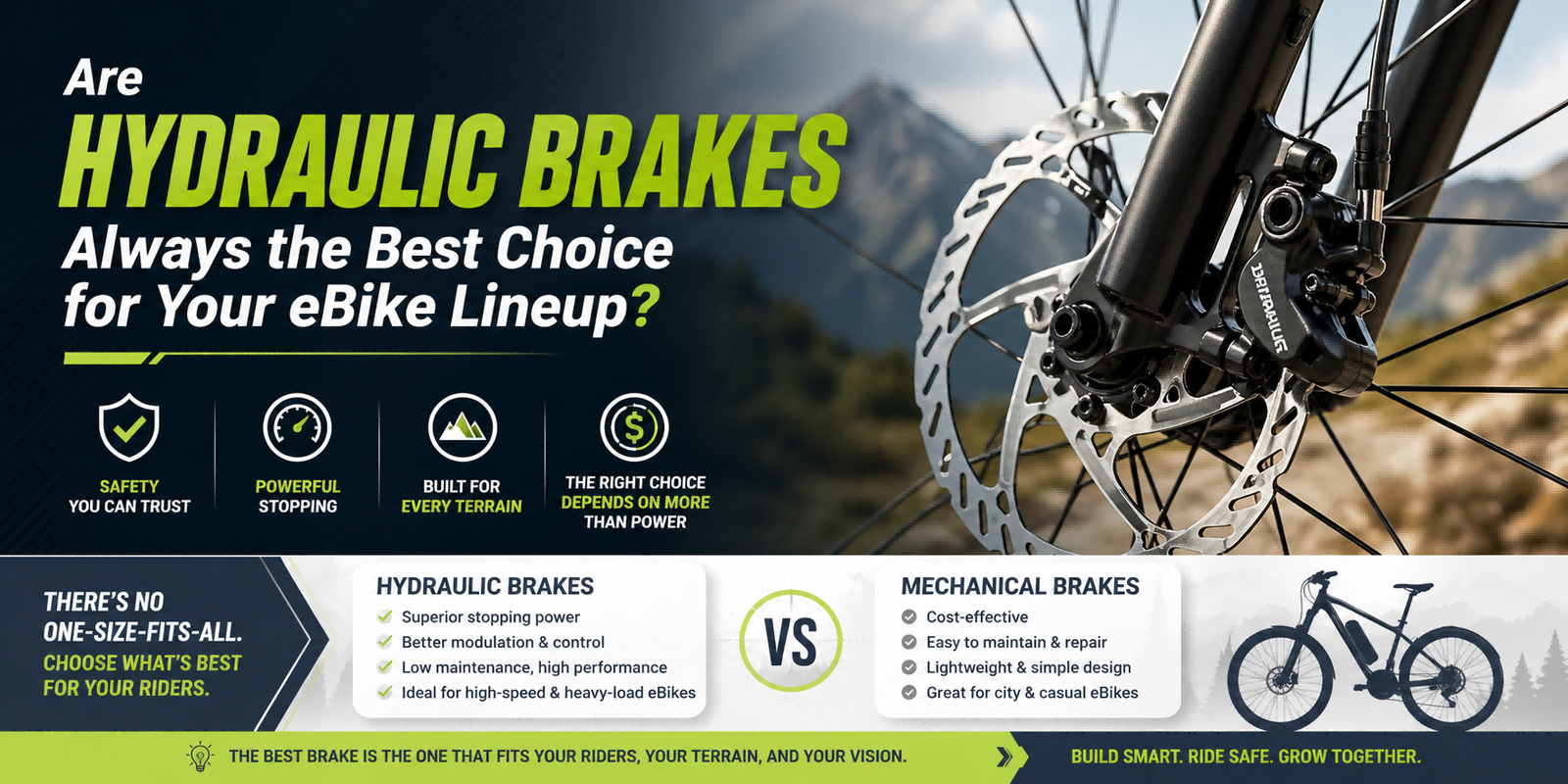
Hydraulic brakes become the necessary choice when an eBike's motor power, total weight, and riding style1 create braking loads that mechanical systems cannot safely and reliably handle. For many standard commuter bikes, a high-quality mechanical system is often the smarter, more cost-effective option2.
I've been manufacturing eBikes for 15 years, and I've seen countless brands wrestle with this decision. It's one of the most critical points in balancing the Bill of Materials (BOM) against real-world performance. Many think "hydraulic" just means "premium," but the reality is far more practical. It's not about marketing; it's about physics and safety. Let me walk you through the exact same logic I use when advising my clients, so you can avoid common pitfalls and spec your bikes with confidence.
When Do You Actually Need Hydraulic Brakes on an eBike?
You see competitors adding hydraulic brakes to basic models and feel the pressure to follow suit. But this adds cost, potentially pricing you out of a key segment. Is it truly necessary?
You cross the threshold into needing hydraulic brakes when the combination of a powerful motor (over 500W3), a heavy frame, and high-speed use overwhelms a mechanical system's ability to stop consistently. This is especially true on long descents where heat buildup causes brake fade4.
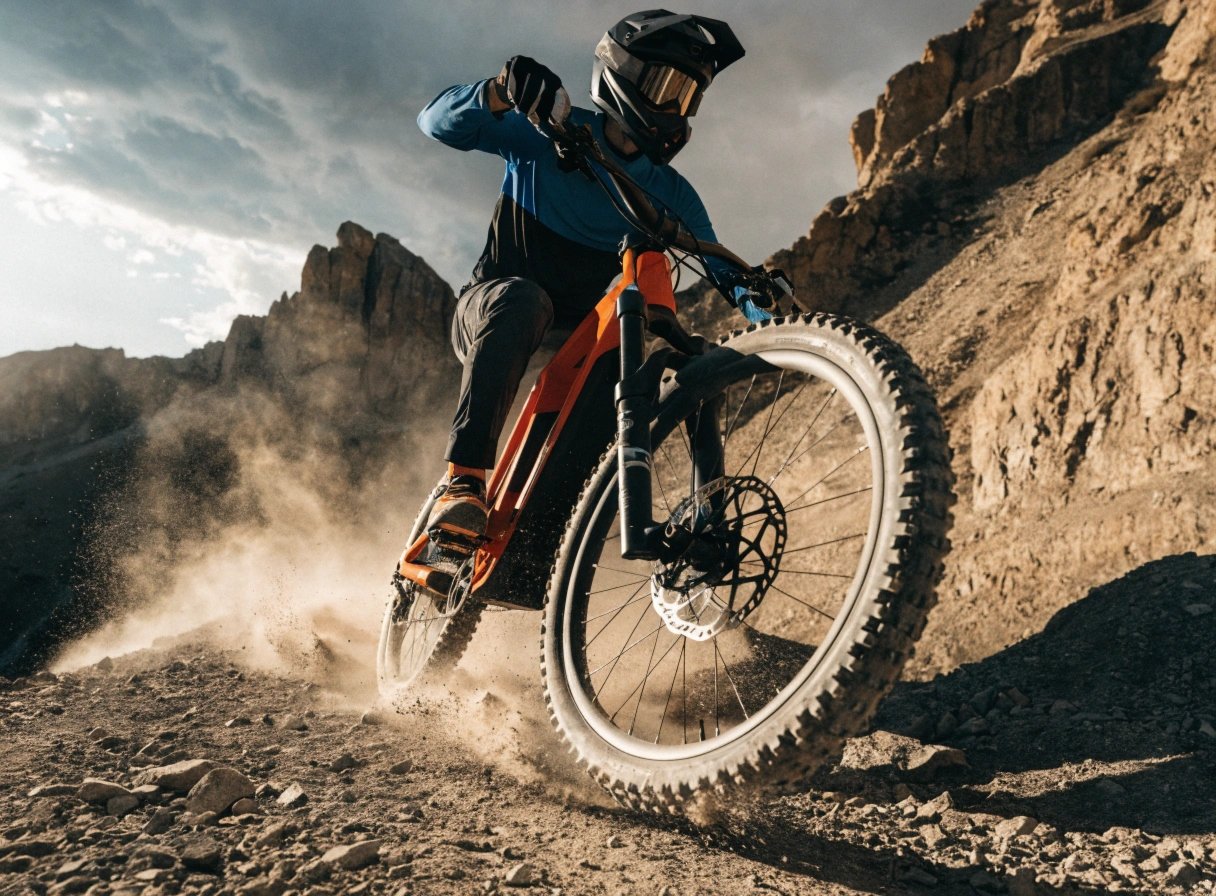
In my experience, the decision comes down to a simple formula: Motor Power + Total Vehicle Weight + Use Case. When this combination gets high enough, mechanical brakes start to fail. The main issue is heat. A mechanical brake cable can only apply so much force before it starts to stretch5, and the pads can overheat on long descents, a phenomenon called "brake fade6." The bike simply stops slowing down as effectively.
I remember a client who wanted to spec mechanical disc brakes on a new heavy-duty cargo eBike to save about $30 per unit. On paper, it seemed fine. But I asked him, "What happens when your customer has 100 lbs of cargo and is going down a 10% grade for half a mile?" That $30 savings vanishes instantly when the first brake failure leads to an accident. We switched to a robust 4-piston hydraulic system. It increased the BOM, but it guaranteed the bike was safe and reliable for its intended purpose, protecting his brand and his customers.
Here’s a simple breakdown I use to guide these decisions:
| eBike Class | Motor Power | Typical Use | Recommended Brake System | Why? |
|---|---|---|---|---|
| City Commuter | 250W - 500W7 | Flat terrain, stop-and-go | High-Quality Mechanical Disc | Cost-effective, low maintenance, sufficient power for typical use. |
| Performance Hybrid | 500W - 750W | Hilly terrain, higher speeds | Entry-Level Hydraulic Disc | Handles higher speeds and moderate hills without fade. |
| eMTB / Trail | 500W+ (Mid-Drive) | Steep, long descents | Performance 2 or 4-Piston Hydraulic | Maximum power, fine control (modulation), and heat management are critical. |
| Cargo / Utility | 750W+8 | Heavy loads, all terrains | Robust 4-Piston Hydraulic | Essential for safely stopping a very heavy vehicle in any condition. |
The physics don't lie. Once the energy you need to dissipate as heat9 gets too high, you need a hydraulic system to provide the necessary clamping force and heat resistance.
Why Do So Many Brands Get Their Brake Configurations Wrong?
You're trying to perfectly balance your BOM, and the brake system is a huge variable. But you either over-spec and kill your margin, or under-spec and face a wave of angry customers.
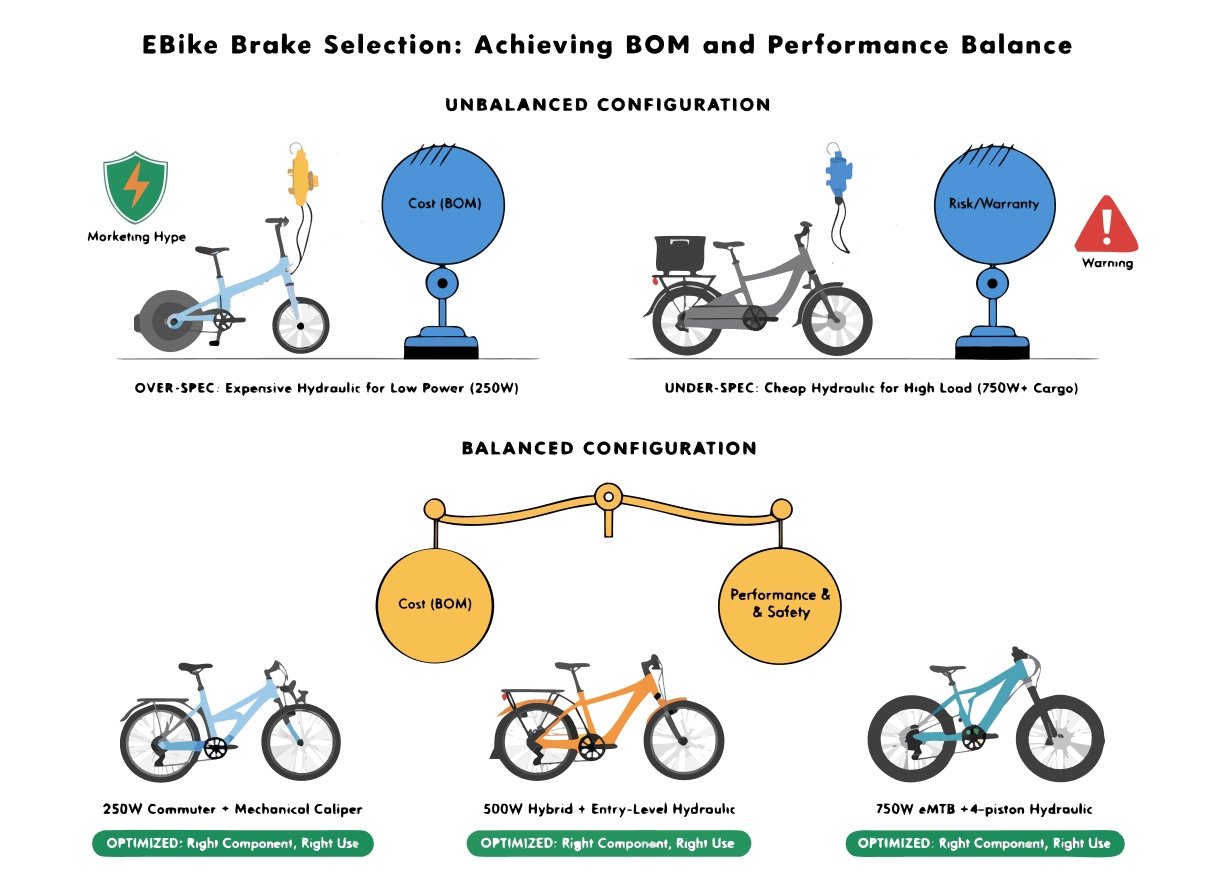
Brands often get their configurations wrong by either chasing a "premium" label with expensive hydraulic brakes on low-power bikes or by cutting corners with cheap hydraulic systems on high-performance eBikes. Both paths create a mismatch between cost, performance, and user expectation that ultimately fails.
I see this happen in two main ways, and I've helped clients navigate both.
Scenario 1: Over-Speccing for Marketing
A brand owner came to me convinced he needed a name-brand hydraulic brake system on his 250W folding city bike. His marketing team told him it would make the bike feel more "premium." The system added $50 to his BOM. I had to be direct. I told him, "Your target customer is riding 5 miles to work on flat ground. They will never feel the difference, but they will definitely notice that your bike costs $150 more than the competition." We switched to a top-tier mechanical disc brake setup. It performed flawlessly for the use case, saved him $40 per unit, and allowed him to hit the price point his market demanded. He ended up with a bestseller.
Scenario 2: Under-Speccing for Cost Savings
The other side is more dangerous. A distributor I work with once sourced a batch of 1000W fat-tire eBikes from a factory that was not one of my own. To get the price down, the factory used a very cheap, no-name hydraulic brake system. Within three months, the distributor was drowning in warranty claims. Leaking fluid, failing master cylinders, and inconsistent stopping power were constant complaints. The factory saved maybe $15 per bike, but my distributor friend lost thousands in labor, parts, and returns. Not to mention the damage to his reputation. We now work together to ensure his bikes have properly matched components.
| Mismatch Type | The Mistake | The Consequence | The Right Approach |
|---|---|---|---|
| Over-Speccing | Expensive hydraulic brakes on a low-power commuter. | Unnecessarily high BOM, non-competitive retail price, no real user benefit. | Match the brake to the use case. A quality mechanical brake is perfect. |
| Under-Speccing | Cheap hydraulic brakes on a high-power eMTB or cargo bike. | High failure rates, dangerous performance, costly warranty claims, reputation damage. | Invest in a reliable system that matches the bike's power and weight. |
The brake system isn't a place to add marketing fluff or to cut a few dollars. It must be a carefully considered engineering choice that matches the rest of the bicycle.
How Does Your Target Market Change Your Brake Choice?
A brake system that is perfect for a rugged mountain bike is complete overkill for a simple city cruiser. If you use a one-size-fits-all approach, you'll fail to meet anyone's expectations properly.
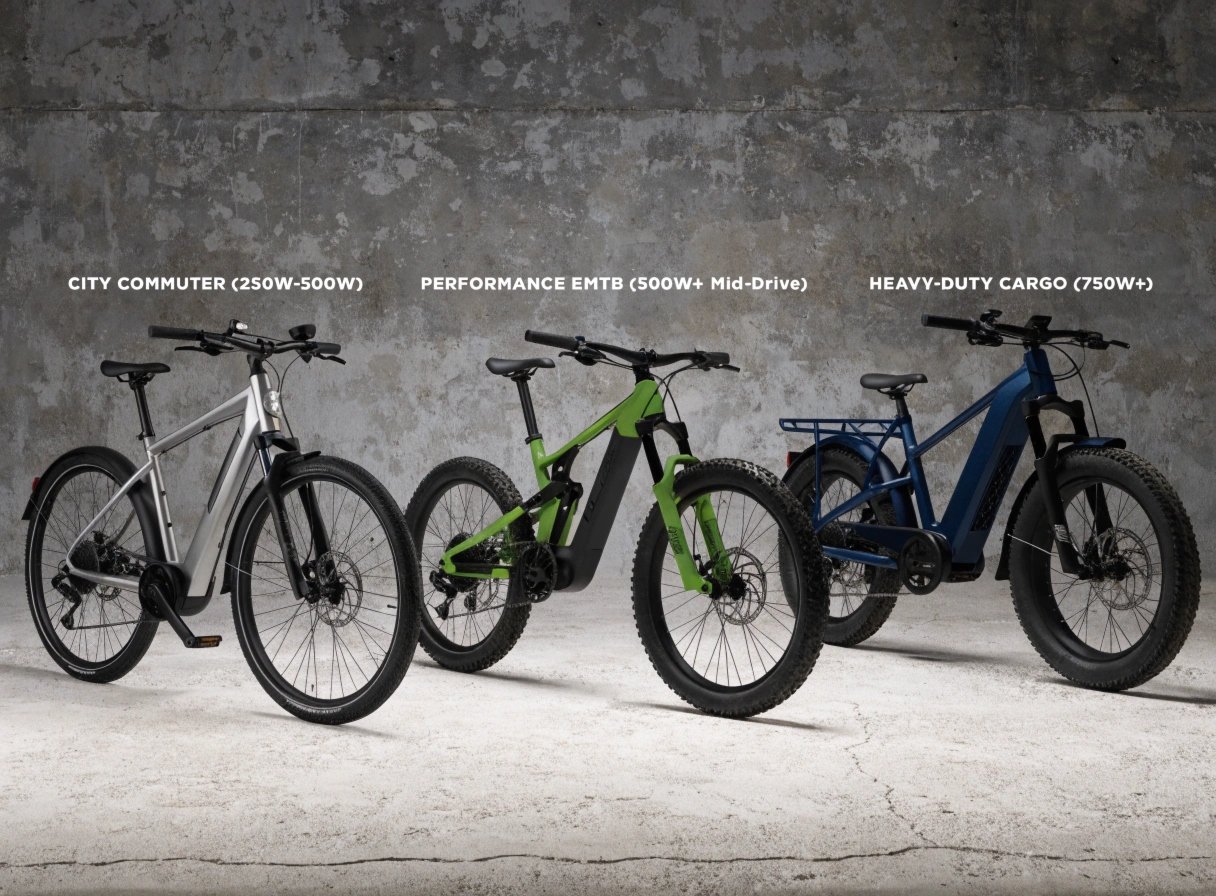
Your target market's needs and expectations directly determine the right brake choice. A mountain biker demands power and accepts maintenance, a city commuter values reliability and low cost, and a cargo bike user requires absolute, non-negotiable stopping power for safety.
After years of building bikes for different brands and distributors, I've learned that you have to think like the end-user. What is their priority? What are they willing to pay for, and what do they consider a standard feature?
The City Commuter
This rider's main concerns are reliability and low maintenance. They need brakes that work every time without fuss. They are not descending mountains, so extreme heat management is not a concern. For this segment, a high-quality, easy-to-adjust mechanical disc brake is often the ideal choice. It provides ample stopping power for urban environments and is simple for any local bike shop to service. Adding a hydraulic system here often just adds a potential point of failure and a higher price tag.
The eMTB Rider
This user is the exact opposite. They are pushing the bike to its limits on steep, technical terrain. They need immense stopping power that they can control with a single finger. They also need excellent "modulation," which is the ability to finely control the braking force.10 Heat dissipation is critical to prevent brake fade on long downhills11. For this market, a powerful 2-piston or 4-piston hydraulic brake system is not a luxury; it's a baseline requirement for safety and performance.
The Cargo Bike User
This person's priority is safety above all else. They might be carrying hundreds of pounds of goods12, or even their own children. The total weight of the bike and rider can easily exceed 400 lbs (180 kg). Stopping that much mass requires a powerful and incredibly reliable brake system. There is no room for compromise here. A robust, often 4-piston, hydraulic brake system with large rotors (180mm or 203mm) is the only responsible choice.
| Market Segment | Primary Need | Customer Expectation | Ideal Brake System |
|---|---|---|---|
| Urban Commuter | Reliability & Low Cost | "It just works" | High-Quality Mechanical Disc |
| eMTB / Trail | Power & Control | One-finger stopping, no fade | Performance Hydraulic (2 or 4-piston) |
| Cargo / Utility | Ultimate Safety | Stops a heavy load, every time | Robust 4-Piston Hydraulic w/ Large Rotors |
Understanding these customer profiles is the most important step. Build the bike for their world, not for a generic spec sheet.
Conclusion
The right brake choice isn't about hydraulic versus mechanical. It's about matching the system to the eBike's power, weight, and market to perfectly balance performance, cost, and safety.
"Bicycle Requirements Business Guidance | CPSC.gov", https://www.cpsc.gov/content/bicycle-requirements-business-guidance. Bicycle and EPAC braking standards treat braking performance as a function of vehicle configuration and intended operating conditions, supporting the relevance of power-assisted speed, mass, and use case to brake specification; these standards generally set performance tests rather than naming hydraulic or mechanical systems. Evidence role: general_support; source type: institution. Supports: Brake choice should be based on an eBike's motor power, total weight, and riding style.. Scope note: Contextual support only; standards do not define a single hydraulic-brake threshold. ↩
"How To Set Up Bike Disc Brakes Superior Stopping Power Every Time",
. Bicycle maintenance and safety guidance from neutral cycling organizations recognizes cable-actuated disc brakes as serviceable and adequate for many ordinary bicycle uses, supporting the claim that mechanical brakes can be appropriate for commuter applications; it does not evaluate this article’s specific cost model. Evidence role: general_support; source type: institution. Supports: For many standard commuter eBikes, a high-quality mechanical brake system can be a practical and cost-effective choice.. Scope note: Supports suitability in ordinary use, not the precise cost-effectiveness of any supplier configuration. ↩"Electric Bicycles - Regulations.gov", https://www.regulations.gov/document/CPSC-2024-0008-0001. Regulatory summaries of electric bicycle classes show that many jurisdictions distinguish lower-power pedal-assist bicycles from higher-powered vehicles by motor output and assisted speed, providing context for why brake demands may differ across eBike categories; regulations do not themselves prove that 500 W is a universal brake-system cutoff. Evidence role: historical_context; source type: government. Supports: Motor output above roughly 500 W is treated as a meaningful threshold when assessing higher-performance eBike brake needs.. Scope note: The 500 W threshold is jurisdiction-dependent and should be presented as a practical design marker, not a universal legal or engineering boundary. ↩
"Temperature Influence on Brake Pad Friction Coefficient Modelisation", https://pmc.ncbi.nlm.nih.gov/articles/PMC10779514/. Engineering literature on friction braking describes brake fade as a reduction in braking effectiveness caused by elevated brake temperatures and changes in pad or rotor friction, supporting the mechanism stated here; most studies address vehicles generally rather than eBikes specifically. Evidence role: mechanism; source type: paper. Supports: Long descents can cause heat buildup that leads to brake fade.. Scope note: Mechanism is general to friction brakes and may not quantify fade for the exact eBike systems discussed. ↩
"self-tensioning spring-loaded devices: Topics by Science.gov", https://www.science.gov/topicpages/s/self-tensioning+spring-loaded+devices. Mechanical engineering references on Bowden cables and bicycle brake systems explain that cable-actuated brakes transmit force through a tensioned cable and housing subject to elastic deformation and friction losses, supporting the distinction from hydraulic force transmission; this does not establish a precise failure point for all mechanical eBike brakes. Evidence role: mechanism; source type: education. Supports: Mechanical brake cables can lose efficiency through stretch and friction under load.. Scope note: Supports the mechanism of cable stretch and friction losses, not a universal maximum safe braking load. ↩
"Wikipedia", https://www.wikipedia.org/. Standard technical definitions identify brake fade as the temporary loss of braking power caused by overheating in friction-brake components, supporting the article’s use of the term; definitions may not address eBike-specific loading. Evidence role: definition; source type: encyclopedia. Supports: Brake fade is the loss of braking effectiveness caused by overheated brake components.. Scope note: Defines the term but does not prove its frequency in eBike use. ↩
"Electric bicycle laws - Wikipedia", https://en.wikipedia.org/wiki/Electric_bicycle_laws. Government and standards-based descriptions of EPACs and electric bicycles commonly use motor-power categories such as 250 W in the EU and 500 W in some jurisdictions, supporting the article’s segmentation of lower-power commuter eBikes; these categories vary by market and regulation. Evidence role: historical_context; source type: government. Supports: City commuter eBikes are commonly found in the 250 W to 500 W power range.. Scope note: Power categories are regulatory and regional, not direct proof of brake sufficiency. ↩
"Bicycle Requirements Business Guidance | CPSC.gov", https://www.cpsc.gov/content/bicycle-requirements-business-guidance. U.S. federal and state e-bike class descriptions commonly use 750 W as the upper motor-power limit for classed electric bicycles, providing regulatory context for the article’s use of 750 W as a high-power category marker; this does not prove that all 750 W cargo bikes require a particular brake design. Evidence role: historical_context; source type: government. Supports: A 750 W motor output is a recognized high-end marker in some eBike classifications.. Scope note: Regulatory context only; brake requirements depend on mass, speed, and use conditions. ↩
"Analyzing a system: Identifying objects, attributes, and relationships", https://ct-stem.northwestern.edu/curriculum/preview/29/page/1/. Basic mechanics texts describe braking as the conversion of a moving vehicle’s kinetic and potential energy into heat through friction, supporting the article’s explanation of braking load; the physics principle is general and does not specify hydraulic-component selection. Evidence role: mechanism; source type: education. Supports: Brakes dissipate vehicle kinetic and gravitational potential energy primarily as heat.. Scope note: Supports the thermodynamic mechanism, not a specific product recommendation. ↩
"What does "modulate" mean when referring to brakes?", https://bicycles.stackexchange.com/questions/11282/what-does-modulate-mean-when-referring-to-brakes. Technical cycling and engineering discussions define brake modulation as the rider’s ability to vary braking force progressively, supporting the article’s definition of the term; the source may not rank all hydraulic and mechanical systems by modulation performance. Evidence role: definition; source type: education. Supports: Brake modulation means fine control over applied braking force.. Scope note: Defines modulation and its relevance, but may not directly compare every brake design. ↩
"Thermal/Mechanical Measurement and Modeling of Bicycle Disc ...", https://www.academia.edu/108763189/Thermal_Mechanical_Measurement_and_Modeling_of_Bicycle_Disc_Brakes. Studies of downhill braking show that sustained descending increases thermal loading in brake components, supporting the claim that long downhills increase fade risk and heat-management requirements; results may come from broader vehicle or bicycle-brake studies rather than eMTB-only tests. Evidence role: mechanism; source type: paper. Supports: Long downhill riding places sustained thermal loads on bicycle brakes.. Scope note: Contextual support; exact temperatures depend on rider mass, speed, rotor size, pad compound, and descent profile. ↩
"[PDF] Exploring Benefits of Cargo-Cycles versus Trucks for Urban Parcel ...", https://dspace.mit.edu/bitstream/handle/1721.1/132690/0361198120917162.pdf?sequence=2&isAllowed=y. Cargo-bike standards and safety guidance recognize that cycles designed for carrying goods or passengers operate at substantially higher gross masses than conventional bicycles, supporting the article’s emphasis on high braking demand for cargo eBikes; specific load ratings vary by model and jurisdiction. Evidence role: general_support; source type: institution. Supports: Cargo bikes may carry very heavy loads, including goods or passengers, increasing braking requirements.. Scope note: Supports the general load context, not the exact load carried by every cargo-bike user. ↩