

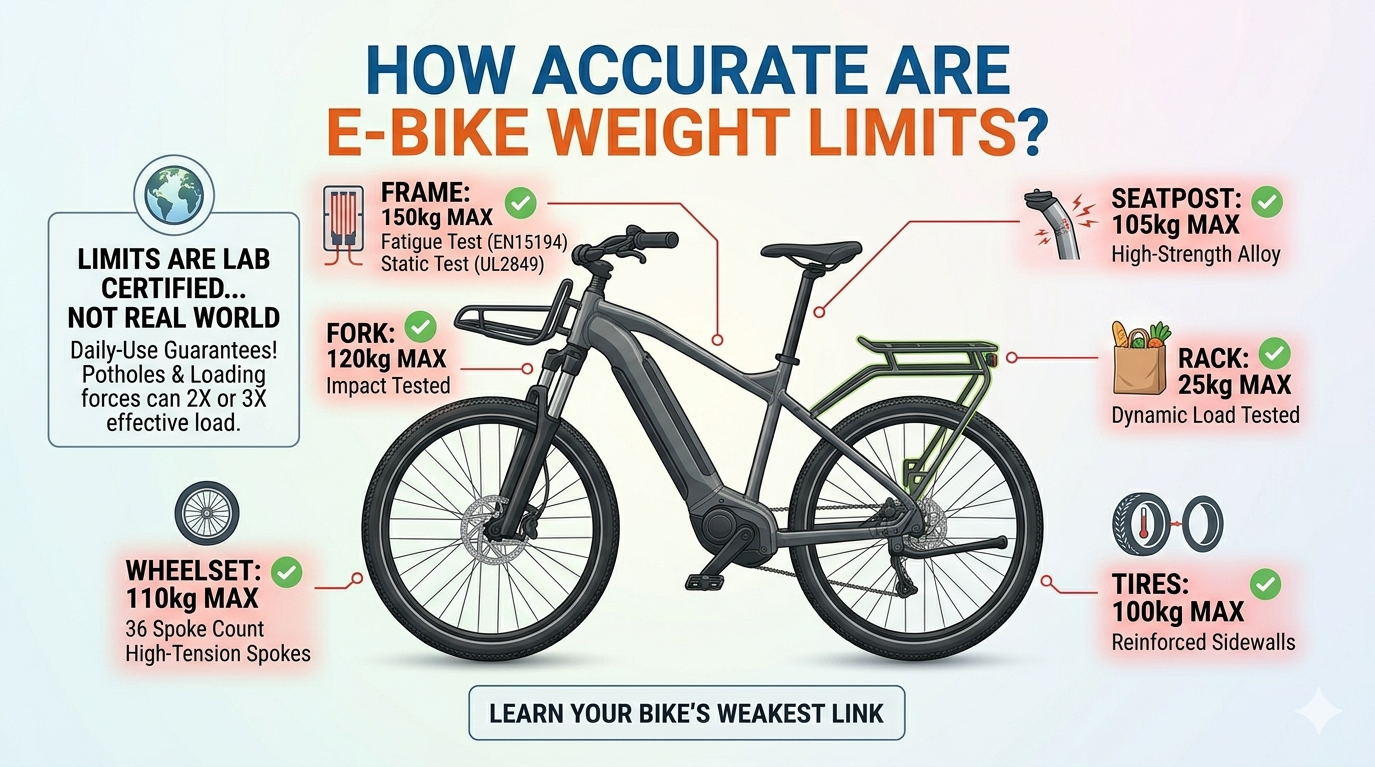
You just found the perfect e-bike online. The price is right, the range looks solid, and then you see it: "Maximum rider weight: 120 kg." But you're 115 kg, and you plan to carry groceries. You pause. Is that number a hard safety limit, a suggestion, or just marketing fluff?
Most e-bike weight limits are test-pass thresholds from lab standards like EN 15194 or UL 28491, not real-world daily-use guarantees. The number tells you the frame survived a specific static or fatigue test, but it doesn't account for potholes, curbs, or loaded panniers — forces that can double or triple the effective load on your bike2.
I work with brands and distributors across three continents, and this question comes up in almost every serious buyer conversation. The confusion isn't your fault. The industry uses a single number to represent something far more complicated. Let me walk you through what that number actually means, and more importantly, what it doesn't.
What does the weight capacity number actually measure?
When you see "max load 120 kg" on an e-bike spec sheet, you're looking at the outcome of a laboratory test, not a real-world riding scenario.
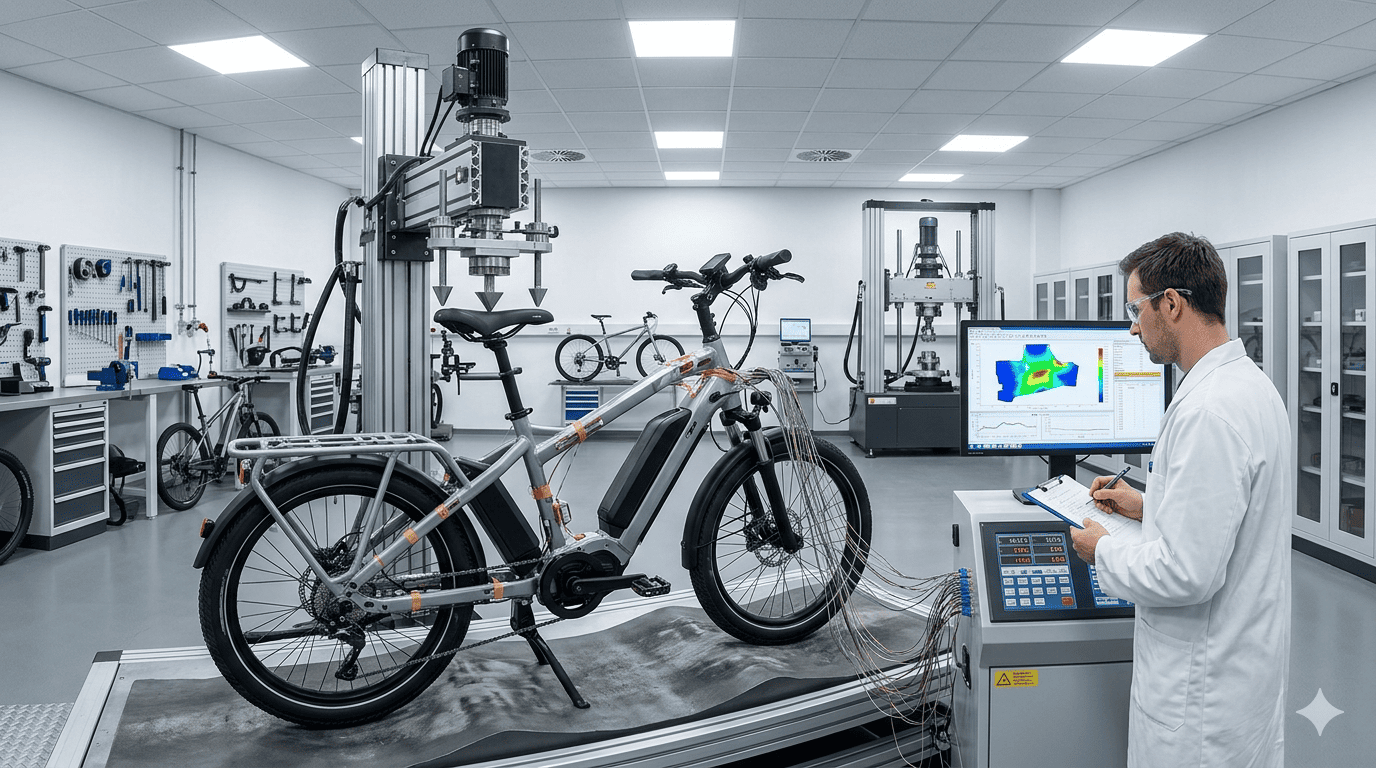
That number typically comes from a static load test or a fatigue test performed on the frame and fork assembly under a regional safety standard. The bike sits on a rig, weight gets applied to the saddle and handlebars in controlled cycles, and engineers check for cracks or permanent deformation. If it passes, the manufacturer stamps that test weight onto the spec sheet.
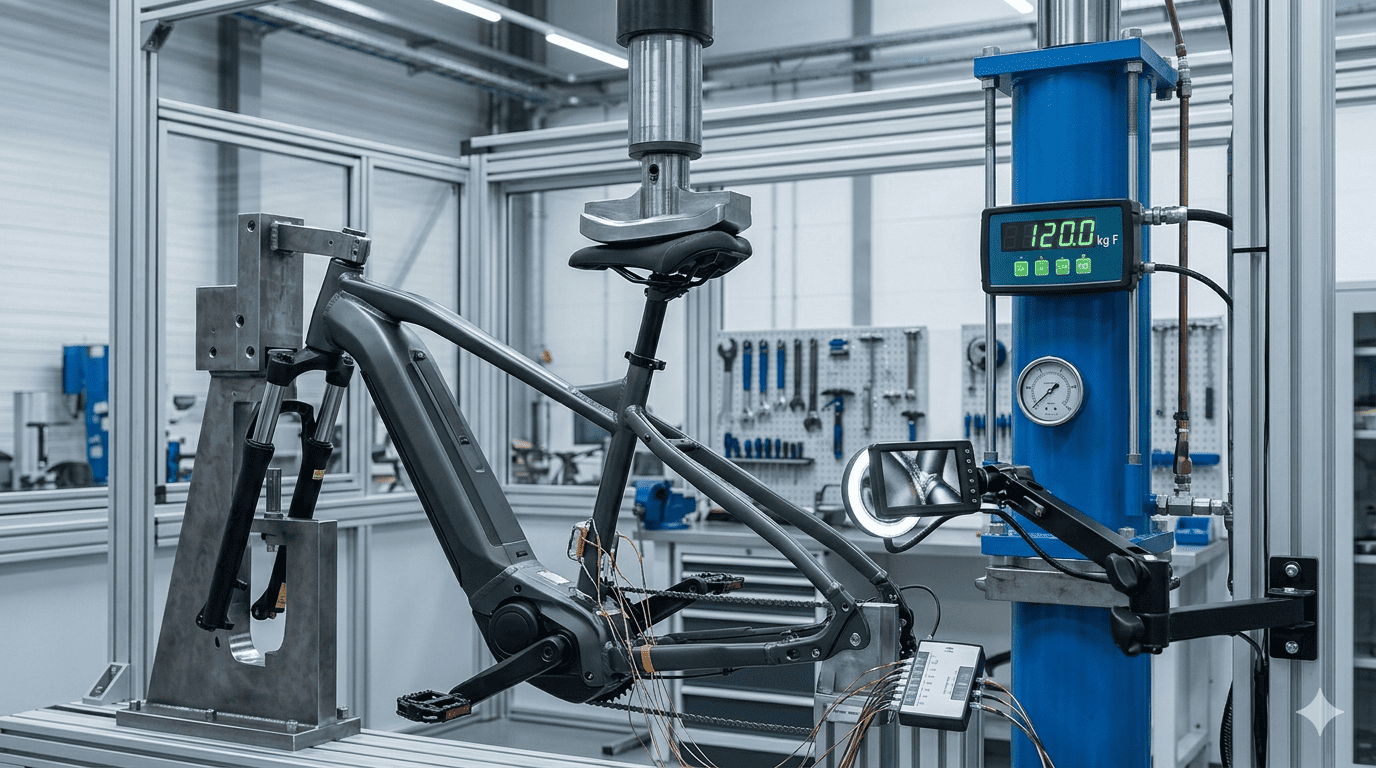
Here's the problem: the test assumes smooth, predictable loading. You sit still. The weight is distributed evenly. No bumps. No sudden braking. No panic swerves.
But real roads aren't lab floors. When you hit a pothole at 25 km/h with 10 kg of groceries in a rear rack, the instantaneous force on your frame can easily exceed 200 kg. The test passed at 120 kg tells you the structure can handle that load in ideal conditions. It doesn't tell you how much margin is left for the chaos of daily commuting.
In my experience supplying OEM e-bikes to brands in multiple markets, I've seen buyers request spec changes specifically because end users reported issues at weights below the stated limit. The frame passed the test. The real world broke it anyway. That gap is what most riders don't understand when they read the spec sheet.
Different standards, different numbers
Not all weight capacity claims are created equal. A bike certified under EN 15194 in Europe and one certified under UL 2849 in the US may both say "120 kg max," but they weren't tested the same way.
| Standard | Region | Typical Test | Cycle Count | Safety Factor |
|---|---|---|---|---|
| EN 15194 | EU | Static + fatigue | 100,000 cycles3 | Moderate |
| UL 2849 | US | Static + impact resistance | Varies | Conservative |
| JIS D 91114 | Japan | Frame strength + load distribution | 50,000 cycles | High |
| GB 177615 | China | Static + road simulation | 100,000 cycles | Variable |
The standards test different things. EN 15194 focuses heavily on electrical safety and motor behavior but still includes mechanical load tests. UL 2849 adds more aggressive impact and abuse scenarios. Japanese JIS standards tend to apply higher safety margins. Chinese GB standards are evolving rapidly and now align closely with EN for export models.
When a brand sources bikes from us for the EU, we certify to EN 15194. If the same model goes to a US Amazon seller, we add UL 2849 testing. The frame didn't change. The number might. That's not dishonesty — it's compliance with different regional requirements. But it does mean two identical-looking bikes can have legitimately different stated capacities depending on where they're sold.
A common pattern I see in buyer inquiries: they compare two bikes, one says 120 kg, the other says 136 kg, and they assume the second is structurally superior. Sometimes it is. Sometimes it just means the manufacturer applied a more conservative safety factor or tested under a standard with lower pass/fail thresholds. Without knowing which standard was used, the numbers are hard to compare directly.
Why does the same bike have different stated limits in different markets?
This one frustrates a lot of people, and honestly, I get it. You find an e-bike on a European brand's website: "Max load 130 kg." Same model on the US site: "Max load 286 lbs" — which converts to 129.7 kg. Close enough. But then you find the exact same frame sold under a private label in Australia, and it says "Max load 120 kg."
Three markets. Three numbers. One frame.
The answer usually isn't that the bike got weaker. It's that liability expectations, certification costs, and marketing strategies vary by region. Brands apply different safety buffers depending on local lawsuit risk, insurance requirements, and return rate history.

In the EU, manufacturers often publish the test-pass weight directly because the certification body requires transparency and the legal framework is relatively predictable. In the US, where product liability litigation is more aggressive6, some brands subtract 10–15% from the test weight before printing it on the box. That buffer protects them if a rider loads the bike right up to the limit and something fails.
Australia and New Zealand tend to follow EU standards for certification but apply stricter import and consumer protection rules. So a brand might keep the EU test report but lower the stated capacity in the manual to account for local legal advice.
Then there's the OEM layer. We manufacture the same frame for multiple brands. One brand targets premium commuters and wants a high weight limit for marketing credibility. Another brand targets budget buyers and doesn't want to over-promise. We give them the same test report. They print different numbers. Both are technically compliant — one just chose a bigger safety margin.
The "grey zone" in spec-sheet publishing
Here's something most buyers never think about: the weight capacity number isn't always pulled directly from the test report. Sometimes it's a business decision.
I've had brand clients ask, "Can we list this as 130 kg instead of 120 kg?" My first question is always, "What did the frame pass at?" If it passed at 150 kg under EN 15194, then yes, listing 130 kg is conservative and defensible. If it barely passed at 125 kg, then no, listing 130 kg is wishful thinking.
But not every brand asks. Some look at competitor listings, see most bikes in the category claim 120 kg, and just match it. Others round up from test data to hit a psychological threshold. A bike tested at 118 kg becomes "120 kg max" on the product page.
This grey zone exists because weight capacity isn't regulated the same way motor power or battery voltage is. A bike claiming 250W nominal motor power in the EU has to prove it or face fines7. A bike claiming 120 kg capacity rarely gets audited unless something breaks and a customer sues.
The result: the number on the spec sheet is a blend of engineering reality, legal caution, and marketing positioning. All three ingredients matter, and the recipe changes by brand.
Your bike has multiple weight limits, not just one
This is the part that surprised me most when I started working with component suppliers. You can have a frame rated for 150 kg, but if the wheels are only rated for 100 kg, the bike's real capacity is 100 kg. The frame doesn't decide the limit. The weakest link does.
Every major component on an e-bike has its own weight threshold: frame, fork, wheelset, spokes, tires, seatpost, saddle, and rack. The "max rider weight" on the spec sheet usually refers to the frame's tested limit, but it assumes every other part can handle the same load. That assumption doesn't always hold.
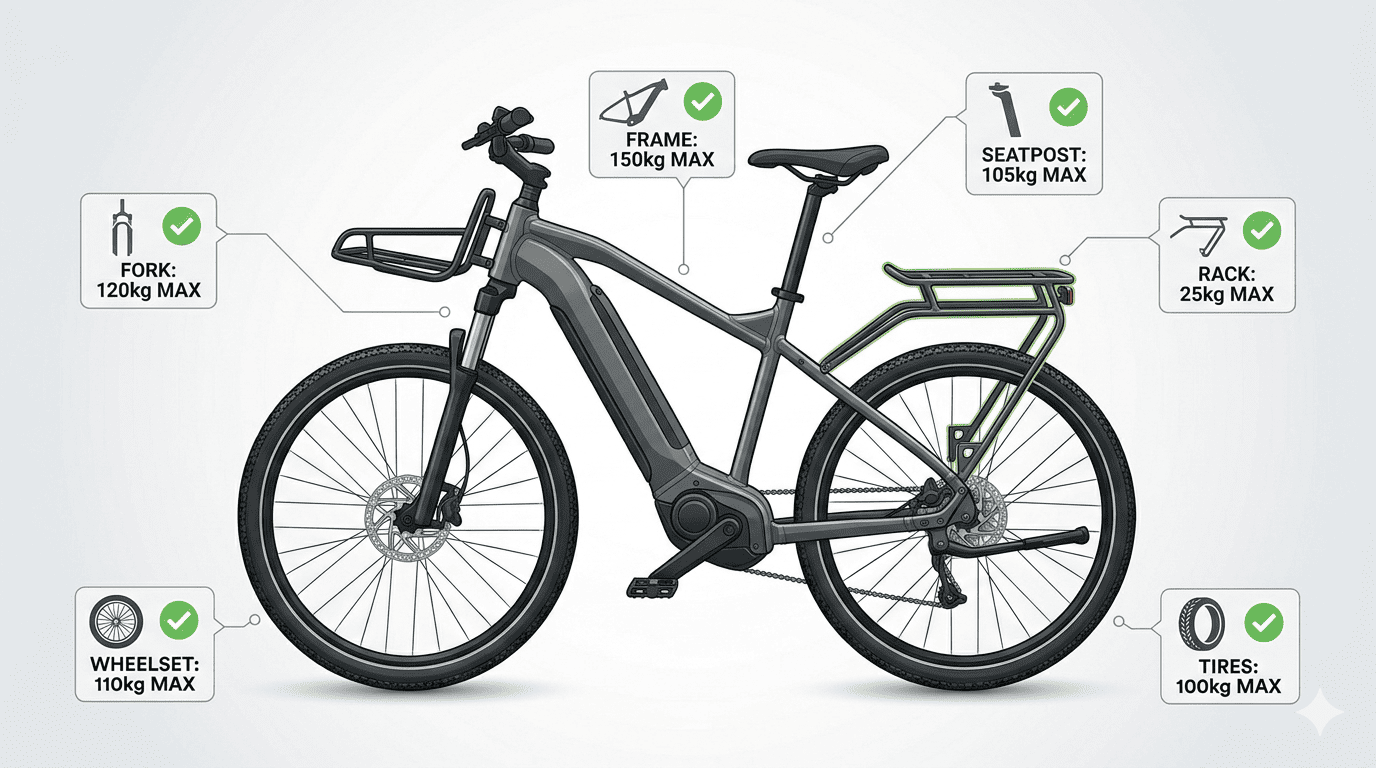
A typical breakdown looks like this:
| Component | Typical Weight Limit | Failure Mode |
|---|---|---|
| Frame | 120–150 kg | Cracks near welds, seat tube deformation |
| Fork | 100–130 kg | Steerer tube failure, crown cracking |
| Wheelset (rims) | 100–120 kg | Rim collapse, spoke nipple pullthrough |
| Spokes | 80–100 kg per wheel | Spoke breakage, uneven tension leading to wheel wobble |
| Tires | 90–110 kg | Sidewall blowout, bead separation |
| Seatpost | 100–120 kg | Bending, clamp slippage |
| Saddle | 100–130 kg | Rail bending, shell cracking |
| Rear rack (if installed) | 20–35 kg cargo | Mounting bolt shear, frame stress concentration |
Notice the problem? If your bike's spec sheet says "max 120 kg," but the stock wheels are entry-level and only rated for 100 kg, you're riding at the wheel's limit, not the frame's. The frame is fine. The wheels are on borrowed time.
This mismatch is incredibly common in budget and mid-range e-bikes. Brands optimize cost by using a strong frame (because it's a selling point) but pair it with cheaper wheels, tires, or seatposts (because most buyers don't check). The result: the spec sheet number is technically true for the frame, but misleading for the bike as a system.
How to find the real weak point
When I negotiate specs with buyers, the first question I ask heavier riders or cargo users is, "What's your wheelset rated for?" Nine times out of ten, they don't know. The product page doesn't say. The manual doesn't say. Even the brand sometimes doesn't know, because they sourced the wheels from a sub-supplier and never asked.
Here's how to find out:
- Check the rim sidewall. Many rims have a maximum pressure and weight rating stamped on them, though it's often in tiny print.
- Count the spokes. A 36-spoke wheel can handle more load than a 28-spoke wheel8 of the same diameter and rim material. If your bike has 28 or 32 spokes and you're a heavier rider, the wheels are likely your limiting factor.
- Look up the tire spec. Tire manufacturers publish load ratings. A Schwalbe Marathon9, for example, has a stated max load that varies by width and pressure. If you're running your tires at the max pressure and you're near the frame's weight limit, you're stressing the tires hard.
- Ask about the seatpost material. Aluminum seatposts are stronger than steel in most cases10, but cheap aluminum can fail suddenly. If your seatpost is unmarked and came stock with a budget bike, it's worth upgrading if you're a heavier rider.
A common pattern I see in buyer inquiries: someone returns a bike claiming it "wasn't rated for their weight," but the frame was fine. The wheels taco'd, or the seatpost bent, or the saddle rails cracked. The spec sheet told the truth about the frame. It just didn't tell the whole truth about the bike.
Does the weight limit include cargo, or just the rider?
This is where the confusion gets expensive. You weigh 100 kg. The bike says "max 120 kg." You think, "Great, I have 20 kg of margin for a backpack and some groceries." Then your rear rack cracks, or your bike starts handling strangely, or your tire blows out on a hill.
Most e-bike weight limits refer to total system load: rider + cargo + accessories. A few brands specify "rider weight only" and publish a separate cargo limit, but that's the exception, not the rule. If the spec sheet just says "max 120 kg" with no clarification, assume it means everything.
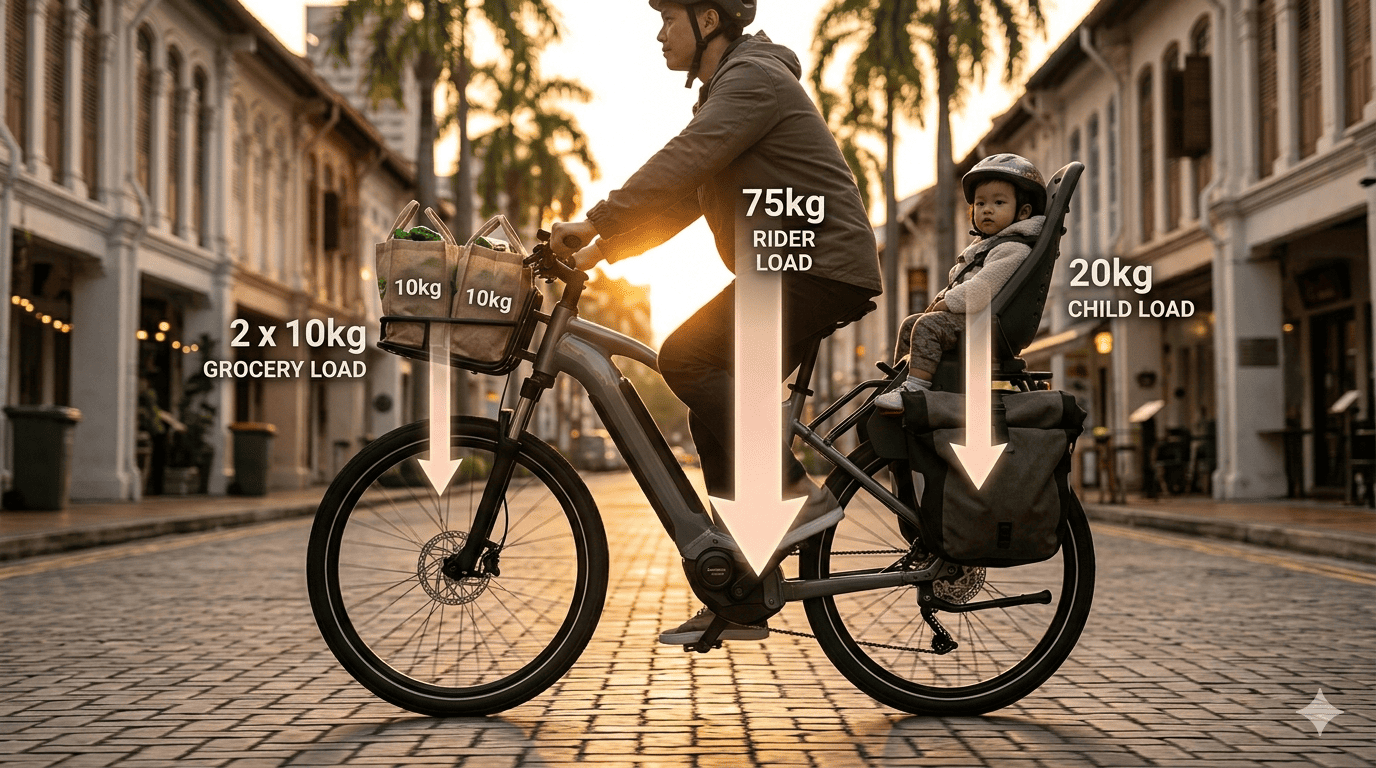
The math gets tricky because cargo doesn't distribute weight the same way a rider does. A 100 kg rider sitting on the saddle puts most of their weight on the rear wheel and seatpost, with some on the handlebars. A 15 kg pannier hanging off a rear rack puts all its weight on the rear wheel and the rack mounting points, and none on the handlebars. The rear wheel sees a higher effective load, even though the total system weight is lower.
This matters because most e-bike rear racks are rated for 20–35 kg of cargo, independent of the frame's weight limit. If your bike has a 120 kg total limit, and you weigh 100 kg, and you load 25 kg of cargo on the rear rack, you're within the frame's limit but you've exceeded the rack's design load. The rack bolts can shear, or the rack can bend, or it can stress the frame's mounting points until they crack.
How brands handle cargo in the spec sheet
In my experience supplying OEM e-bikes to brands in multiple markets, I've seen three approaches:
-
Total system weight only. The spec sheet says "max 120 kg" and doesn't mention cargo separately. This is the most common approach for commuter and leisure bikes. Buyers are expected to do the math themselves.
-
Rider weight + separate cargo limit. The spec sheet says "max rider weight 100 kg, max cargo 25 kg." This is clearer but raises a question: can you combine them? Is 125 kg total allowed, or is 100 kg rider + 25 kg cargo a separate certification? Usually, it's separate — the frame might handle 125 kg total, but the rack doesn't, so the brand splits the numbers to manage liability.
-
No stated limit at all. Budget bikes sometimes skip the weight limit entirely or bury it in fine print. This is almost always a red flag. If a brand won't publish the number, they either don't know it (because they didn't test) or they know it's low and don't want to scare off buyers.
If you're planning to carry cargo regularly, look for bikes that explicitly state a cargo limit and have a rear rack pre-installed or spec'd by the manufacturer. Aftermarket racks can work, but you're adding another component with its own weight limit, and you have to trust the rack's mounting bolts won't overstress the frame.
What happens when you exceed the weight limit?
Let's be honest: plenty of people ride e-bikes over the stated weight limit and never have a problem. I'm not here to scare you. But I am here to explain what you're risking, because the failure modes aren't always obvious or immediate.
Exceeding the weight limit doesn't mean the bike will break tomorrow. It means the bike is operating outside the conditions it was tested for, and the risk of failure — sudden or gradual — goes up. How much it goes up depends on how far over the limit you are, how you ride, and which component fails first.
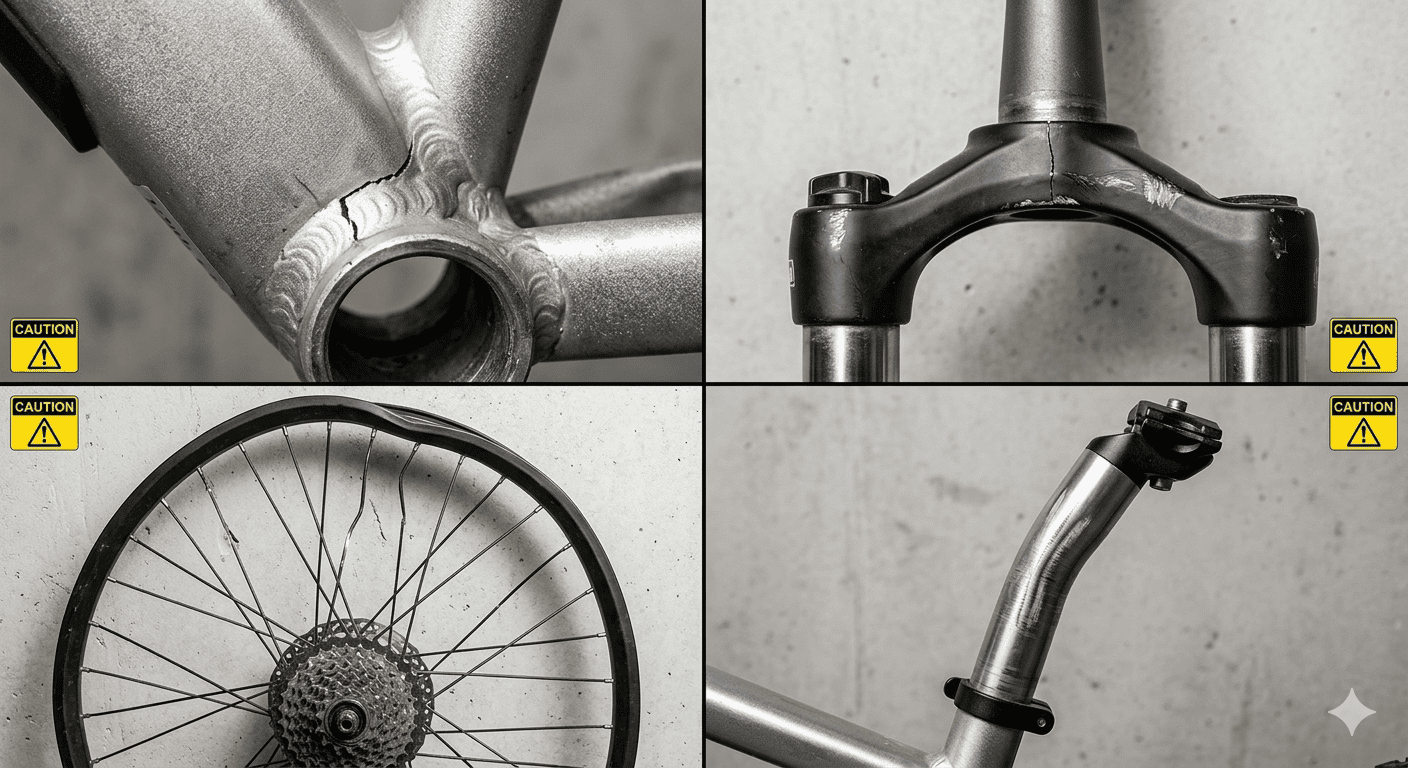
Here's what I've seen happen in return cases and buyer complaints:
Immediate failures
These are rare but dangerous. They happen when a single component is pushed past its yield point suddenly — usually during impact or heavy braking.
- Wheel collapse. Hit a pothole at speed with too much weight, and the rim can fold inward. This usually happens to the front wheel because the rider's weight shifts forward under braking.
- Fork steerer tube crack. The fork's steerer tube (the part that fits into the frame's head tube) is under constant stress. Add too much weight and hit a bump, and it can crack. This can cause total loss of steering control.
- Seatpost failure. A cheap or corroded seatpost can bend or snap under excessive weight, especially if the rider hits a bump while seated.
Gradual failures
These are far more common. The bike doesn't break immediately, but components wear out faster than designed.
- Frame fatigue cracks. Aluminum frames develop microscopic cracks near welds over time11. Riding over the weight limit accelerates this. The frame might last 10,000 km under normal load but only 3,000 km when overloaded.
- Spoke breakage. Spokes under constant overload start breaking one by one. The wheel stays rideable for a while, but it gets wobblier and less safe with each broken spoke.
- Tire sidewall damage. Running tires at max pressure with too much weight causes the sidewall to flex excessively. Over time, the sidewall weakens and can blow out without warning.
- Bearing wear. Hubs, bottom brackets, and headsets all have bearings that wear faster under heavier load. You'll notice rough shifting, creaking noises, or loose-feeling steering before anything breaks.
Handling and performance issues
Even if nothing breaks, overloading changes how the bike rides.
- Longer braking distances. Heavier load means more momentum12. Your brakes have to work harder, and
"[PDF] Summary of Electric and Non- Powered Bicycle Standards", https://www.cpsc.gov/s3fs-public/Electric-and-Non-Powered-Bicycle-Standards-Summary-Report.pdf?VersionId=rZGs9tSONCKqT8AEaJJMZd_S1nDJpKEW. EN 15194 is the European standard for electrically power assisted cycles, covering safety requirements and test methods including mechanical strength testing, while UL 2849 is the North American standard for electrical systems in e-bikes, which includes structural load testing protocols. Evidence role: definition; source type: government. Supports: the existence and scope of EN 15194 and UL 2849 as e-bike safety standards. Scope note: Standards documents describe test procedures but do not specify how manufacturers must translate test results into published weight limits ↩
"Analyzing the impact of bicycle geometry and cargo loading ... - PMC", https://pmc.ncbi.nlm.nih.gov/articles/PMC11033132/. Studies of bicycle dynamics show that impact events such as striking obstacles can generate dynamic load factors ranging from 1.5 to 3.0 times the static load, depending on speed, obstacle geometry, and suspension characteristics. Evidence role: statistic; source type: paper. Supports: the magnitude of dynamic load multiplication during impact events on bicycles. Scope note: Research typically focuses on traditional bicycles or motorcycles; e-bike-specific dynamic loading data is limited ↩
"[PDF] Summary of Electric and Non- Powered Bicycle Standards", https://www.cpsc.gov/s3fs-public/Electric-and-Non-Powered-Bicycle-Standards-Summary-Report.pdf?VersionId=rZGs9tSONCKqT8AEaJJMZd_S1nDJpKEW. EN 15194:2017 specifies fatigue testing requirements for e-bike frames, including cyclic loading tests, though the exact cycle count varies by test type and component being evaluated. Evidence role: statistic; source type: government. Supports: the number of test cycles required in EN 15194 fatigue testing. Scope note: The standard contains multiple test procedures with different cycle counts; 100,000 cycles may apply to specific tests but not universally ↩
"[PDF] Summary of Electric and Non- Powered Bicycle Standards", https://www.cpsc.gov/s3fs-public/Electric-and-Non-Powered-Bicycle-Standards-Summary-Report.pdf?VersionId=rZGs9tSONCKqT8AEaJJMZd_S1nDJpKEW. JIS D 9111 is a Japanese Industrial Standard that specifies safety requirements for electrically power-assisted bicycles, including structural strength and durability testing protocols. Evidence role: definition; source type: government. Supports: the existence and scope of JIS D 9111 as a Japanese bicycle safety standard. Scope note: English-language documentation of specific JIS standard requirements is limited; cycle counts and test parameters may vary by standard revision ↩
"GB 17761-2024 English PDF", https://www.chinesestandard.net/PDF.aspx/GB17761-2024?srsltid=AfmBOorn7aUMKyNmjAFc59XUrFHR_193k_cN0LxDY1pt1VoJfc4yfDQr. GB 17761 is the Chinese national standard for electric bicycles, establishing safety and technical requirements including maximum speed, weight, and structural integrity testing, with recent revisions aligning more closely with international standards. Evidence role: definition; source type: government. Supports: the existence of GB 17761 as China's national standard for electric bicycles. Scope note: The standard has undergone multiple revisions; specific test cycle counts and procedures vary by version and may not be fully documented in English sources ↩
"[PDF] A Comparative Introduction to Product Liability Law in the US and ...", https://scholarcommons.sc.edu/cgi/viewcontent.cgi?article=1128&context=scjilb. Legal scholars note that the United States generally has a more plaintiff-friendly product liability system than the European Union, with features including broader discovery rules, jury trials, contingency fee arrangements, and higher damage awards, which collectively create different risk profiles for manufacturers. Evidence role: expert_consensus; source type: education. Supports: differences in product liability legal frameworks between the US and EU. Scope note: This characterizes general legal system differences rather than specific outcomes in e-bike cases ↩
"Electric bicycle laws - Wikipedia", https://en.wikipedia.org/wiki/Electric_bicycle_laws. Under EU regulations, electrically assisted pedal cycles (EAPCs) are limited to motors with a maximum continuous rated power of 250W to qualify for bicycle classification rather than motor vehicle classification, which affects licensing, insurance, and where the vehicles may be used. Evidence role: general_support; source type: government. Supports: EU regulatory requirements for e-bike motor power ratings. Scope note: This describes the regulatory requirement but does not specifically address enforcement mechanisms or penalty structures ↩
"How Spoke Count Affects Ride Quality and Wheel Durability", https://superteamwheels.com/pages/how-spoke-count-affects-ride-quality-and-wheel-durability?srsltid=AfmBOoo9Ed4sOAGRHrwjAXyoAh1XSzBB-CNwF4Y9wMG0ERIDT9jtZMDD. In bicycle wheel design, increasing spoke count distributes loads across more structural elements, reducing stress per spoke and generally increasing the wheel's overall load capacity and durability, though actual capacity also depends on spoke material, rim strength, spoke tension, and lacing pattern. Evidence role: mechanism; source type: education. Supports: the relationship between spoke count and wheel load capacity. Scope note: This describes the general principle; actual load capacity differences depend on multiple design factors beyond spoke count alone ↩
"Should I multiply maximum tyre load by number of wheels to get ...", https://bicycles.stackexchange.com/questions/58548/should-i-multiply-maximum-tyre-load-by-number-of-wheels-to-get-maximum-bike-load. Bicycle tire manufacturers typically specify maximum load ratings based on tire dimensions and inflation pressure, following standards such as ETRTO (European Tyre and Rim Technical Organisation) guidelines, which establish the relationship between tire size, pressure, and safe load capacity. Evidence role: case_reference; source type: other. Supports: the practice of tire manufacturers publishing load ratings. Scope note: This describes industry practice generally rather than verifying specifications for the specific tire model mentioned ↩
"Steel or aluminum seat post ? : r/MTB - Reddit", https://www.reddit.com/r/MTB/comments/13sd7fr/steel_or_aluminum_seat_post/. In bicycle component design, aluminum alloys offer higher strength-to-weight ratios than steel, but steel has higher absolute strength and fatigue resistance; the performance of seatposts depends on alloy selection, wall thickness, and manufacturing quality rather than material alone. Evidence role: mechanism; source type: education. Supports: material property differences between aluminum and steel in bicycle components. Scope note: This clarifies that the material comparison is more complex than a simple 'stronger than' statement; actual performance depends on specific alloys and design ↩
"Assessment of fatigue damage in welded aluminum joints subjected ...", https://pmc.ncbi.nlm.nih.gov/articles/PMC10161593/. In welded aluminum structures, fatigue cracks commonly initiate in the heat-affected zone near welds due to microstructural changes, residual stresses, and stress concentrations, with crack propagation rates depending on load cycles, stress amplitude, and alloy properties. Evidence role: mechanism; source type: paper. Supports: the mechanism of fatigue crack development in welded aluminum structures. Scope note: This describes the general phenomenon in aluminum structures; bicycle frame-specific research is limited ↩
"Science of Cycling: Steering + Activity - Exploratorium", https://annex.exploratorium.edu/cycling/brakes2.html. In vehicle dynamics, momentum is the product of mass and velocity; increased mass requires proportionally greater braking force to achieve the same deceleration, and if braking force is limited by tire-road friction or brake system capacity, stopping distance increases with load. Evidence role: mechanism; source type: education. Supports: the relationship between mass, momentum, and braking requirements. Scope note: This describes the theoretical relationship; actual braking distance increases depend on brake system design, tire grip, and rider technique ↩