
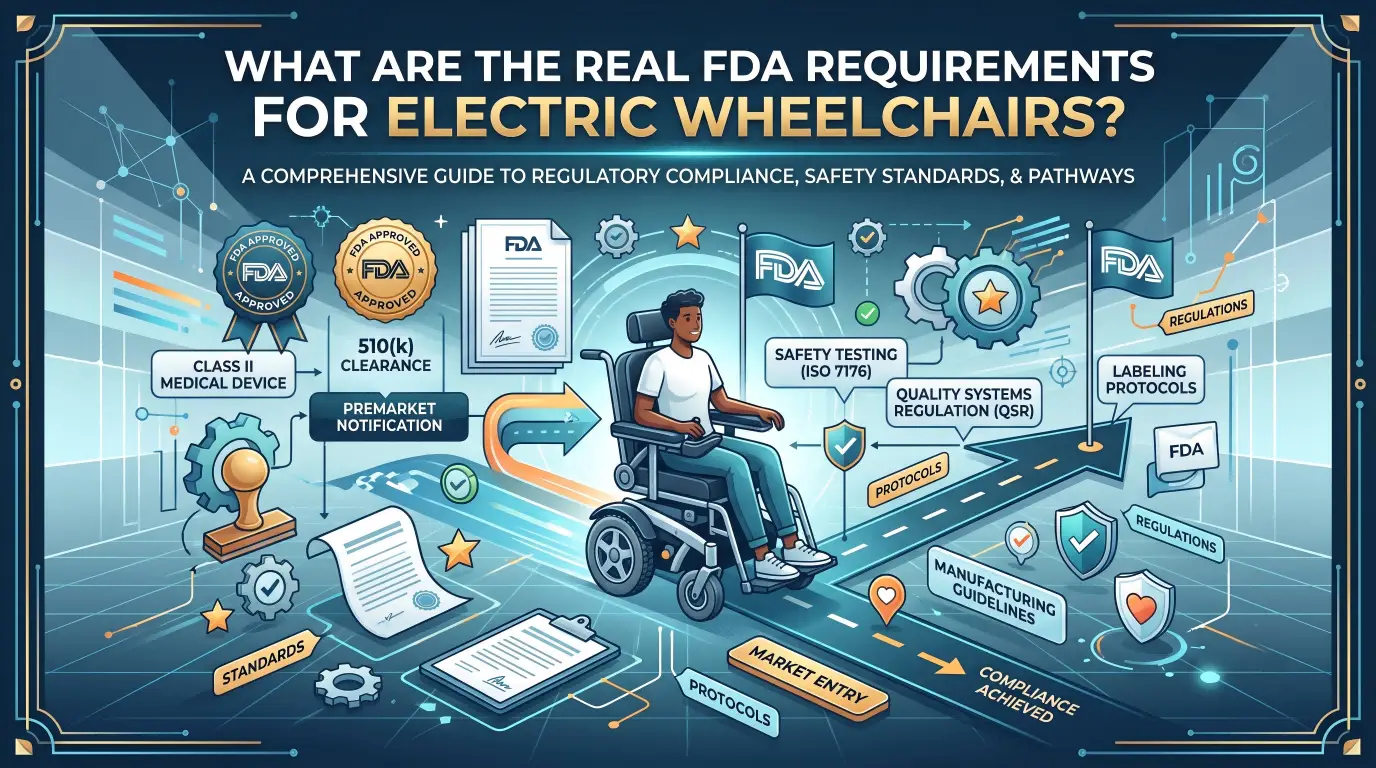
Sourcing electric wheelchairs for the U.S. market but getting confusing answers about "FDA certificates"? You're not alone. Many buyers risk choosing a supplier who can't meet compliance, leading to import detentions, legal trouble, and wasted investment. To navigate this, you must understand that the real FDA requirements for these devices are a pathway, not a one-time certificate, empowering you to ask the right questions and verify supplier capabilities.
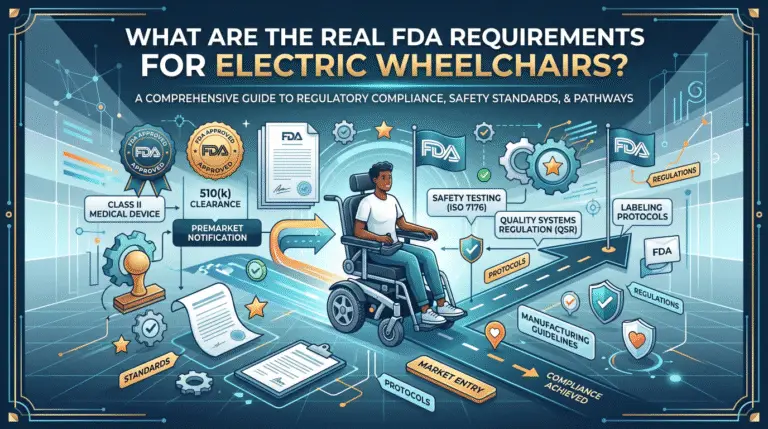
The core FDA requirements for an electric wheelchair or mobility scooter depend entirely on its "intended use" and marketing claims. If marketed with medical benefits (e.g., for individuals with mobility impairments), it is a regulated medical device. This requires the manufacturer to have an FDA Establishment Registration, a Device Listing for the specific product, and possibly a 510(k) premarket clearance.1 If marketed purely for convenience, the regulatory path may differ, but it is never a simple "FDA certificate."
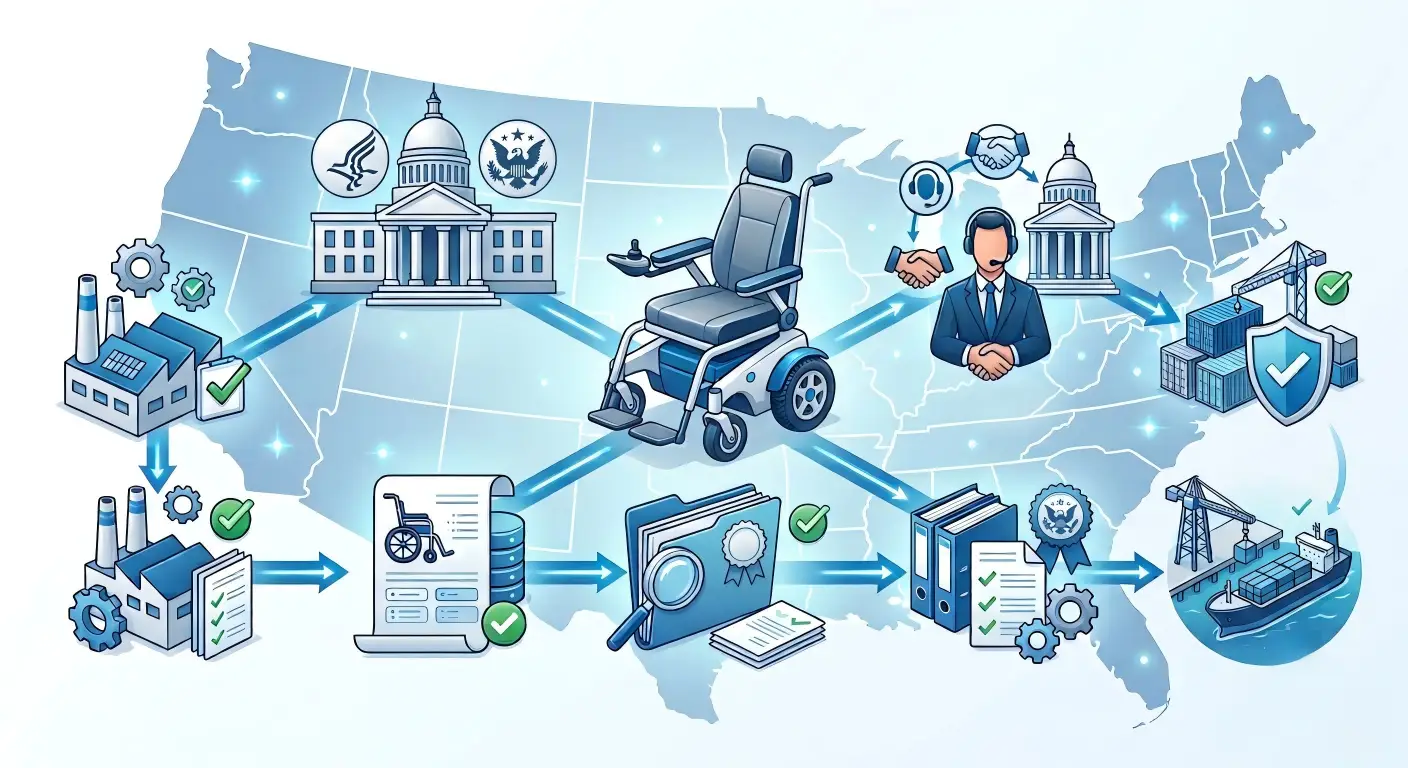
Now that you have the direct answer, you’re probably wondering how to apply this. How do you determine your product's specific path? What exact questions should you ask a potential supplier, and what verifiable evidence should you demand? Let's break down the process step-by-step so you can source with confidence.
How Do You Determine the Correct FDA Pathway for Your Product?
Are you feeling stuck deciding whether your mobility scooter is a regulated medical device or a simple consumer product? This single decision dictates your entire compliance strategy, budget, and timeline. Getting it wrong at the start is one of the most expensive mistakes a U.S. importer can make.
Your compliance pathway is determined by two main factors: your marketing claims (which define the "intended use") and your sales channel. Medical claims, such as stating a product "aids in rehabilitation," firmly place it in the medical device category, which involves more stringent FDA requirements than claims of simple convenience.
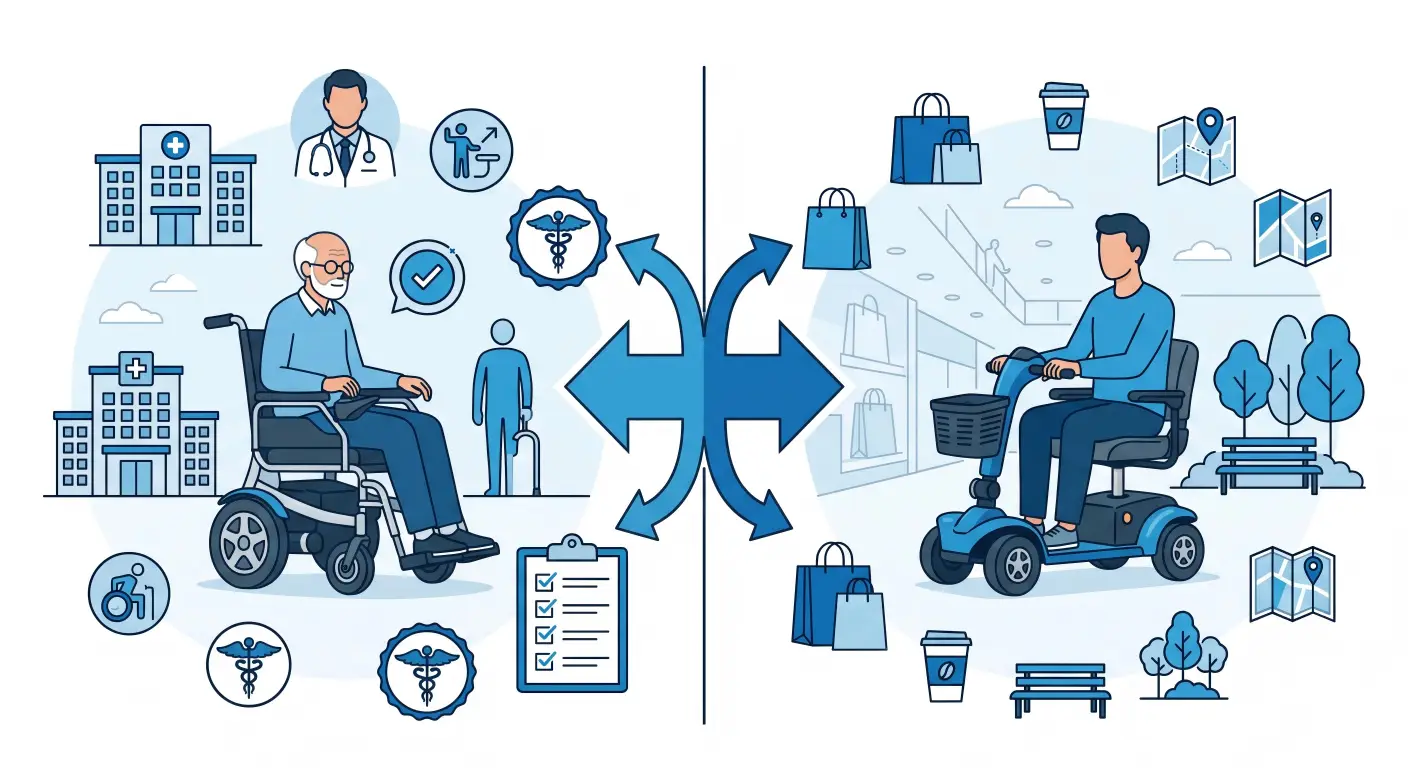
H3: Medical vs. Non-Medical Intended Use
The FDA defines "intended use" by the objective intent of the persons legally responsible for the labeling of devices.2 In simple terms, it's what you say your product does. This is conveyed through your product labels, Instructions for Use (IFU), website copy, and advertising materials.
- Medical Claims Examples:
- "For individuals with mobility impairments."
- "Aids recovery and improves quality of life for patients."
- "Designed for users who cannot operate a manual wheelchair."
- Non-Medical / Convenience Claims Examples:
- "A convenient personal transport vehicle."
- "An easy way to get around the mall or a large campus."
- "For recreational use in outdoor environments."
I once worked with a new U.S. buyer who wanted to market their electric scooter as a fun, recreational vehicle. However, their draft website copy included a testimonial about how it "helped my grandfather regain his independence after his surgery." I had to explain that this one phrase would likely cause the FDA to view the product as a medical device, completely changing the compliance scope and cost. Seemingly small wording details have huge implications.
H3: The Role of Your Sales Channel
Your intended sales channel provides further evidence of intended use.
- Medical Channels: If you plan to sell to Durable Medical Equipment (DME) suppliers, distributors who service hospitals, or businesses that will seek reimbursement from Medicare or private insurance, your product is unequivocally a medical device.
- Retail Channels: If you sell directly to consumers (DTC) via your own website or through big-box retailers, the line can seem blurry. However, the FDA still scrutinizes your marketing language across all platforms. You cannot sell the same device through a DME channel and a retail channel with different claims; the highest classification will apply to all units.
H3: A Practical Decision Flow for Buyers
To avoid confusion, I guide my clients through this simple, logical flow:
- Define Your Claims & Channel: Decide definitively how you will market and sell the product. Write it down.
- Identify a Likely Product Code: Based on your claims, find a potential FDA product classification code. For many motorized wheelchairs and scooters, a common code is ITE ("Wheelchair, Powered")3 or IRI ("Scooter, Motorized, 3-Wheeled").
- Verify in the FDA Database: Use the official FDA Product Classification Database to look up the code. The database will tell you the device class (usually Class I or Class II) and whether it is exempt from 510(k) premarket notification.
- Communicate Your Pathway: Once you have a clear intended pathway (e.g., "We will market this as a Class II device under product code ITE, which requires a 510(k)"), you can communicate this clearly to potential suppliers.
Disclaimer: This flow is a starting point. Always verify your final product classification and pathway with a qualified regulatory consultant.
What Are the Key Roles and FDA Requirements for My Supplier?
You've just received a quote, and the supplier mentions needing a "U.S. Agent" and an "FEI number." What do these terms mean, and who is responsible for what? Without absolute clarity on these roles, your import can be detained at the border simply because a critical registration step was missed.
A capable supplier must actively manage or provide evidence for key FDA requirements, including their own Establishment Registration and the specific Device Listing for your product. You, as the importer, will also have responsibilities, and a U.S. Agent is a mandatory component for any non-U.S. manufacturer.
H3: Defining the Key Players
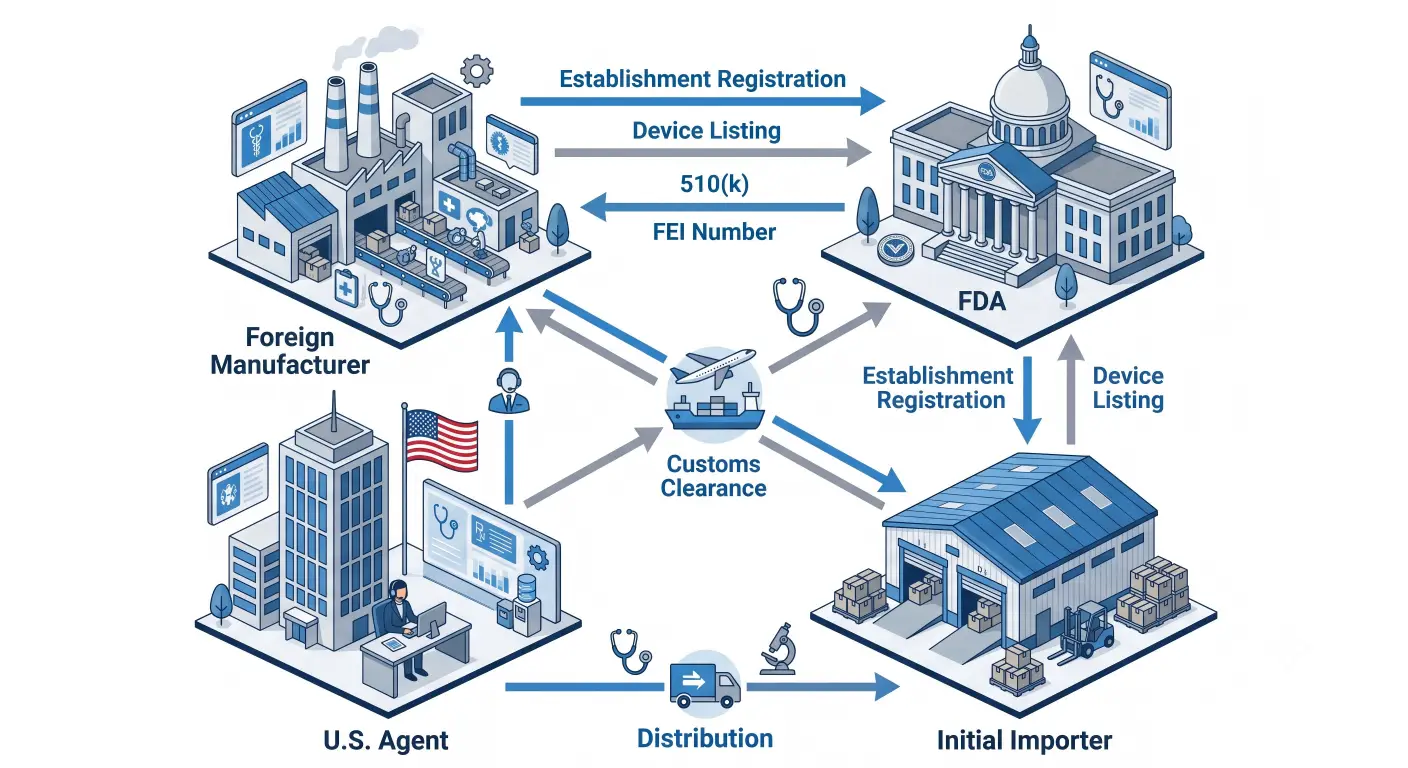
Clear definitions prevent costly misunderstandings. In any import transaction involving FDA-regulated devices, there are at least three key roles.
- Foreign Manufacturer / Specification Developer: This is the entity that manufactures the device. They are legally required to register their facility with the FDA through the FURLS system. Upon successful registration, they are assigned an FDA Establishment Identifier (FEI) number4. They are also responsible for listing each device they produce for the U.S. market.
- U.S. Agent: This is a mandatory requirement for any foreign manufacturer.5 The U.S. Agent must reside or maintain a place of business in the United States and serves as the primary point of contact between the FDA and the foreign manufacturer. They do not handle sales or marketing; their role is purely regulatory communication.
- Initial Importer / Distributor: This is likely your company. You are the first entity in the U.S. to take ownership of the imported devices. Initial importers also have FDA responsibilities, which may include their own establishment registration.6
H3: Procurement Actionables: What to Ask For
Stop asking "Do you have an FDA certificate?" and start asking specific, verifiable questions. A professional supplier will have this information ready.
- Evidence of Establishment Registration: Ask, "Can you please provide your 10-digit FEI (FDA Establishment Identifier) number?" You can then use the FDA Establishment Registration & Device Listing database to verify that their registration is current.
- Device Listing Details: Ask, "Under which product code and listing number is this specific model listed?" This confirms they have registered the actual product you intend to buy, not just a similar one.
- 510(k) Number (if required): If your device requires premarket notification, ask, "Does this device have 510(k) clearance? If so, what is the clearance number (e.g., Kxxxxxx)?" You can verify this in the FDA 510(k) Premarket Notification database.
- U.S. Agent Information: Ask, "Can you provide the name and contact details of your appointed U.S. Agent?" While you may not need to contact them directly, a supplier who cannot name their agent is a major red flag.
Here's a sample email I often help my clients draft:
"Hi [Supplier Name],
In reviewing your quotation for model M-500, we need to verify the FDA compliance pathway. Can you please provide the following details?
- Your FDA Establishment Registration (FEI) number.
- The FDA product code and device listing number for the M-500.
- If applicable, the 510(k) clearance number.
- The contact information for your designated U.S. Agent.
This information is essential for our due diligence process. Thank you."
This line of questioning immediately separates the professional suppliers from those who are just paying lip service to compliance.
What Documentation Should I Expect from a Supplier to Prove FDA Requirements are Met?
A supplier confidently tells you they are "fully FDA compliant" but becomes vague when you ask for proof. How do you move beyond verbal assurances to concrete, verifiable evidence without needing to audit their entire quality system yourself?
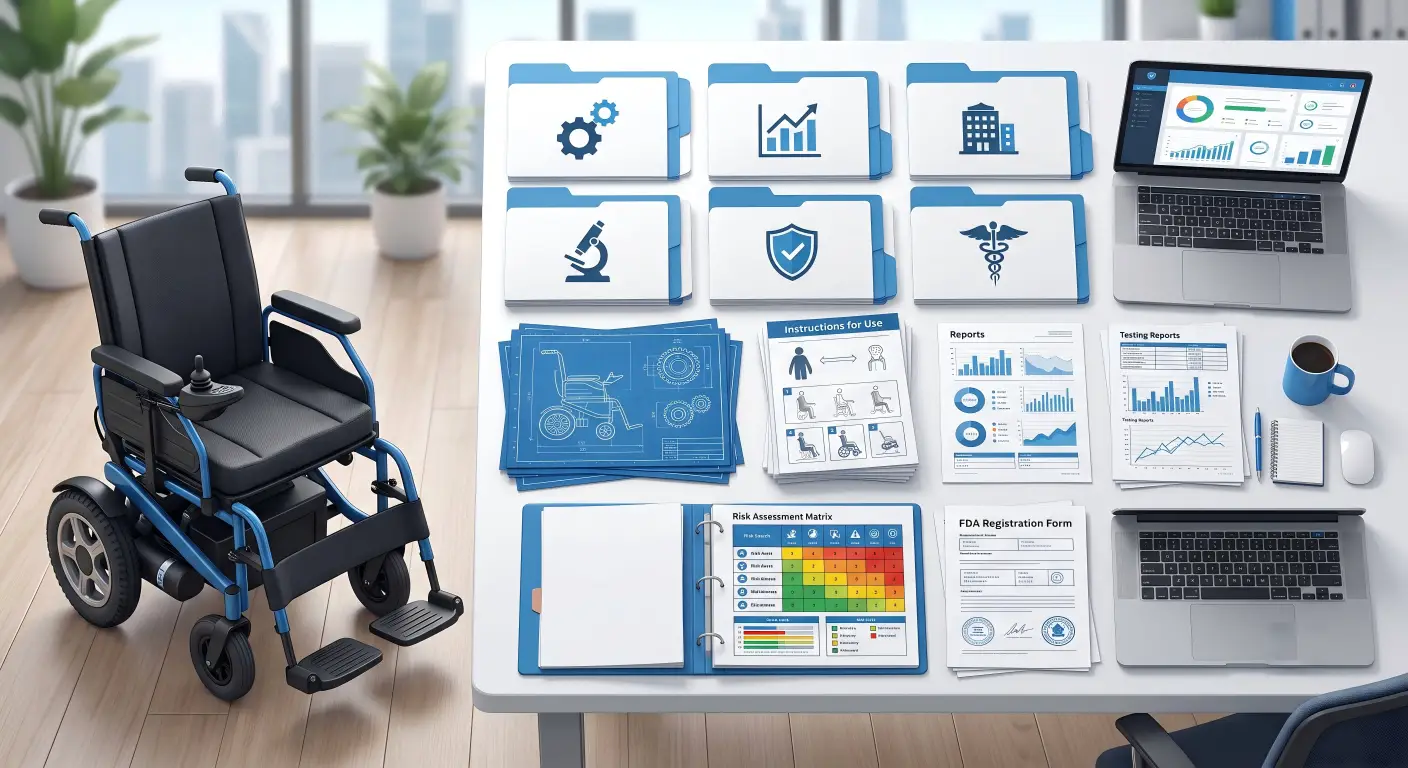
A professional supplier should maintain a "living compliance pack" that demonstrates they manage FDA requirements proactively. This isn't a single certificate but a collection of controlled documents, such as a risk management file, relevant test reports, and approved labeling, which you can and should sample during your due diligence.
H3: The Core Components of a Compliance Pack
Think of this as the product's regulatory resume. While you may not need to see every page, asking for samples or summaries shows you are a serious buyer who understands compliance. A good supplier will appreciate this.
- Risk Management File (RMF): Based on the ISO 14971 standard, this file proves the manufacturer has systematically identified, evaluated, and mitigated potential hazards associated with the device. What to ask for: A redacted table of contents or a summary of the risk analysis. A supplier who doesn't know what this is cannot be compliant.
- Labeling & Instructions for Use (IFU): This documentation is critical as it legally defines the intended use. It must be consistent across the device label, packaging, and user manual. It should also include the manufacturer's name, address, and, for many devices, a space for the UDI. What to ask for: A PDF sample of the final artwork for the device label and the full IFU.
- Key Test Reports: Compliance requires proving safety and performance. This includes reports for standards like IEC 60601-1 (medical electrical equipment safety), IEC 60601-1-2 (EMC), and the ISO 7176 series7 (wheelchair-specific tests). What to ask for: A list of completed tests and confirmation that the tested device is the exact same model you are purchasing.
- Unique Device Identification (UDI) Plan: If selling a medical device, the manufacturer must have a plan to assign a UDI to each device and submit it to the FDA's Global Unique Device Identification Database (GUDID).8 What to ask for: "Can you describe your process for UDI assignment and GUDID submission?"
Table: De-branded Compliance Checklist Example
Use this table as a guide when creating your supplier RFI (Request for Information).
| Document | What to Ask For | What it Proves |
|---|---|---|
| Establishment Registration | Current FEI Number | The manufacturing facility is actively registered with the FDA. |
| Device Listing | Specific Listing Number & Product Code | The exact product model is registered with the FDA. |
| Risk Management File | Redacted summary or Table of Contents | The supplier proactively manages product safety and risks. |
| Labeling & IFU | PDF samples of the label and user manual | Claims are controlled and aligned with the chosen regulatory path. |
| 510(k) Clearance Letter | K-number for the specific device | The FDA has found the device to be "substantially equivalent." |
| UDI/GUDID Plan | A brief description of their process | The supplier is prepared for device traceability requirements. |
I remember a buyer who was very close to placing a large order based on a supplier's low price. As a final check, we asked for a summary of their risk management file. The supplier sent back their ISO 9001 quality system certificate. This was a huge red flag. It showed they didn't understand device-specific risk management, a core pillar of meeting medical device FDA requirements. We advised the client to walk away.
What Are the Realistic Timelines and Costs for Meeting FDA Requirements?
You have a target launch date for your new mobility scooter, but you have no clear idea how long the FDA process takes or how much to budget for it. Underestimating the time and money required for compliance can derail your entire project and put your investment at risk.
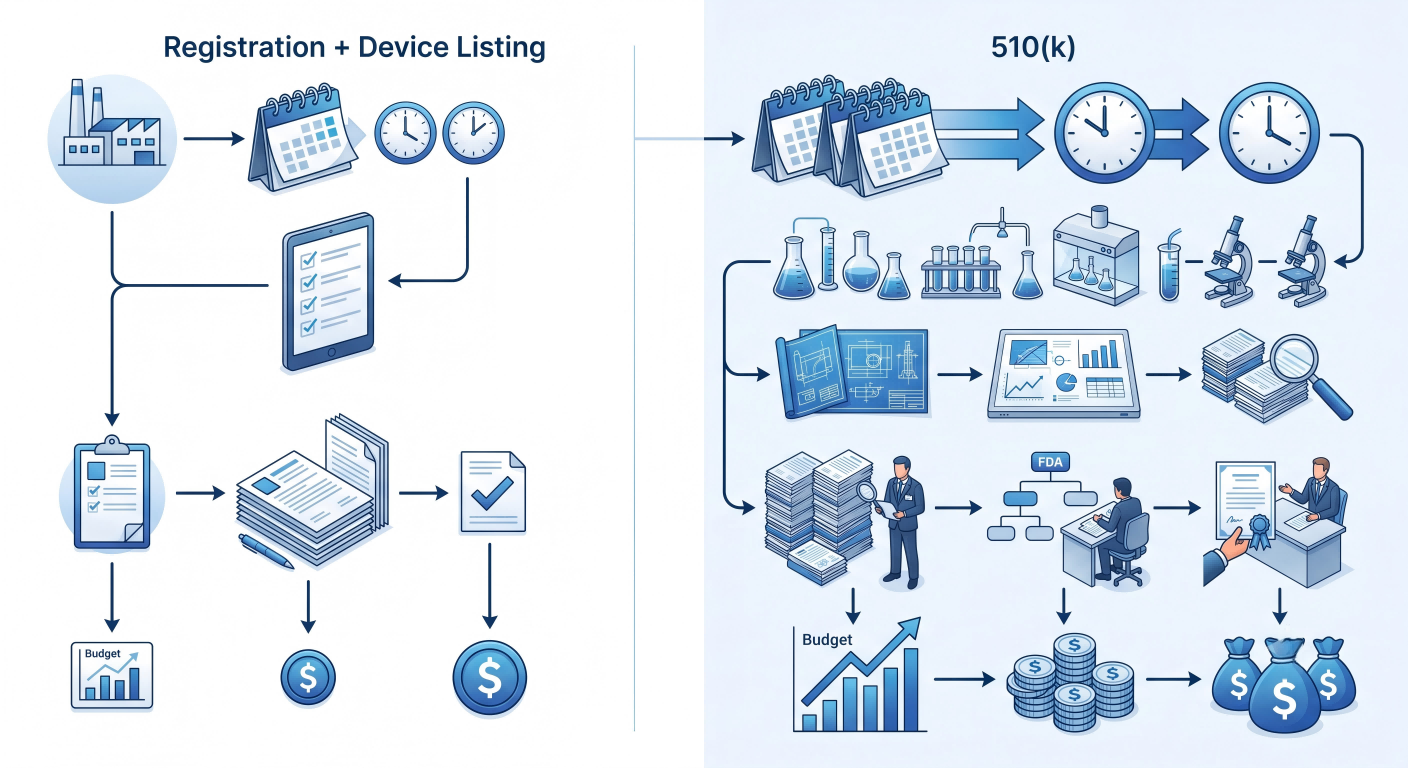
The timeline and cost for meeting FDA requirements vary dramatically based on your chosen regulatory pathway. A simple registration and listing for an exempt device is relatively fast and affordable, while a pathway involving a 510(k) submission is a major project that can take over a year and cost tens of thousands of dollars.
H3: Scenario A: Class I or II 510(k)-Exempt Device
This is the simplest path for a regulated medical device. It applies when the FDA has determined that a 510(k) is not required to provide reasonable assurance of safety and effectiveness for a specific device type.
- Pathway: FDA Establishment Registration + U.S. Agent designation + FDA Device Listing.
- Timeline (Example): 4-8 weeks. This covers finding a U.S. Agent, the supplier completing the registration/listing process, and you verifying everything.
- Cost Bracket (Example): $8,000 - $15,000 for the first year. This includes the annual FDA Establishment Registration Fee (this was $7,653 for fiscal year 20249–always check the official FDA site for the current fee), U.S. Agent annual fees ($1,000-$3,000), and potential consultant fees.
- Disclaimer: All timelines and costs are illustrative examples and should be verified for your specific project.
H3: Scenario B: Class II Device Requiring 510(k)
This pathway is required for devices that are not exempt and need to demonstrate they are "substantially equivalent" to a legally marketed predicate device.
- Pathway: All steps from Scenario A, plus the preparation and submission of a 510(k) premarket notification file to the FDA for review and clearance.
- Timeline (Example): 9-18 months. This extensive timeline includes performing all necessary testing, compiling the technical submission file, the FDA's review period (statutorily 90 days10, but often paused with questions), and responding to those questions.
- Cost Bracket (Example): $30,000 - $100,000+. This wide range includes significant costs for performance and safety testing, fees for a specialized consultant to write and manage the submission, and the FDA's own 510(k) review fee.
H3: The Hidden Cost: Ongoing Maintenance
This is the single most overlooked aspect by new importers. FDA compliance is not a one-time event; it is an ongoing obligation.
- Annual Fees: The FDA Establishment Registration fee is due every single year. Failure to pay on time will render your device misbranded and subject to refusal at the U.S. border.
- Listing Updates: If your supplier makes a significant change to the device—such as a new motor controller, a different battery chemistry, or updated software that affects performance—the device listing may need to be updated. A significant change could even trigger the need for a new 510(k).11
- Document Maintenance: Your risk management file is a "living document" and must be updated whenever changes are made or new post-market data becomes available.
When you are vetting a supplier, ask them: "What is your process for managing engineering changes and updating FDA documentation?" A professional partner will have a clear change control procedure. A risky one will have no answer.
Frequently Asked Questions
Is an "FDA Certificate" a real thing for electric wheelchairs?
No, the FDA does not issue a general "certificate of compliance" for electric wheelchairs. Compliance is demonstrated through a system of verifiable actions: the manufacturer's Establishment Registration, the product's Device Listing, and, if applicable, a 510(k) clearance letter from the FDA. Beware any supplier offering a single "FDA certificate."
Do I need a U.S. Agent if my supplier is in China?
Yes. Any foreign establishment involved in the manufacture, preparation, or processing of a medical device for the U.S. market must designate a U.S. Agent. This is a non-negotiable FDA requirement and serves as the official communication link between the FDA and the foreign company.
What happens if I import a device without proper FDA compliance?
Importing a non-compliant device carries severe risks. Your entire shipment can be held under "Detention Without Physical Examination" (DWPE), refused entry, and you could be forced to either ship it back or have it destroyed at your own expense. It can also lead to warning letters and damage your company's reputation.
Can I sell the same electric wheelchair as both a medical device and a consumer product?
This is extremely risky and generally not advisable. The FDA determines a product's intended use based on all available evidence, including your website, advertising, and sales channels. If you make medical claims anywhere, the FDA will likely regulate all units of that model as a medical device, regardless of where they are sold.
If a supplier has a 510(k), am I automatically compliant?
No. A 510(k) clearance is a critical piece of the puzzle, but it's not the whole story. You must verify that the clearance is for the exact model you are buying, that the manufacturer's establishment registration is active, and that the device listing is current. As the initial importer, you also have your own responsibilities to the FDA.
Conclusion
Navigating the U.S. market for electric wheelchairs means moving beyond the myth of the "FDA certificate." True compliance is a process, a pathway determined by your specific marketing claims and sales channels. By focusing on this pathway, you can shift from a position of uncertainty to one of control. The key is to ask precise questions, demand verifiable evidence like FEI and listing numbers, and understand that compliance is an ongoing commitment. Mastering these FDA requirements is less about becoming a regulatory expert and more about becoming an expert at vetting your partners.
At MorethingGO, we pride ourselves on providing the professional service and transparent documentation that serious international buyers require. If you are looking for a sourcing partner who understands the complexities of compliance and can support your entry into the U.S. market, we are here to help. Contact us today to discuss your project needs and experience the MorethingGO difference.
"Device Registration and Listing - FDA", https://www.fda.gov/medical-devices/how-study-and-market-your-device/device-registration-and-listing. FDA’s Registration and Listing information explains that manufacturers must register establishments and list each device, and the 510(k) program requires many Class II devices to obtain premarket notification clearance prior to marketing. Evidence role: general_support; source type: government. Supports: That FDA requires establishments to register and list devices, and that certain device types require 510(k) clearance before marketing.. ↩
"21 CFR 801.4 -- Meaning of intended uses. - eCFR", https://www.ecfr.gov/current/title-21/chapter-I/subchapter-H/part-801/subpart-A/section-801.4. Federal regulation at 21 CFR 801.4 defines 'intended use' as the objective intent of the persons legally responsible for labeling, as evidenced by claims in labeling and other circumstances. Evidence role: definition; source type: government. Supports: The regulatory definition of 'intended use' that ties device status to labeling and claims.. ↩
"Wheelchair, powered - Product Classification - FDA", https://www.accessdata.fda.gov/scripts/cdrh/cfdocs/cfpcd/classification.cfm?ID=ITI. The FDA Product Classification database lists product code ITE for 'Wheelchair, Powered,' along with its class and regulatory requirements. Evidence role: general_support; source type: government. Supports: That the FDA Product Classification database lists product code ITE described as 'Wheelchair, Powered.'. Scope note: Product code applicability must be confirmed for a specific device’s features and claims; the code example is not prescriptive. ↩
"Firm/Supplier Evaluation Resources - FDA Data Dashboard", https://datadashboard.fda.gov/oii/fd/fser.htm. FDA documentation describes the FEI as a unique identifier assigned to establishments for use across FDA systems, including registration and compliance databases. Evidence role: general_support; source type: government. Supports: That FDA assigns an FEI (FDA Establishment Identifier) to establishments and uses it across registration and compliance systems.. Scope note: An FEI identifies a facility but does not itself confirm active registration status; assignment timing may be independent of successful registration. ↩
"U.S. Agents - FDA", https://www.fda.gov/medical-devices/device-registration-and-listing/us-agents. FDA registration and listing guidance states that foreign establishments must designate a U.S. Agent to serve as the communication link with FDA. Evidence role: definition; source type: government. Supports: That foreign medical device establishments are required to designate a U.S. Agent as part of registration and communication with FDA.. ↩
"Who Must Register, List and Pay the Fee - FDA", https://www.fda.gov/medical-devices/device-registration-and-listing/who-must-register-list-and-pay-fee. FDA’s device registration guidance specifies that initial importers of medical devices must register their establishments and adhere to applicable importer responsibilities. Evidence role: definition; source type: government. Supports: That initial importers must register their establishments and comply with FDA requirements applicable to importers.. ↩
"Wheelchair - Wikipedia", https://en.wikipedia.org/wiki/Wheelchair. The International Organization for Standardization publishes the ISO 7176 series specifying test methods and performance requirements for wheelchairs, including stability, dimensions, and durability. Evidence role: general_support; source type: institution. Supports: That ISO 7176 defines test methods and performance requirements relevant to wheelchairs.. Scope note: Use of specific standards in FDA submissions depends on device type and recognized standards status; applicability must be confirmed for the product. ↩
"Global Unique Device Identification Database (GUDID) - FDA", https://www.fda.gov/regulatory-information/search-fda-guidance-documents/global-unique-device-identification-database-gudid. FDA’s Unique Device Identification regulations require most devices to include a UDI on labeling and for device identification data to be submitted to the Global Unique Device Identification Database (GUDID). Evidence role: definition; source type: government. Supports: That FDA’s UDI regulations require device labels to include UDIs and mandate submission of data to GUDID.. Scope note: Exemptions and phased compliance dates apply; requirements vary by device class and intended use. ↩
"Medical Device User Fee Amendments (MDUFA) - FDA", https://www.fda.gov/industry/fda-user-fee-programs/medical-device-user-fee-amendments-mdufa-fees. FDA’s Registration and Listing user fee page lists the medical device establishment registration fee for FY 2024 as $7,653. Evidence role: statistic; source type: government. Supports: The published FDA annual establishment registration fee amount for FY 2024.. Scope note: Fees are adjusted annually; readers should confirm the current fiscal year amount. ↩
"21 CFR 807.100 -- FDA action on a premarket notification. - eCFR", https://www.ecfr.gov/current/title-21/chapter-I/subchapter-H/part-807/subpart-E/section-807.100. FDA regulations on 510(k) reviews indicate a statutory 90‑day review period for premarket notifications, though review clocks may be paused for requests for additional information. Evidence role: definition; source type: government. Supports: That FDA’s regulations provide a 90-day statutory review period for 510(k) notifications.. Scope note: Real-world timelines may be longer due to holds and interactive review. ↩
"[PDF] Deciding When to Submit a 510(k) for a Change to an Existing Device", https://www.fda.gov/media/99812/download. FDA’s guidance 'Deciding When to Submit a 510(k) for a Change to an Existing Device' explains that modifications affecting safety or effectiveness generally require a new 510(k). Evidence role: mechanism; source type: government. Supports: That FDA guidance outlines conditions under which changes to a device necessitate a new 510(k) submission.. Scope note: Determinations are case-specific and rely on risk analysis and the nature of the change. ↩