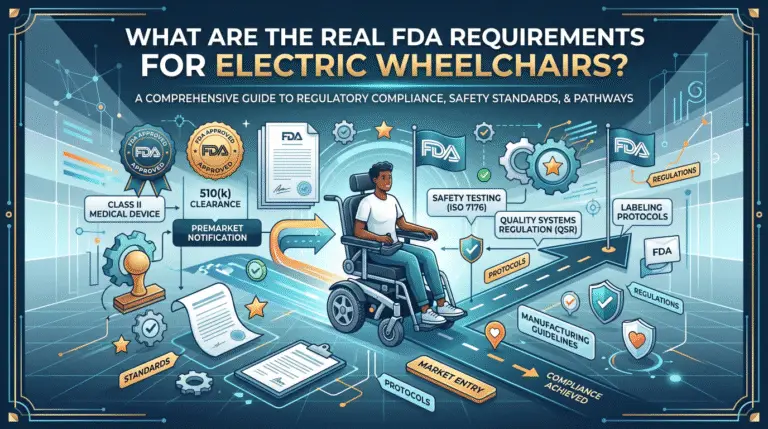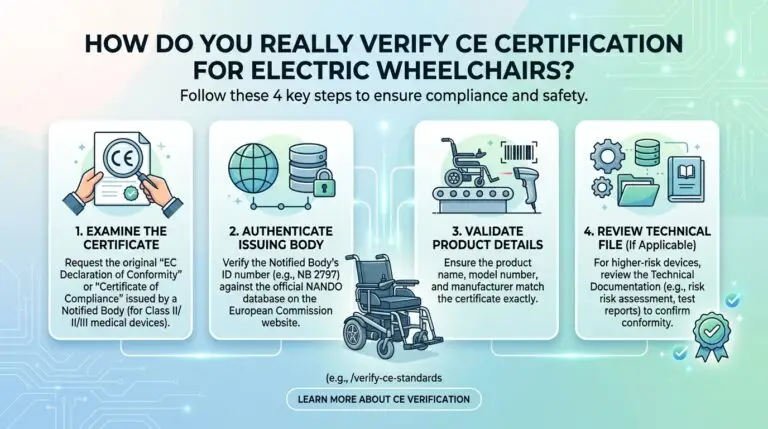


You just received FDA clearance for your premium electric wheelchair. Your team is celebrating. But three months later, a distributor tells you Medicare won't reimburse it. You assumed certification meant market access. Now you're stuck with inventory that no DME provider will order.
FDA and CE marks prove your product is safe, not that anyone will pay for it. Medicare reimbursement depends on HCPCS coding assignments, competitive bidding caps, and clinical documentation requirements that exist completely separate from regulatory approval. Without a viable payment pathway, certified products sit unsold.
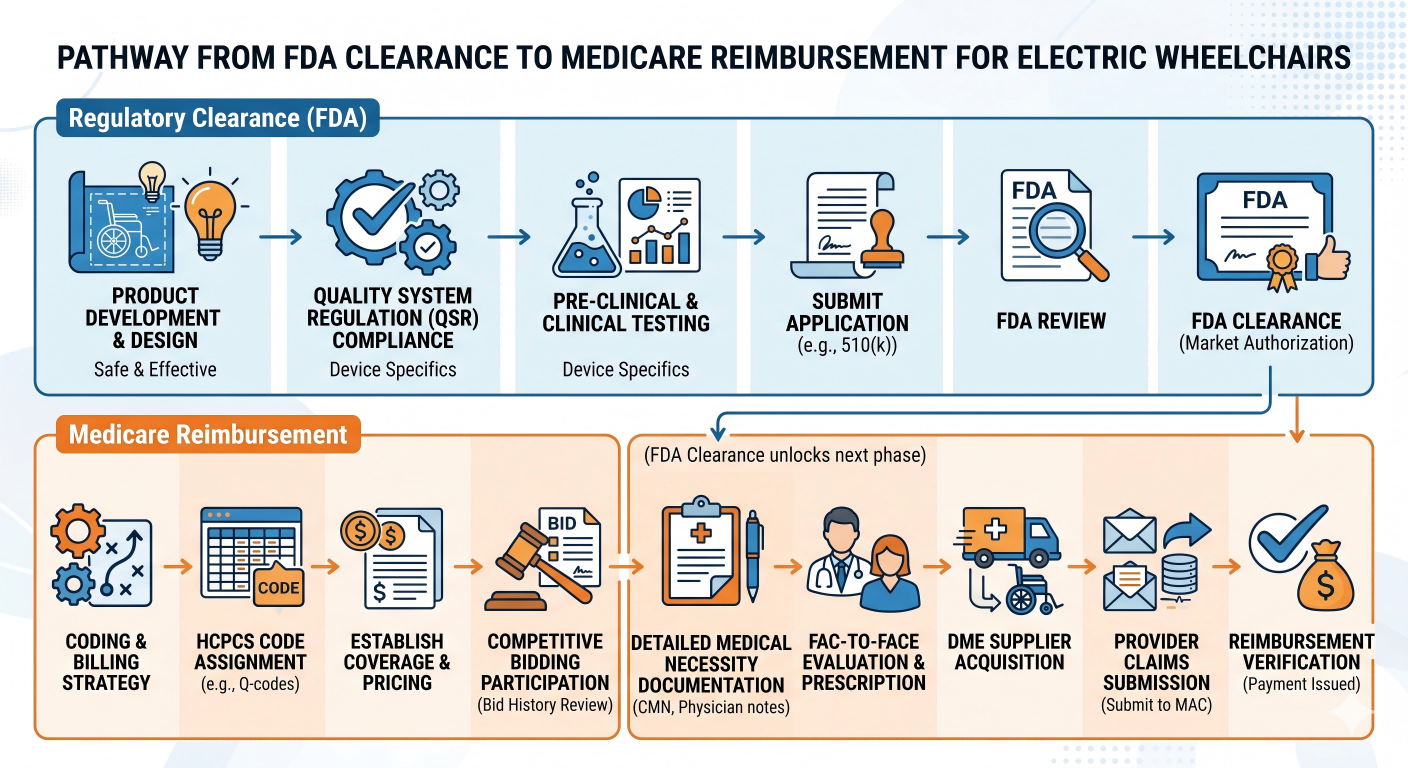
I've spent fifteen years manufacturing electric wheelchairs. The question I hear most from importers isn't about quality standards. It's about why their compliant, certified product can't get reimbursed. The answer reshapes everything about product selection and market strategy.
Why does FDA/CE approval not guarantee Medicare coverage?
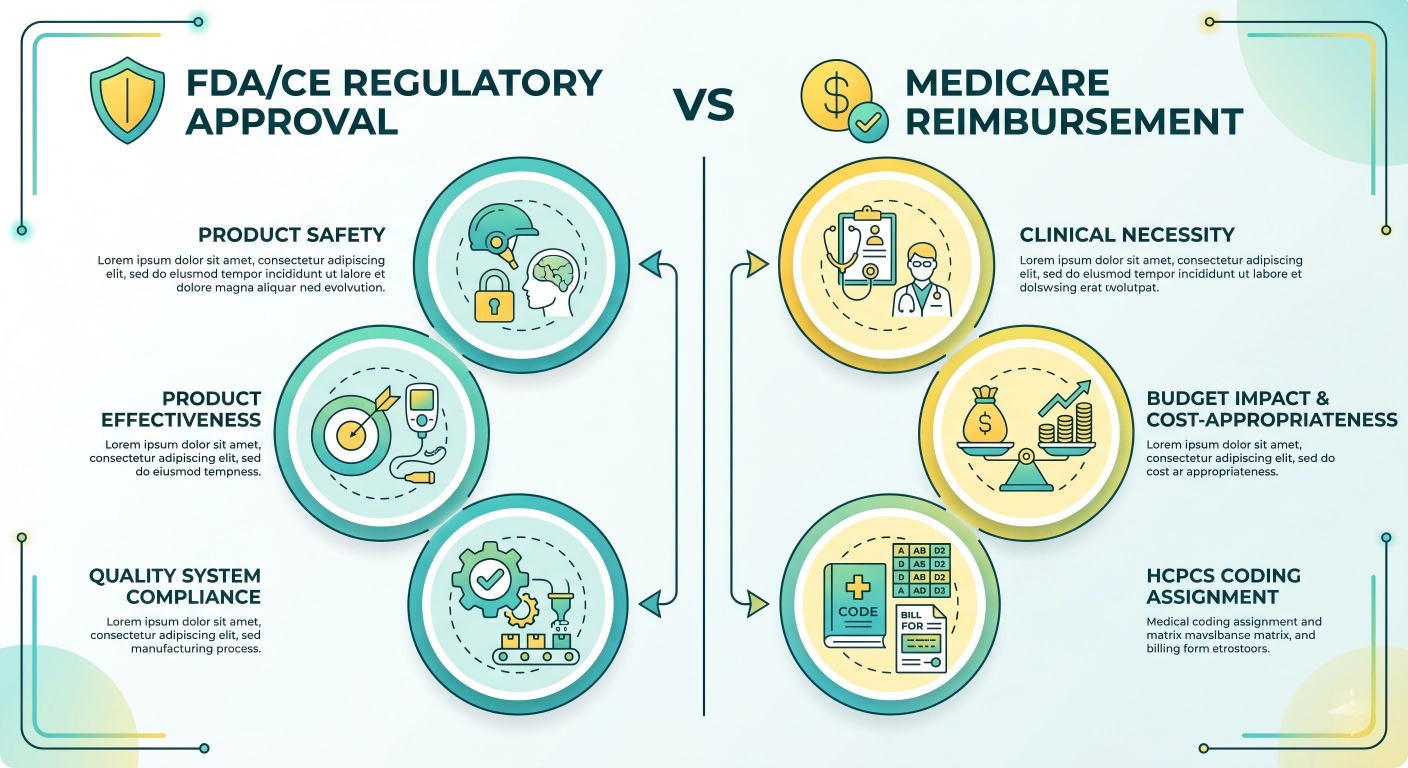
Regulatory agencies answer one question: Is this device safe and effective? Medicare answers a different question: Is this device medically necessary and cost-appropriate within our payment structure?
FDA clearance proves you meet safety standards. Medicare reimbursement requires that your product fits an existing payment category (HCPCS code), that providers can document medical necessity, and that your pricing aligns with fee schedules or competitive bidding results. These are separate systems with separate criteria.
An importer contacted us last month about a wheelchair with advanced seating. FDA cleared it as a Class II device. When his distributor tried billing Medicare, they discovered the product's features pushed it into a HCPCS category with lower reimbursement than standard power chairs. The advanced seating that justified the higher price wasn't separately payable. The product was legal to sell but commercially unviable for most DME providers.
This happens because regulators evaluate safety data. Medicare evaluates clinical necessity and budget impact. A product can pass every safety test and still not fit Medicare's payment framework. The certification gets you to market. The HCPCS code determines if anyone can afford to sell it.
The certification-reimbursement gap in practice
| Regulatory requirement | Reimbursement requirement | Commercial impact |
|---|---|---|
| Safety testing | HCPCS code assignment | Product may not have a billable code |
| Performance validation | Medical necessity documentation | Providers resist products requiring extra paperwork |
| Quality system compliance | Supplier standards (DMEPOS) | Additional credentialing for distributors |
| Labeling accuracy | Competitive bidding participation | Price caps regardless of features |
I see distributors invest heavily in certification before checking payment pathways. One customer spent two years on FDA submissions for a tilt-in-space wheelchair. When they approached DME providers, they learned the assigned HCPCS code reimbursed at rates below their cost structure. The product worked perfectly. The business case didn't.
Certification addresses product risk. Reimbursement addresses system cost. These goals don't always align. When importers ask why their approved wheelchair isn't covered, we walk them through HCPCS coding requirements and fee schedule constraints that no certification process addresses.
What determines if a rehab product receives its own HCPCS code?
Medicare uses HCPCS codes to categorize and price durable medical equipment. A product without an appropriate code cannot be billed. Getting a new code requires clinical evidence, stakeholder input, and years of review.
HCPCS coding depends on whether your product represents a distinct clinical category, has sufficient evidence of medical benefit, and differs meaningfully from existing coded items. New codes require formal applications reviewed annually, with decisions based on clinical necessity and budget impact.
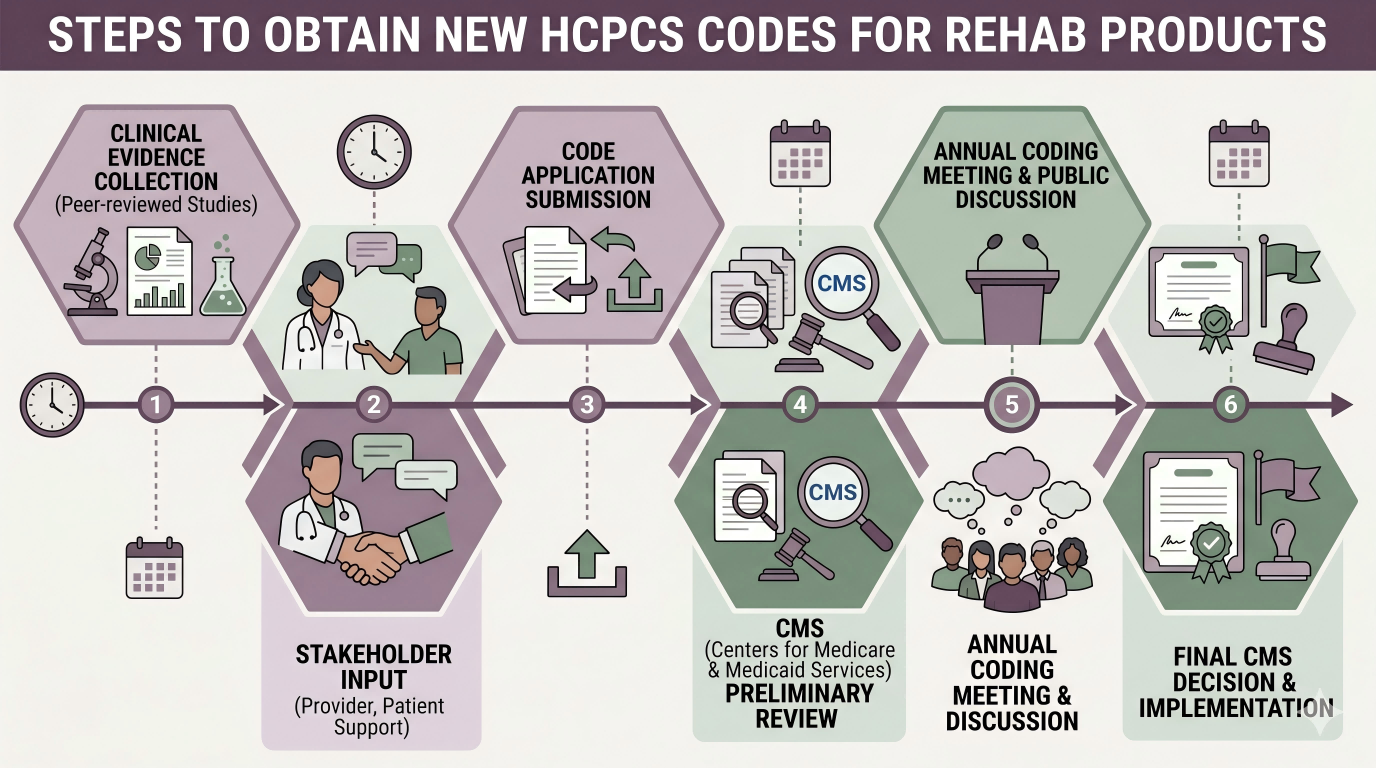
A distributor partner recently asked about a wheelchair with integrated vital sign monitoring. Clinically innovative. But no HCPCS code exists for "wheelchair with telemetry." They had two options: Bill under an existing power wheelchair code (and lose reimbursement for the monitoring feature) or apply for a new code (a multi-year process requiring clinical studies and stakeholder testimony).
They chose to bill under existing codes. The monitoring features became a non-reimbursed premium. Only customers paying out-of-pocket valued those features enough to justify the higher price. The Medicare-reimbursed market remained inaccessible.
Decision factors for HCPCS code assignment
Medicare evaluates new code requests based on specific criteria. These aren't published as a checklist, but patterns emerge from our customers' experiences and published HCPCS decisions.
| Evaluation factor | What it means for manufacturers | Common failure point |
|---|---|---|
| Clinical distinction | Product addresses a different medical need than existing codes | Feature differences aren't clinically meaningful |
| Evidence of benefit | Published studies show improved outcomes | Only manufacturer data available |
| Prevalence of need | Sufficient patient population to justify separate category | Condition too rare to merit distinct code |
| Cost impact | New code won't significantly increase Medicare spending | Product much more expensive than alternatives |
I've seen products with genuine clinical advantages fail to get separate codes because the patient population was small. Medicare won't create a new category for a condition affecting 5,000 beneficiaries annually. Those products default to broader codes with lower reimbursement, making the specialized features economically invisible.
One importer told us their standing wheelchair got denied a new code because reviewers considered it a "feature variation" of standard power chairs, not a distinct clinical category. Years of development reduced to a checkbox feature. The product sells in private-pay markets but struggles where reimbursement drives purchasing.
How does competitive bidding affect pricing strategy for certified products?
Medicare's competitive bidding program caps reimbursement at bid-winning amounts regardless of product features or certifications. Suppliers who don't win contracts often can't serve Medicare beneficiaries profitably.
Competitive bidding sets maximum reimbursement rates through supplier auctions in designated regions. Products priced above winning bid amounts become economically inaccessible to Medicare patients, even with perfect compliance and clinical superiority. Pricing strategy must start with bid history, not product value.
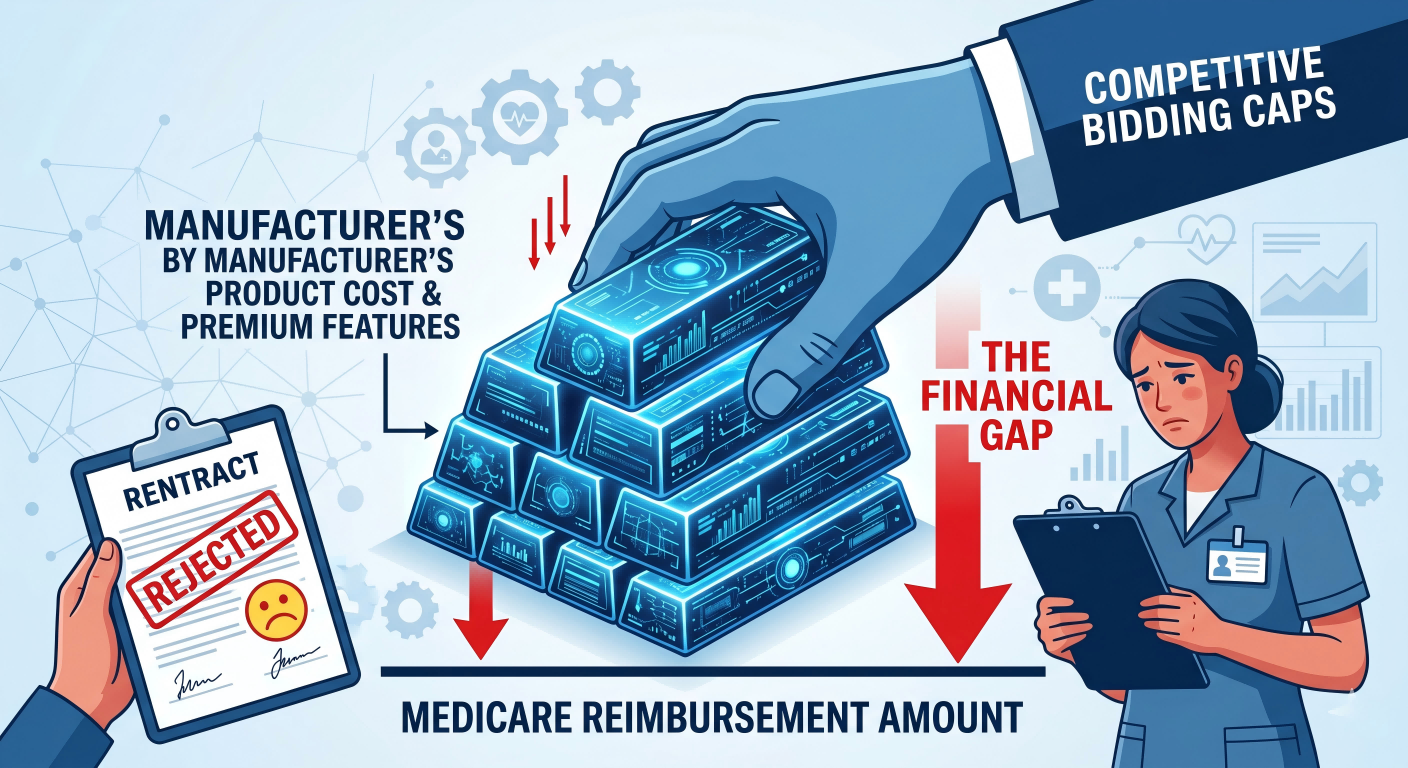
A distributor showed me their experience in the last bidding round. Their premium power chair retailed for $4,200. The winning bid in their region came in at $2,800. Medicare now reimburses at that lower amount. The distributor faced a choice: Accept $2,800 and lose money on every sale, or stop serving Medicare patients in that region.
They stopped serving those patients. A certified, high-quality product became unavailable to Medicare beneficiaries because the bidding structure compressed pricing below sustainable levels. The product didn't fail clinically. It failed economically.
Competitive bidding constraints by product category
Different DME categories face different bidding dynamics. Understanding these patterns helps importers predict market access before committing to inventory.
| Product category | Typical bid behavior | Impact on premium products |
|---|---|---|
| Standard power wheelchairs | Heavy downward price pressure | Premium features often not valued in bids |
| Complex rehab (Group 3) | More bid variation | Some room for feature differentiation |
| Power mobility (scooters) | Extremely compressed pricing | Nearly impossible to justify premium models |
| Seating systems | Moderate competition | Specialty items sometimes protected |
From our customer conversations, I've learned that importers often underestimate how much bidding affects their actual market. You might have contracts with ten distributors nationwide, but if eight of them operate in competitive bidding areas with low winning bids, your effective market shrinks dramatically.
One partner told us they designed a wheelchair specifically for the Medicare market. They studied the fee schedule, priced competitively, secured FDA clearance. Then the new bidding round results came out. Winning bids dropped 18% below their cost structure. The product they built for Medicare couldn't serve Medicare patients profitably. That's not a compliance problem. It's a market access problem that certification never addressed.
What clinical documentation barriers do high-value features create?
Advanced product features often require additional documentation to prove medical necessity. Providers avoid products that increase their administrative burden or audit risk, even when those products offer clinical benefits.
Reimbursement requires that physicians document specific clinical conditions justifying the prescribed equipment. Features beyond standard specifications demand additional evidence of medical necessity. Products requiring non-routine documentation face provider resistance regardless of clinical merit, because documentation failures trigger claim denials and audits.
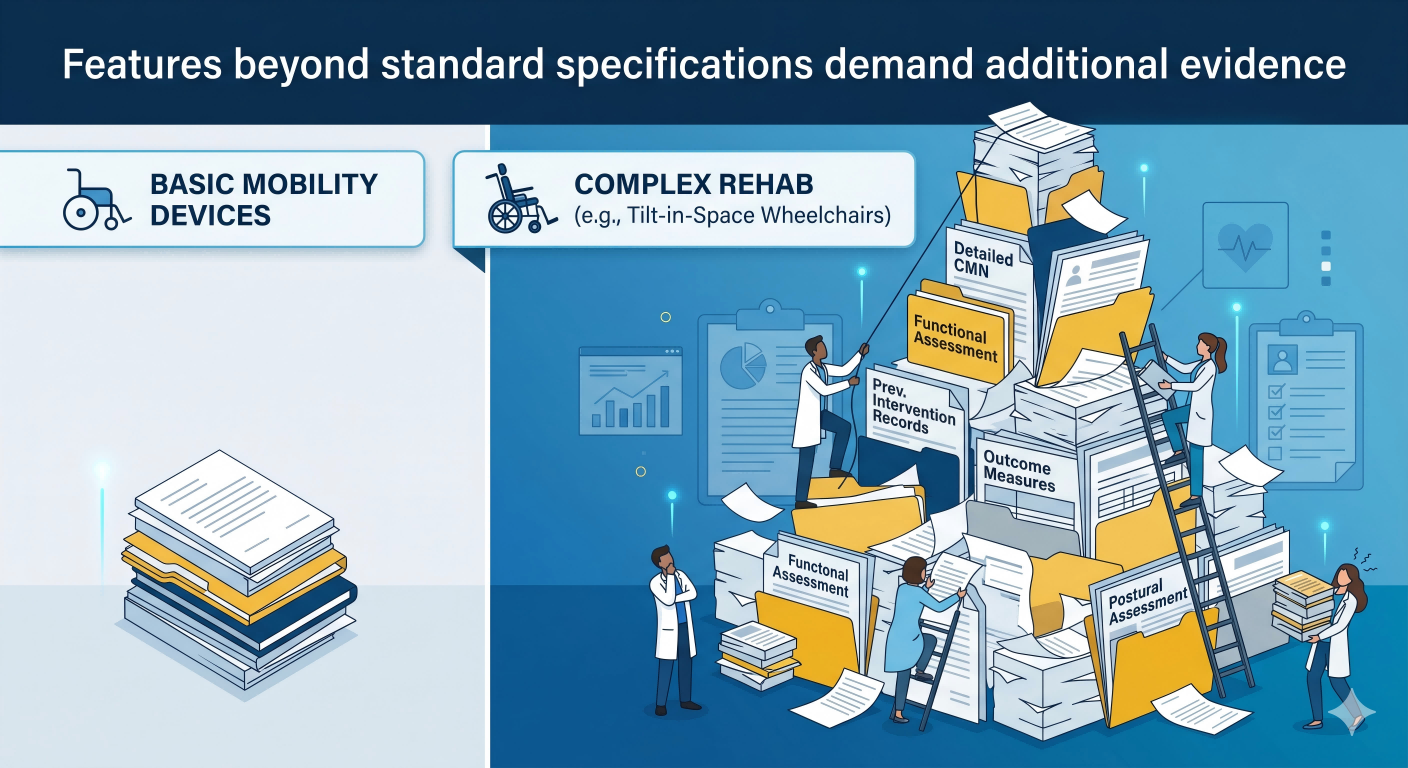
A distributor recently explained why they stopped carrying our tilt-in-space model. The wheelchair worked beautifully for patients with pressure ulcer risks. But Medicare required detailed documentation of positioning needs, previous interventions, and expected outcomes. Physicians pushed back on the paperwork. Even when they agreed the patient needed it, they'd prescribe a simpler chair to avoid the documentation burden.
The clinical case was strong. The administrative case was weak. The product sat in inventory while patients received less appropriate equipment because the documentation pathway created friction.
Documentation requirements by feature complexity
| Feature type | Standard documentation | Enhanced documentation required | Provider adoption barrier |
|---|---|---|---|
| Basic power mobility | Mobility limitation, need for powered device | None beyond standard | Low barrier |
| Specialized seating | Positioning needs, pressure concerns | Detailed postural assessment, failed alternatives | Moderate barrier |
| Advanced controls | Hand function limitations | Specific functional testing, control trial documentation | High barrier |
| Environmental control integration | Multiple equipment needs | Justification for integrated vs separate systems | Very high barrier |
I've heard from distributors that products requiring "Certificate of Medical Necessity" forms with detailed clinical notes get prescribed less often than products with simpler documentation. Not because they're less appropriate. Because providers prioritize administrative efficiency. A feature that adds three paragraphs to the CMN reduces prescribing volume.
One importer asked why sales of their wheelchair with advanced pressure mapping were disappointing despite great clinical reviews. Their distributor explained: The pressure mapping required documentation of specific wound staging, previous cushion trials, and ongoing monitoring plans. Most providers defaulted to standard seating options that required simpler justification. The better clinical solution lost to the administratively simpler option.
How do bundled payments affect reimbursement for integrated rehab technologies?
Medicare increasingly uses bundled payments that combine multiple items into single reimbursement amounts. Integrated technologies that span multiple traditional categories often get caught in payment classification problems.
Bundled payments reimburse a set amount for related services and equipment combined. When your product integrates functions traditionally billed separately (mobility plus respiratory support, for example), Medicare may not pay for both elements. The integration that creates clinical value can eliminate revenue streams.
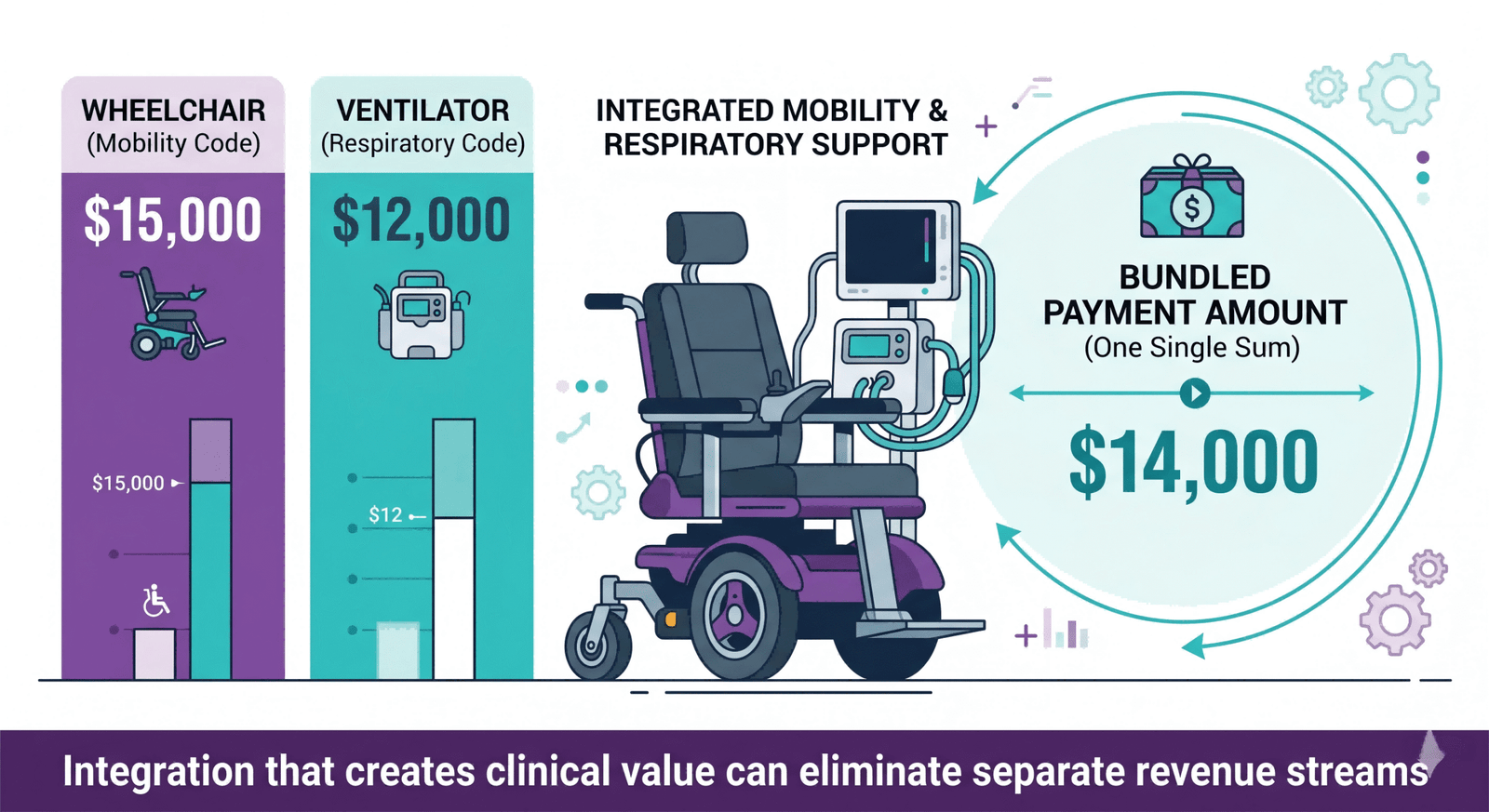
A distributor told me about a wheelchair with integrated respiratory support for ALS patients. Clinically, the integration made perfect sense. Financially, it created chaos. Medicare historically paid for the wheelchair and the respiratory equipment under separate codes. The integrated unit didn't fit either code cleanly. After months of billing challenges, they separated the components and billed them individually, eliminating the integration benefit that justified the product.
Integration challenges in current payment structures
The payment system evolved for discrete products. Integration often works against that structure.
| Integrated function | Traditional billing approach | Integration problem | Typical resolution |
|---|---|---|---|
| Mobility + positioning | Separate chair and seating codes | Combined unit may only qualify for base chair code | Bill base, lose seating payment |
| Mobility + respiratory | Separate wheelchair and ventilator codes | No code for integrated unit | Split components, lose integration |
| Mobility + communication | Separate DME and speech device codes | Uncertainty which code applies | Often requires separate devices |
| Mobility + environmental control | Separate wheelchair and control unit codes | Integrated system may not fit either code | Revert to separate systems |
I've seen manufacturers invest heavily in integration only to discover the payment system penalizes them for it. One customer developed a wheelchair with integrated communication for non-verbal users. The integration reduced costs and improved usability. But Medicare's codes separated mobility devices and communication devices into different categories with different documentation requirements. The integrated product created billing confusion. Providers returned to separate devices that fit cleanly into existing codes.
This isn't a compliance issue. The product met all regulatory requirements. It's a payment architecture issue. When your innovation crosses payment category boundaries, you're fighting the reimbursement structure itself. We route these questions to our customers' reimbursement specialists because the decision involves trade-offs between clinical design and commercial viability that go beyond manufacturing.
How should importers evaluate reimbursement viability before product selection?
Most importers assess regulatory compliance and product quality before purchase commitments. Adding reimbursement evaluation prevents costly market access failures after certification investment.
Reimbursement viability requires checking existing HCPCS codes for feature alignment, reviewing competitive bidding results in target regions, understanding documentation requirements for the product category, and assessing whether integrated features span multiple payment categories. This analysis should happen before, not after, regulatory submissions.
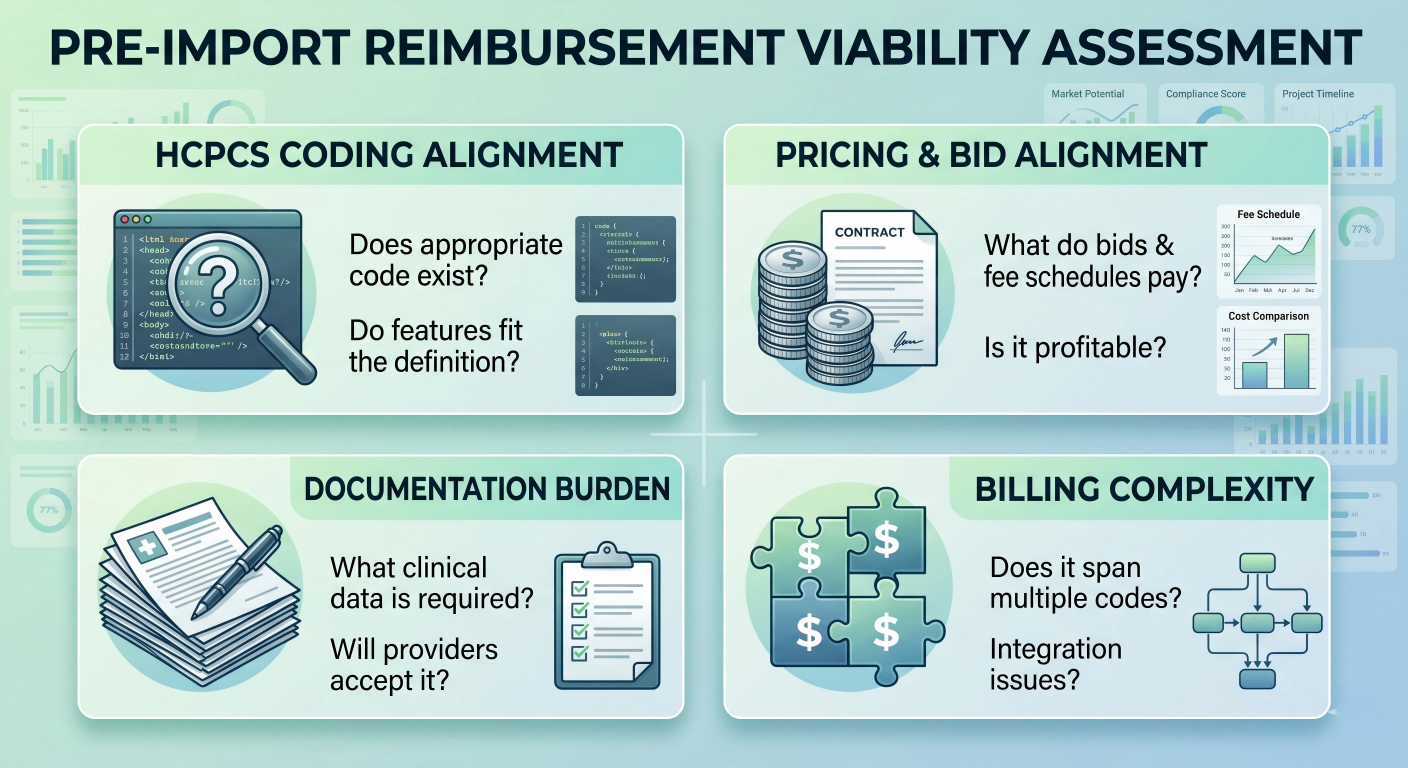
An importer recently shared their new process with me. Before finalizing product selection, they now map features to HCPCS codes, check the last three years of competitive bidding results, and interview three DME providers about documentation requirements. They've avoided two products that looked promising but had poor reimbursement pathways. They told me this analysis now happens before they contact manufacturers, not after they've committed to purchase agreements.
Reimbursement due diligence checklist
This represents what our most successful distributor partners have told us they now evaluate systematically.
| Evaluation area | Key questions | Information sources |
|---|---|---|
| HCPCS coding | Does an appropriate code exist? Do features fit that code's definition? | CMS HCPCS database, coding specialists |
| Pricing alignment | What do competitive bids and fee schedules pay? Can the product be profitable at those rates? | CMS bidding results, local fee schedules |
| Documentation burden | What clinical documentation does this product require? Will providers accept that burden? | DME supplier interviews, CMN templates |
| Billing complexity | Does the product span multiple codes? Are there integration issues? | Billing specialists, similar product precedents |
I've watched the conversation shift over the past five years. It used to start with "Is this product certified?" Now it starts with "What's the HCPCS code and what does it reimburse?" That change reflects hard-won experience. Distributors who skipped reimbursement evaluation learned expensive lessons.
One distributor told me they now won't consider products unless the manufacturer provides HCPCS code mapping and sample CMN documentation. They've been burned too often by products that were compliant but unbillable. They need to know the payment pathway before they invest in inventory.
What role do LCD policies play in market access for regional distributors?
Local Coverage Determinations let regional Medicare contractors set their own coverage rules beyond national policies. A product may be covered in one state and denied in another with identical clinical circumstances.
LCDs create regional variation in what Medicare covers and what documentation providers must submit. The same wheelchair may have straightforward reimbursement in one MAC jurisdiction and face additional requirements or denials in another. Regional distributors must navigate LCD differences that fragment the national market.
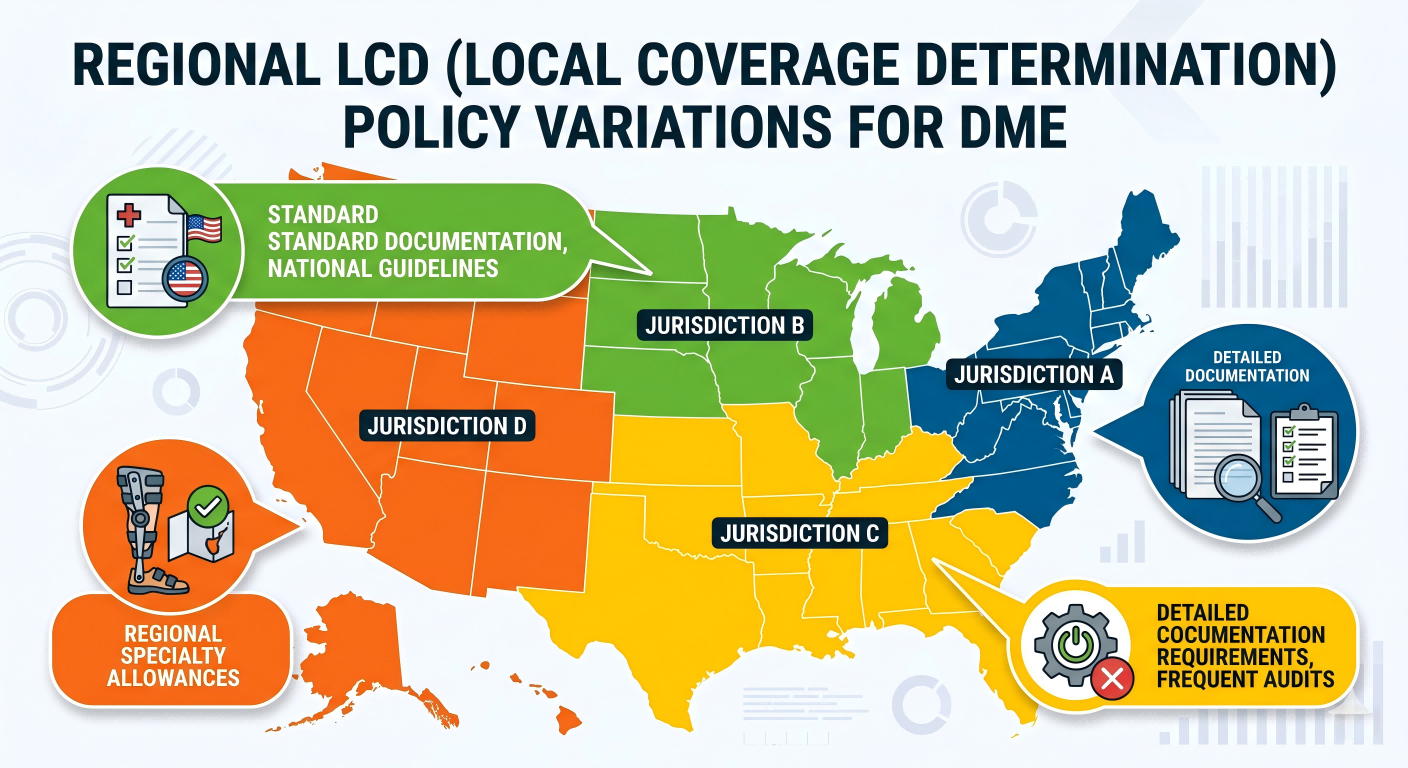
A distributor operating in three states described their LCD challenges to me. One of their MACs requires face-to-face evaluations and detailed functional assessments for all power wheelchairs. The adjacent MAC accepts standard physician orders. Same product, same clinical scenarios, completely different documentation requirements. They've had to train staff differently by region and sometimes tell customers certain products aren't available in their state despite being covered elsewhere.
LCD variation patterns by MAC jurisdiction
Different Medicare Administrative Contractors interpret coverage differently. These patterns come from what distributors have reported to us.
| MAC region | Common LCD approach | Impact on distributors |
|---|---|---|
| Jurisdiction A | Detailed documentation requirements, frequent audits | Higher administrative burden, some avoid complex products |
| Jurisdiction B | Standard documentation, follows national guidelines | Easier market access |
| Jurisdiction C | Restrictive coverage for advanced features | Limited market for premium products |
| Jurisdiction D | Regional specialty allowances | Some high-value products more viable |
I've heard distributors say they choose which products to carry based partly on which MAC jurisdictions they serve. Products requiring extensive documentation only make sense in regions where providers are equipped to handle those requirements and where the MAC doesn't frequently deny claims.
One partner told me they stopped carrying certain seating systems in two of their five operating regions because those regions' LCDs added documentation requirements that providers refused to complete. Not because the clinical case was weak. Because the regional interpretation made the administrative burden too high. The product was nationally certified and had an appropriate HCPCS code. Regional LCD policies still blocked market access.
Conclusion
FDA and CE marks open market doors. HCPCS codes, competitive bidding results, and documentation requirements determine who can walk through profitably. Evaluate payment pathways before committing to products, because certification guarantees compliance, not commercial viability.