
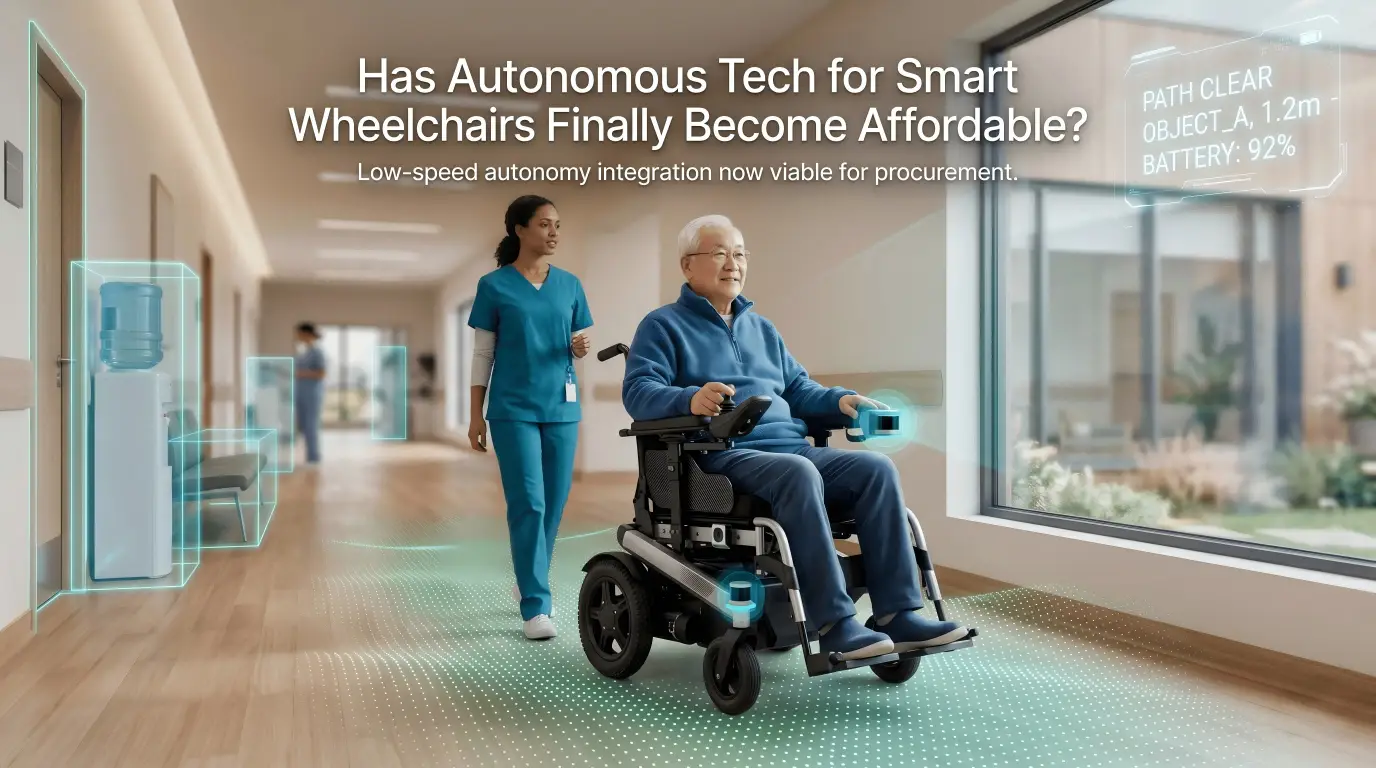
Has Autonomous Tech for Smart Wheelchairs Finally Become Affordable?
Are you watching the self-driving car industry and thinking that technology is years away from being useful for wheelchairs? This assumption makes you hesitate, worried about high costs and unproven tech.
Yes, the technology is affordable and ready. Key components for low-speed autonomous functions have dropped in price dramatically.1 Our own testing confirms that integrating LiDAR and depth cameras into wheelchairs is now a cost-effective manufacturing decision, making smart models a viable product for procurement today.
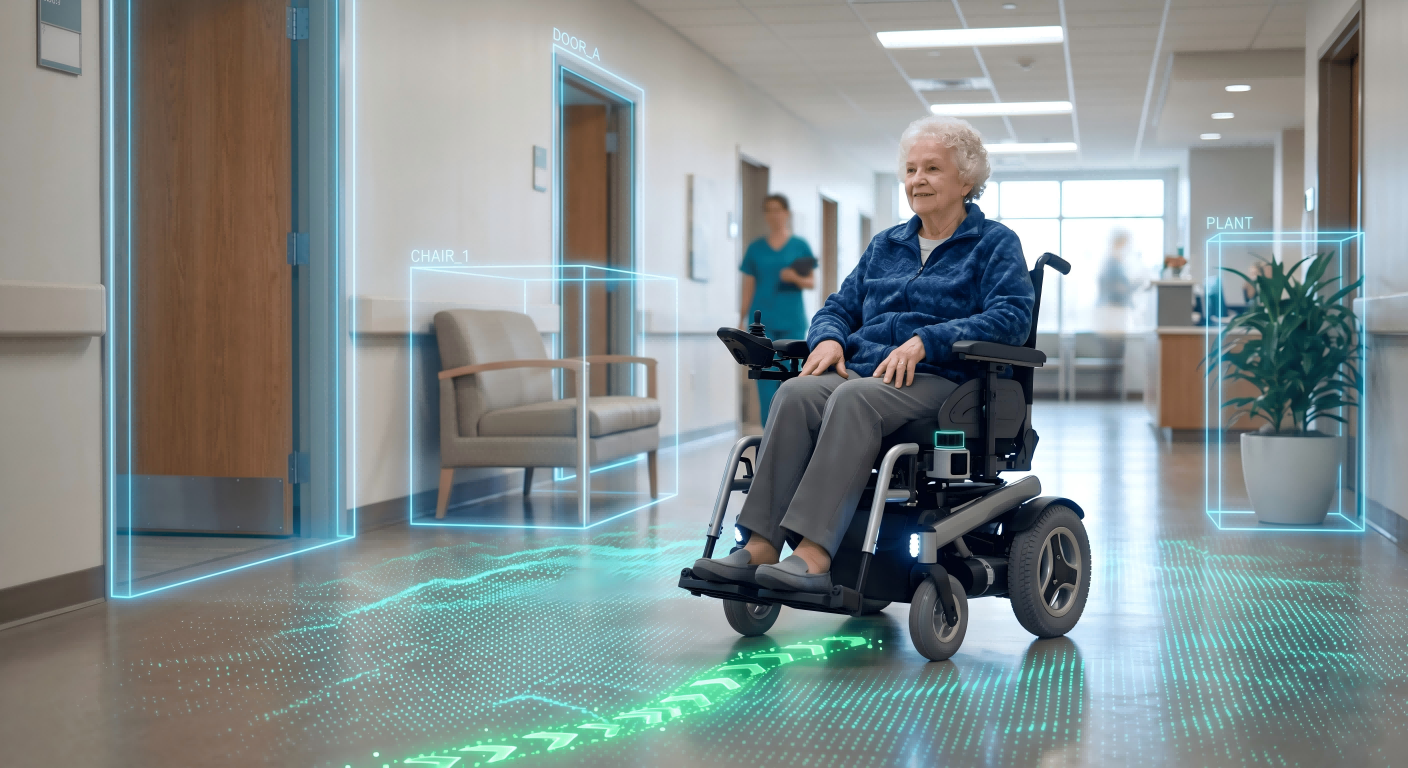
As a manufacturer, we talk to procurement managers and brand owners every day. We hear the same hesitation repeatedly. The phrase "autonomous technology" immediately brings to mind the multi-billion dollar research projects of automotive giants. You see headlines about regulatory hurdles and decade-long timelines, and you understandably apply that thinking to our industry. This is the core of the misunderstanding. We need to look at this technology through a different lens. Based on the components we've tested and integrated in our own R&D labs over the past 24 months, the story for low-speed mobility is not one of future speculation. It's a story of present-day opportunity.
Why Are Smart Wheelchairs Different from Self-Driving Cars?
You see the massive R&D costs for self-driving cars and assume wheelchairs face the same hurdles. This makes you hesitant to add smart wheelchairs to your product line.
Smart wheelchairs operate in low-speed, controlled indoor environments. They do not need the complex, expensive sensors or the highest level of autonomy that cars do. Their technology path, safety standards, and cost structure are completely separate and much more mature.
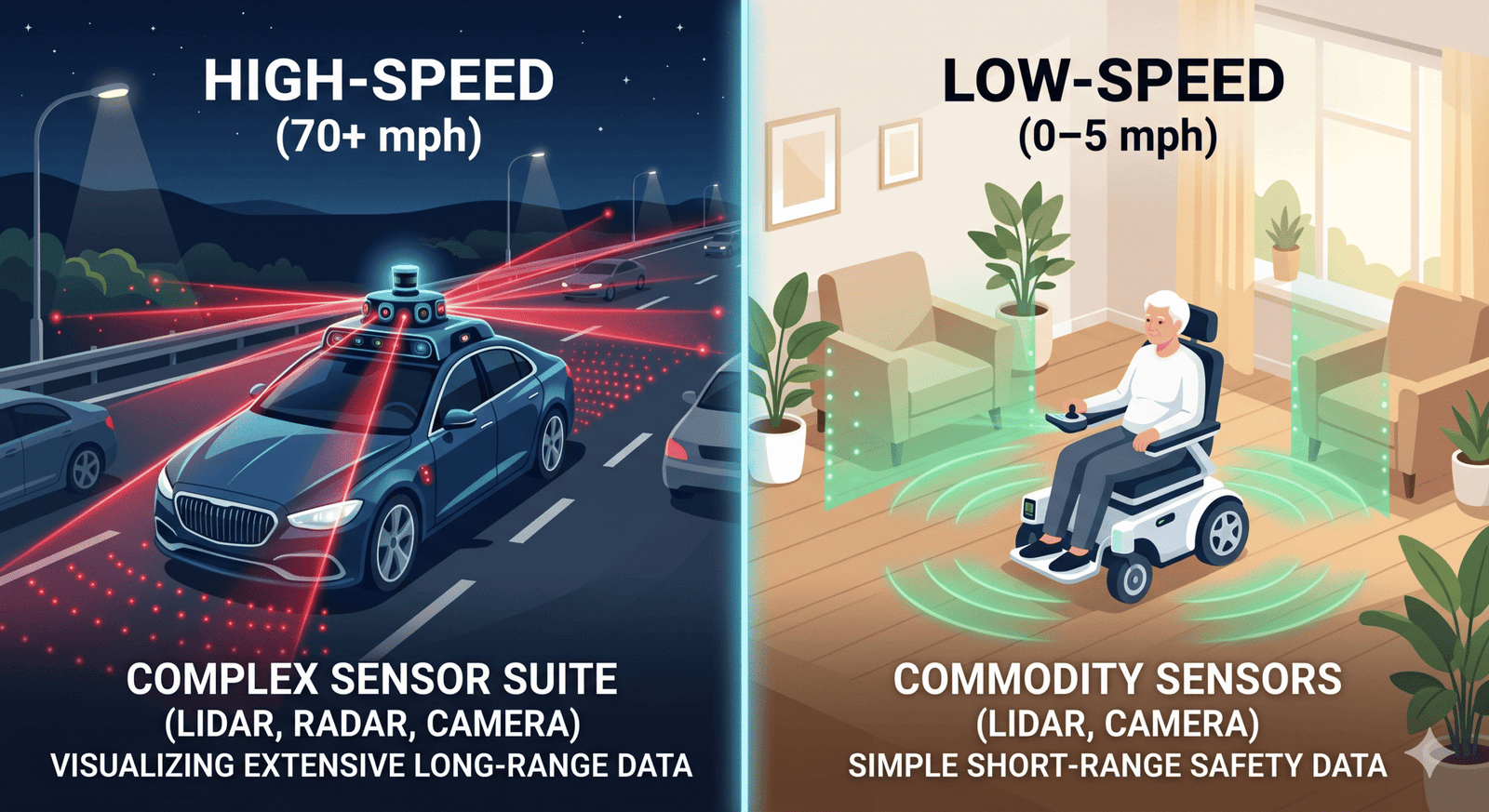
Let's break this down based on our direct experience. The problem is not the technology itself, but the environment it operates in. A self-driving car must navigate highways at 70 mph in rain, snow, and fog.2 It has to identify pedestrians, cyclists, and other vehicles from hundreds of meters away and predict their actions. This requires an incredibly complex and expensive suite of sensors and processing power.
A smart wheelchair, on the other hand, operates in a much simpler world. It moves at walking speed in relatively controlled indoor or pedestrian environments like homes, hospitals, and shopping centers. The challenges are different, and so are the solutions. We don't need to solve for every possible "edge case" on an open road. We need to solve for navigating a hallway, avoiding a piece of furniture, or docking at a table. These are engineering problems that have already been solved.3
Here is a simple breakdown based on our evaluation:
| Feature | Self-Driving Car (L4/L5) | Smart Wheelchair (L2/L3) |
|---|---|---|
| Operating Speed | High (0-100+ mph) | Low (0-5 mph) |
| Environment | Complex, Unpredictable (Open Roads) | Simple, Controlled (Indoors) |
| Primary Sensors | Long-Range LiDAR, Radar, High-Res Cameras | Short-Range LiDAR, Depth Cameras, Ultrasonic |
| Cost of Sensors | Very High ($10,000+) | Low (Now commodity pricing) |
| Autonomy Goal | Full self-driving, no driver needed | User assistance, simple navigation |
This distinction is everything. Confusing these two applications is like comparing the engine of a Formula 1 car to the motor in an electric scooter. Both are motors, but their purpose, complexity, and cost are worlds apart.
Are the Components for Smart Wheelchairs Actually Affordable Now?
You hear that component costs are falling, but you remain skeptical. You need concrete proof from the factory floor, not just market trend reports, before you commit your product budget.
Yes, the components are affordable for mass production. Our 2023-2024 prototyping cycles proved it. We have successfully tested and integrated sensor and processing modules that make the final product cost-effective for brands and distributors to carry profitably.
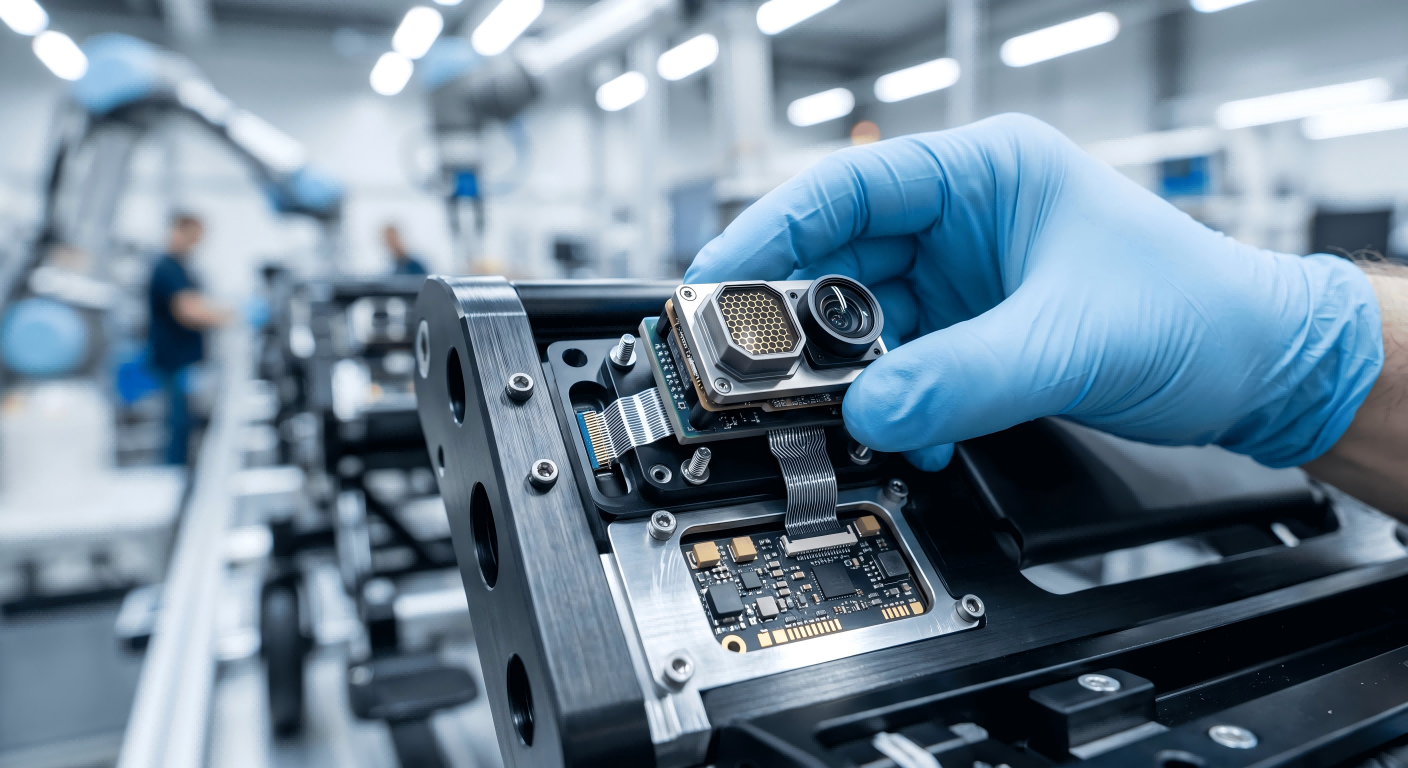
For years, the idea of a smart wheelchair was a great concept limited by a harsh reality: the components were too expensive. That has changed. We are not talking about hypothetical future price drops. We are talking about the prices we are getting from suppliers today. In our labs, we have moved beyond theory and have been actively integrating these parts into our wheelchair chassis.
The key breakthrough is that the sensors required for L2/L3 autonomy in low-speed environments are now commodity items4. These are not the expensive, experimental parts used in high-end automotive research. They are reliable, mass-produced components.
Here are the specific categories of parts we've tested and validated for production readiness:
| Component Category | Function | Our R&D Findings |
|---|---|---|
| Short-Range LiDAR | Creates a 2D map for navigation (SLAM) and basic object detection. | The single-line LiDAR modules we evaluated from three different suppliers are small, solid-state, and now cost-effective enough for mass integration.5 They provide excellent reliability for mapping a room or hallway. |
| 3D Depth Cameras | Provides 3D vision for close-range obstacle avoidance, like detecting table legs, drop-offs (curbs), and people. | We have built prototypes using cameras similar to the Intel RealSense line6 and its alternatives. Their ability to perceive depth in real-time is crucial for safe navigation in cluttered spaces like a busy home or a hospital corridor. |
| Processing Units | Runs the navigation and obstacle avoidance software. | This doesn't require a liquid-cooled supercomputer. We have successfully run our entire assistance and navigation stack on robust ARM-based single-board computers.7 These are low-power, inexpensive, and more than capable of handling the task. |
When your procurement team evaluates a bill of materials for a smart wheelchair today, it will look radically different than it did even two years ago. The key enabling hardware has moved from the "R&D" budget line to the "standard components" list.
Is This a Risky R&D Project or a Ready-to-Sell Product?
You are a businessperson, not a venture capitalist. The idea of "investing" in an unproven technology feels too risky for your distribution model. You need certainty and a clear path to market.
This is a procurement decision, not a research project. The core engineering for Level 2 and Level 3 indoor autonomy is a solved problem.8 You are not being asked to fund fundamental research; you are being offered a new, feature-rich product line with a clear value proposition.

The hesitation we see from buyers often stems from a confusion between "investment" and "procurement." This is not a bet on a future technology. This is about deciding whether to add a market-ready, higher-tier product to your existing catalog. The technical risk that worried you five years ago has been largely engineered away. The work being done now is not in inventing the technology, but in integrating it seamlessly into the wheelchair platform—work that we, the manufacturers, have already done.
Let's clarify what these "autonomy levels" mean in a practical sense for a wheelchair user:
-
Level 2 (L2) - Assisted Driving9: Think of this as an advanced safety system. The user is still in full control, driving the chair with the joystick. However, the system acts as a "co-pilot." It will automatically slow down or stop to prevent a collision with a wall, a doorframe, or a person. In our tests in simulated care-home environments, this feature alone dramatically reduced the kind of minor impacts10 that cause property damage and user frustration. It's like adding anti-lock brakes and stability control to a car.
-
Level 3 (L3) - Conditional Automation11: This is the "go-to-point" function. In a mapped environment like a house or a single floor of a facility, the user can select a destination from a simple interface (e.g., "Kitchen"). The wheelchair will then navigate there by itself while monitoring for obstacles. The user must be ready to take over, but the chair does the driving. We have validated this in our own multi-room facility, confirming its reliability for point-to-point travel.
This is not science fiction. This is practical, assistive technology that solves real-world problems for users. For your business, it represents a clear opportunity for differentiation. You can offer a product that provides tangible safety and convenience benefits, justifying a premium price point and opening up new market segments, such as high-tech rehabilitation centers and smart-enabled homes12.
Conclusion
The technology for smart wheelchairs is no longer a future promise. The components are affordable, the engineering is mature, and the business case is clear. This is a procurement decision for today.
"Autonomous vehicles are expected to reduce fuel consumption by ...", https://www.itskrs.its.dot.gov/2017-b01205. Industry analyses have documented significant price reductions in LiDAR and depth-sensing components between 2020 and 2024, driven by increased production volumes and technological maturation in the broader autonomous systems market. ↩
"[PDF] Levels of Automation - NHTSA", https://www.nhtsa.gov/document/levels-automation. The SAE International taxonomy defines Level 4 and Level 5 autonomous vehicles as systems capable of operating in diverse conditions including varied weather and high-speed scenarios, which presents substantially greater technical complexity than controlled indoor environments. ↩
"Comparison of Various SLAM Systems for Mobile Robot in an Indoor ...", https://arxiv.org/html/2501.09490v1. Academic research in mobile robotics has established that simultaneous localization and mapping (SLAM) and obstacle avoidance in structured indoor environments represent well-understood problems with multiple validated solution approaches, though implementation quality varies by application. ↩
"Time-of-flight camera - Wikipedia", https://en.wikipedia.org/wiki/Time-of-flight_camera. Market analyses indicate that solid-state LiDAR and structured-light depth cameras have transitioned from specialized components to more widely available products as production volumes increased for consumer electronics, robotics, and automotive applications. ↩
"Solid-state LiDAR Market worth $3.20 billion by 2030", https://www.marketsandmarkets.com/PressReleases/solid-state-lidar.asp. Industry reports document that single-line (2D) solid-state LiDAR sensors have experienced significant cost reductions as manufacturing processes matured, making them accessible for integration into consumer and commercial robotics applications. ↩
"Structured Light Project - UC Santa Cruz", https://users.soe.ucsc.edu/~elkaim/elkaim/Structured_light.html. Structured-light depth cameras, exemplified by products like Intel's RealSense series, use infrared projection and stereo vision to generate real-time depth maps at ranges typically effective from 0.3 to 10 meters, suitable for indoor obstacle detection and navigation tasks. ↩
"NanoSLAM: Enabling Fully Onboard SLAM for Tiny Robots - arXiv", https://arxiv.org/html/2309.12008v2. Research in embedded robotics has demonstrated that modern ARM-based processors with sufficient memory can execute real-time SLAM and obstacle avoidance algorithms for low-speed mobile platforms, particularly when optimized for specific sensor configurations and indoor environments. ↩
"Indoor Localization for Autonomous Robot Navigation - arXiv", https://arxiv.org/html/2502.20731v1. While the SAE autonomy level framework was developed primarily for automotive applications, robotics researchers have adapted similar concepts to indoor mobile platforms, noting that assisted operation (analogous to L2) and conditional automation in mapped environments (analogous to L3) represent achievable technical goals with current sensor and computing technology. ↩
"[PDF] SAE International: Levels of Autonomous Driving & Sensor Packages", https://orise.orau.gov/internships-fellowships/documents/scholarships/autonomous-driving/sae-international-levels-of-autonomous-driving-and-sensor-packages.pdf. According to SAE International's J3016 standard, Level 2 automation involves sustained lateral and longitudinal vehicle motion control by the system while the human driver monitors the environment and remains responsible for safe operation, though this taxonomy was designed for road vehicles rather than assistive mobility devices. ↩
"Power Mobility with Collision Avoidance for Older Adults - PMC - NIH", https://pmc.ncbi.nlm.nih.gov/articles/PMC5484630/. Research in assistive technology has explored collision avoidance systems for powered wheelchairs, with studies suggesting that sensor-based obstacle detection can reduce contact events in controlled environments, though real-world effectiveness depends on system design, user acceptance, and environmental factors. ↩
"Predicting Driver Takeover Performance in Conditional Automation ...", http://rosap.ntl.bts.gov/view/dot/73069. SAE Level 3 (conditional automation) is defined as a system that performs all driving tasks within its operational design domain while the human driver must be available to intervene when requested, though this classification system was developed for automotive contexts and may not directly map to assistive mobility device regulations. ↩
"Mainstream Smart Home Technology–Based Intervention to ... - PMC", https://pmc.ncbi.nlm.nih.gov/articles/PMC12062758/. Market analyses of assistive technology indicate growing interest in sensor-equipped mobility devices from rehabilitation facilities and smart home integrators, driven by aging populations and advances in ambient assisted living concepts, though adoption rates depend on cost, reimbursement policies, and demonstrated clinical benefits. ↩