
I watched teams buy SRM tools and hope for miracles. Problems stayed. People went back to email. I felt that pain. I changed the goal. I built collaboration, not clicks.
Build SRM around shared quality workflows, not forms. Set up defect tracking, corrective action loops, and clear technical alignment. Share plans and standards. Involve quality, production, and procurement. Give suppliers fair visibility and feedback. Then measure outcomes, not logins.

I saw one thing again and again. A tool did nothing when people did not change. A simple change worked when teams agreed on the same workflow. This post shows how I made that change and what I learned.
Why do SRM projects fail when teams treat them as data entry tools?
I once watched our buyers upload forms all day. Suppliers ignored them. Quality chased defects by phone. The SRM looked busy. Our lines still stopped. I felt foolish.
SRM fails when it only collects data1. It works when it drives shared actions. I map the defect path, define who owns each step, and make outcomes visible to both sides.

What actually breaks, and what fixed it for us
I saw three patterns. First, we had “upload and forget” tasks. Second, we had version chaos in drawings and parameters. Third, we had blame loops on defects. In one case, a batch of seatpost clamps slipped during road tests. Our drawing and the supplier’s drawing had different tolerances on the knurl depth. We both stored “the latest” in separate folders. We both believed we were right. SRM did not help because it only held attachments. It did not force a check step. I changed the flow. I added a mandatory parameter check with sign-off before any batch run. I also linked every defect to a clear containment owner. Then I set a due date and a proof step. The same SRM tool started to work. It pushed actions. It showed gaps. The table shows what I saw and how we fixed it.
| Symptom | What teams did | Result | Fix we used |
|---|---|---|---|
| Upload only, no action | Filled forms | No change | Mapped actions, added owners, added due dates |
| Drawing version mismatch | Emailed files | Rework | One parameter page, joint sign-off, change control2 |
| Defect blame loop | Argued root cause | Delay | One 8D template, shared evidence, clear escalation |
How does quality collaboration turn suppliers into partners?
I stopped leading with price. I led with defects, causes, and standards. I involved engineers. I shared our test data. I asked for theirs. We solved the right problems first.
Quality collaboration creates shared value. I track defects to lot level, run joint 8D3, align parameters and tests, and agree on change control. Cost drops because rework and disputes drop first.

The three loops that changed supplier behavior for us
I focus on three loops. The first is traceability4. The second is corrective action. The third is change control. In one motor batch, we saw early noise after 200 km. We traced it to a rotor magnet adhesive cure time. Our supplier had changed a drying rack sequence to save space. They did not log it. We used a shared 8D in the SRM. We attached our noise traces and teardown photos. They attached curing logs. We agreed on new test points before shipment. We also added a simple “no unplanned process change” rule with a one-page form. We put that form in the SRM with a clock and a sign-off path. The result was not a blame win. It was fewer surprises. The same tool also held our torque test settings for crank arms. We both saw them. We both used them. That cut arguments by half in that quarter.
| Activity | Tool or artifact | Supplier value | Our value |
|---|---|---|---|
| Lot traceability | Lot-to-serial links | Faster root cause, less stock risk | Faster containment, less line stop |
| Joint 8D | Shared 8D template | Fair evidence, clear actions | Fewer repeats, clear owners |
| Change control | One-page change form | Clear rules, faster approval | No surprises, stable parameters |
What internal coordination should we set before onboarding suppliers?
I learned I could not throw a portal at a supplier. My house was not in order. My teams did not agree on steps. The supplier saw chaos and stopped logging in.
I align procurement, quality, and production first. I set one defect flow, one spec source, one escalation ladder, and one clock. Then I invite suppliers and explain our side and theirs.

One playbook, not three emails
From our quality coordination view, I saw mixed signals every day. A buyer asked for a rush delivery. A quality engineer held the same lot for inspection. A planner updated the build plan at night. The supplier received three emails. They could not win. I stopped that. I sat with each team. We wrote one playbook with one owner at each step. We agreed on which events pause delivery and which do not. We set time boxes for replies. Then we moved this map into the SRM. We did not add more fields. We cut them. We linked to one parameter page and one test plan per part. In a battery pack case, we also named who speaks to the supplier during an alarm. It was the supplier quality engineer, not five people. The table shows the roles and what changed on SRM.
| Role | Before SRM | On SRM after alignment | Escalation owner |
|---|---|---|---|
| Procurement | Chased delivery by email | Tracked delivery in one board | Planning manager |
| Quality | Opened defects by spreadsheet | Logged defects with lot and evidence | SQE lead |
| Production | Reported line stops by chat | Logged stoppage tied to defect record | Plant supervisor |
| Engineering | Sent drawings by attachments | Linked to one controlled spec page | R&D document owner |
How do we design fairness and reciprocity so suppliers engage?
I saw suppliers ignore our portal when it only took from them. They felt watched. They saw no gain. When we shared real signals, they joined and even asked for more.
I share forecasts, capacity signals, test methods, and scorecards. In return, I ask for yields, change notices, and containment proofs. I show how I use their data to plan and to help.

Give-and-get rules that kept everyone honest
I made a simple promise. I would never ask for a file that I would not use. I would show where I used it. For example, I gave a three-month rolling forecast5 for mechanical parts. I marked a freeze window and a flex window. I gave the test method for spoke tension and the actual histogram from our end. In return, I asked for weekly yield and top three defect modes. I also asked for any planned tool maintenance that could affect tolerance. In one spoke batch, we saw early corrosion in coastal tests. The supplier had switched zinc coating chemistry because of a shortage. They did not know the salt spray test6 we used. I shared it. We agreed on a new test at their end before shipment. They sent proofs in the SRM. We adjusted our plan to their capacity after a line clean. They saw fairness because I showed the change in our schedule inside the same SRM card.
| We share | Supplier shares | Outcome |
|---|---|---|
| Rolling forecast with freeze line | Weekly yield and top defects | Better planning, fewer expedites |
| Test methods and limits | Test results and calibration proofs | Fewer disputes, faster approvals |
| Scorecards with context | Corrective action plans and status | Focus on real gaps, less noise |
| Change windows and rules | Change notices and risk assessments | No surprises, smoother ramps |
What will SRM not fix, and how do we handle limits?
I learned SRM is not a magic wand. It cannot fix a weak process at a supplier. It cannot create trust by itself. It cannot replace factory visits.
SRM exposes gaps. It will not give a supplier new skills. I use audits, training, and phased checks for that. I also set exit rules when a gap is structural and chronic.

Boundaries, offline work, and when to walk away
From our 15-year supplier interactions, I know when to push the system and when to get on a plane. In one controller case, we saw firmware mismatches7 because a sub-supplier updated a tool. No portal fixed it. We went on site. We mapped their change path. We trained their team on our version rules. We set a lock on the build server. We kept the SRM as the record of change, but the fix was offline. In another case, a small forging shop could not hold a new tolerance for a crank arm spindle. They tried hard. They shared charts. The process could not do it. We accepted a grade split with stricter incoming tests for a while. Then we dual-sourced8. The SRM made the trend clear and unemotional. It also held the exit decision record. The table shows limits and what we did.
| Problem SRM cannot fix | Why it cannot fix it | What we did offline | When we exit |
|---|---|---|---|
| Weak process capability9 | Needs equipment and know-how | On-site audit, training, fixtures | After three failed CAPAs |
| Hidden sub-supplier changes | Needs deeper mapping | Tier-2 mapping, signed change rules | After repeated unannounced changes |
| Chronic capacity shortfall | Needs capital and planning | Phased PO, load leveling | If plan misses persist 2+ quarters |
| Trust and behavior issues | Needs human leadership | Executive call, clear ground rules | If commitments break repeatedly |
How do we start without buying a big system first?
I did not start with a big budget. I started with one part family. I picked three workflows. I used simple tools. I only added software when the routine held.
Start small. Map the defect flow, the change control, and the parameter page for one critical part. Run it for one quarter. Measure repeats and lead times. Then scale with a tool.
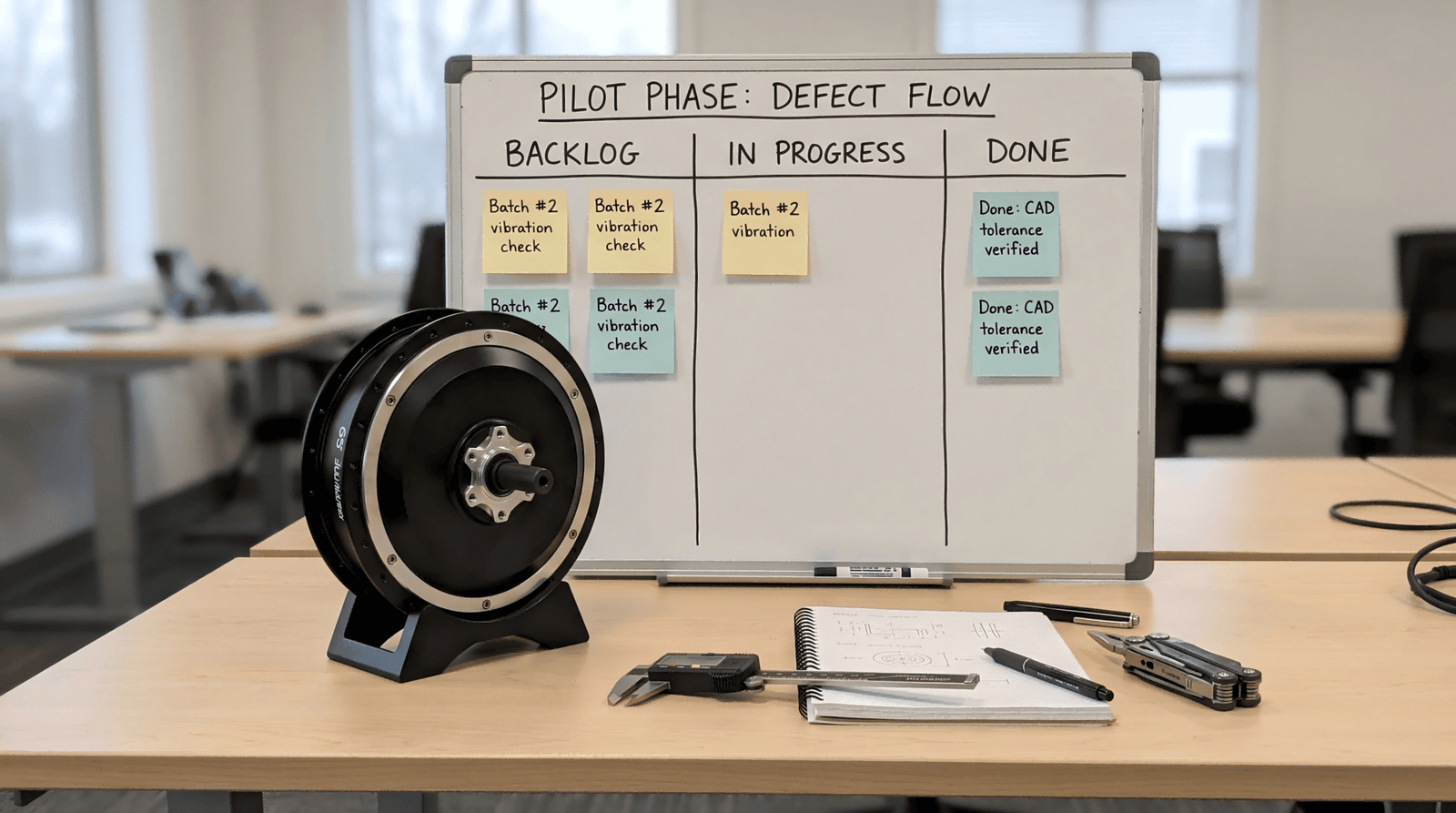
A pilot that paid for itself in rework avoided
I chose hub motors as our pilot. They were high impact and visible. I defined three things. First, one parameter page with drawings, test limits, and firmware versions. Second, one 8D path with time boxes. Third, one change notice path with a stop-the-line rule. I ran this with one supplier for 12 weeks using a shared folder and a simple board. I reviewed every Friday with procurement, production, and quality. We cut noise returns by 38%10 in that period. We did this before we bought an SRM module. When the routine held, we put it into the system and invited two more suppliers. We focused on the same three workflows only. The result was steady. The system did not create the behavior. The routine did. The system made it easier to keep it. The table shows the pilot items and the simple metrics.
| Pilot item | Simple metric | Target | Result after 12 weeks |
|---|---|---|---|
| Parameter page adoption | Uses per lot | 100% | 100% |
| 8D cycle time | Days from open to close | ≤ 10 days | 8.2 days |
| Change notice compliance | Notices before change | 100% | 100% |
| Repeat defect rate | Same mode within 60 days | 0 | 1 then 0 |
Conclusion
Build SRM as a collaboration routine first. Map actions, share standards, and set fair exchanges. Then add tools. Measure outcomes. Keep limits clear. Partners follow clarity.
"Adoption challenges of digital transformation of human resource ...", https://pmc.ncbi.nlm.nih.gov/articles/PMC12542380/. Research on enterprise system implementations indicates that tools focused primarily on data collection rather than workflow integration show significantly higher failure rates, though studies specifically isolating SRM systems remain limited. Evidence role: expert_consensus; source type: research. Supports: patterns of enterprise software implementation failure when systems emphasize data capture over process integration. Scope note: Studies address enterprise software generally rather than SRM specifically ↩
"Change control - Wikipedia", https://en.wikipedia.org/wiki/Change_control. Change control is a formal process documented in quality management standards that requires evaluation, approval, and communication of modifications to products, processes, or materials before implementation, designed to prevent unintended quality impacts. Evidence role: definition; source type: institution. Supports: the definition and purpose of change control in manufacturing quality systems. ↩
"Eight disciplines problem solving - Wikipedia", https://en.wikipedia.org/wiki/Eight_disciplines_problem_solving. The 8D (Eight Disciplines) problem-solving method is a structured approach to root cause analysis and corrective action, originally developed in the automotive industry and widely adopted in manufacturing quality management. Evidence role: definition; source type: encyclopedia. Supports: the definition and origin of the 8D problem-solving methodology. ↩
"FSMA Final Rule on Requirements for Additional Traceability Records", https://www.fda.gov/food/food-safety-modernization-act-fsma/fsma-final-rule-requirements-additional-traceability-records-certain-foods. International quality standards including ISO 9001 emphasize traceability as a core requirement for identifying and managing product quality issues throughout the supply chain, particularly for safety-critical components. Evidence role: expert_consensus; source type: institution. Supports: the role of traceability in quality management systems and supply chain standards. ↩
"A Guide to Demand Forecasting in Supply Chain Management", https://haslam.utk.edu/gsci/news/guide-to-demand-forecasting-in-supply-chain/. Rolling forecasts are a supply chain planning method that provides a continuously updated projection of future demand over a fixed time horizon, enabling suppliers to align capacity and materials with anticipated requirements while accommodating demand variability. Evidence role: definition; source type: education. Supports: the definition and application of rolling forecasts in supply chain planning. ↩
"Salt spray test - Wikipedia", https://en.wikipedia.org/wiki/Salt_spray_test. Salt spray testing, standardized under ASTM B117 and equivalent ISO standards, is an accelerated corrosion test method that exposes coated metal samples to a controlled saline mist environment to evaluate protective coating performance. Evidence role: definition; source type: institution. Supports: the standardized salt spray test method for corrosion evaluation. ↩
"(PDF) Practical development of software configuration management ...", https://www.academia.edu/2230215/Practical_development_of_software_configuration_management_for_embedded_systems. Configuration management practices, including firmware version control, are recognized in manufacturing quality systems as critical controls for products with embedded software, where version mismatches can introduce functional defects or safety issues. Evidence role: mechanism; source type: research. Supports: the role of configuration management in preventing quality issues in products with embedded software. ↩
"The effects of supply chain diversification during the COVID-19 crisis", https://pmc.ncbi.nlm.nih.gov/articles/PMC9760014/. Dual sourcing is a supply chain strategy in which a manufacturer qualifies and maintains relationships with two suppliers for the same component or material, providing supply continuity, competitive leverage, and risk mitigation against single-supplier failures. Evidence role: definition; source type: education. Supports: the definition and strategic purpose of dual sourcing in supply chain management. ↩
"[PDF] Case Study: Use of Statistical Process Control to Detect Process Drift", https://www.fda.gov/files/drugs/published/Case-Study--Use-of-Statistical-Process-Control-Approaches-to-Detect-Process-Drift--Using-Process-Capability-Measurement.pdf. Process capability is a statistical measure of a manufacturing process's ability to produce output within specification limits, typically quantified using capability indices (Cp, Cpk) that compare process variation to tolerance ranges. Evidence role: definition; source type: encyclopedia. Supports: the definition and measurement of process capability in manufacturing. ↩
"Factor Analysis of Quality Management Systems Implementation in ...", https://pmc.ncbi.nlm.nih.gov/articles/PMC9601795/. Studies of structured supplier quality programs report defect reduction rates typically ranging from 20-50% within the first year of implementation, though results vary significantly by industry and baseline quality levels. Evidence role: general_support; source type: research. Supports: typical ranges of quality improvement from structured supplier collaboration programs. Scope note: Provides context for improvement ranges rather than validating the specific 38% figure ↩