
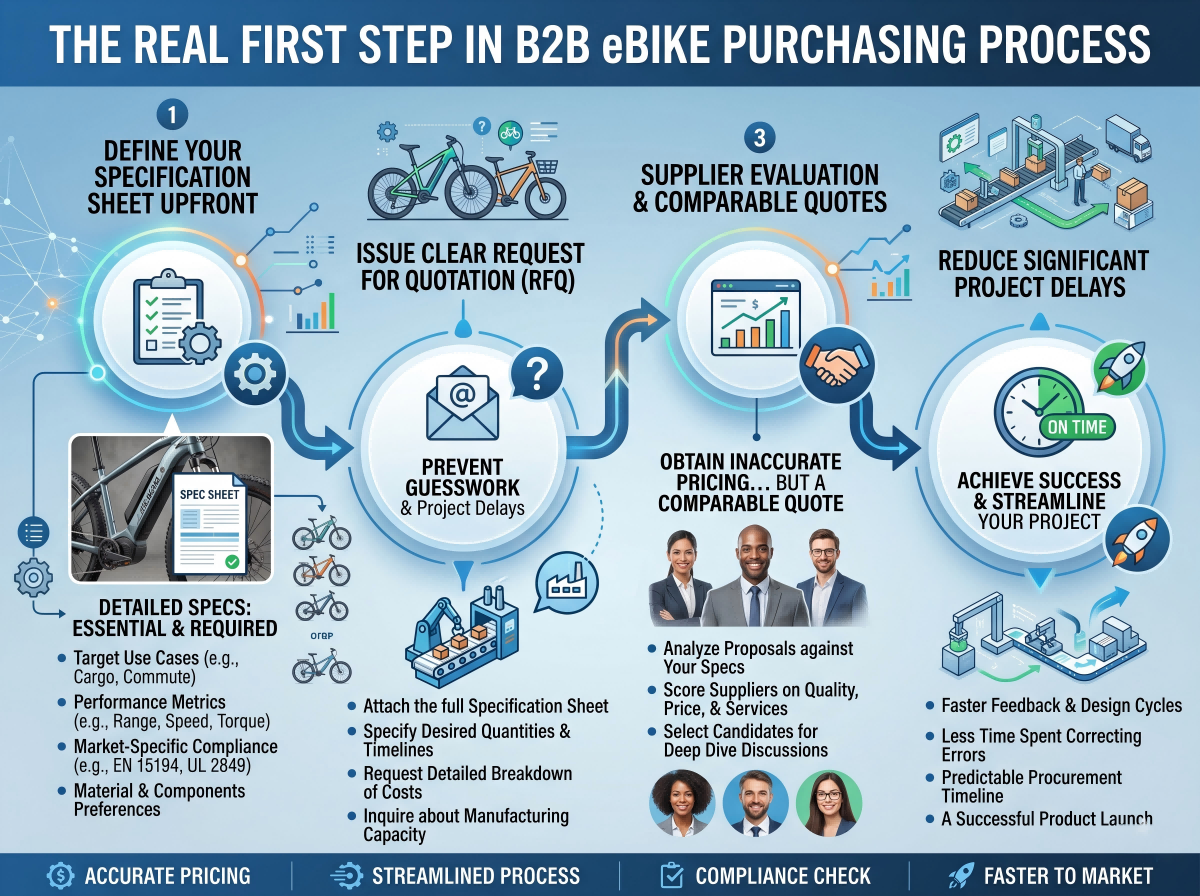
Most buyers start with "What's your price?"—but I've watched this approach destroy procurement projects before they even begin. The real first step isn't contacting suppliers; it's defining what failure looks like for your specific business model.
B2B eBike purchasing succeeds when buyers clarify their risk boundaries and operational constraints before requesting quotes.1 The process involves four stages: needs definition (including hidden cost identification), supplier qualification (verifying production evidence and certifications), negotiation (aligning terms with actual constraints), and relationship management (preventing supply chain disruption through verified communication channels).
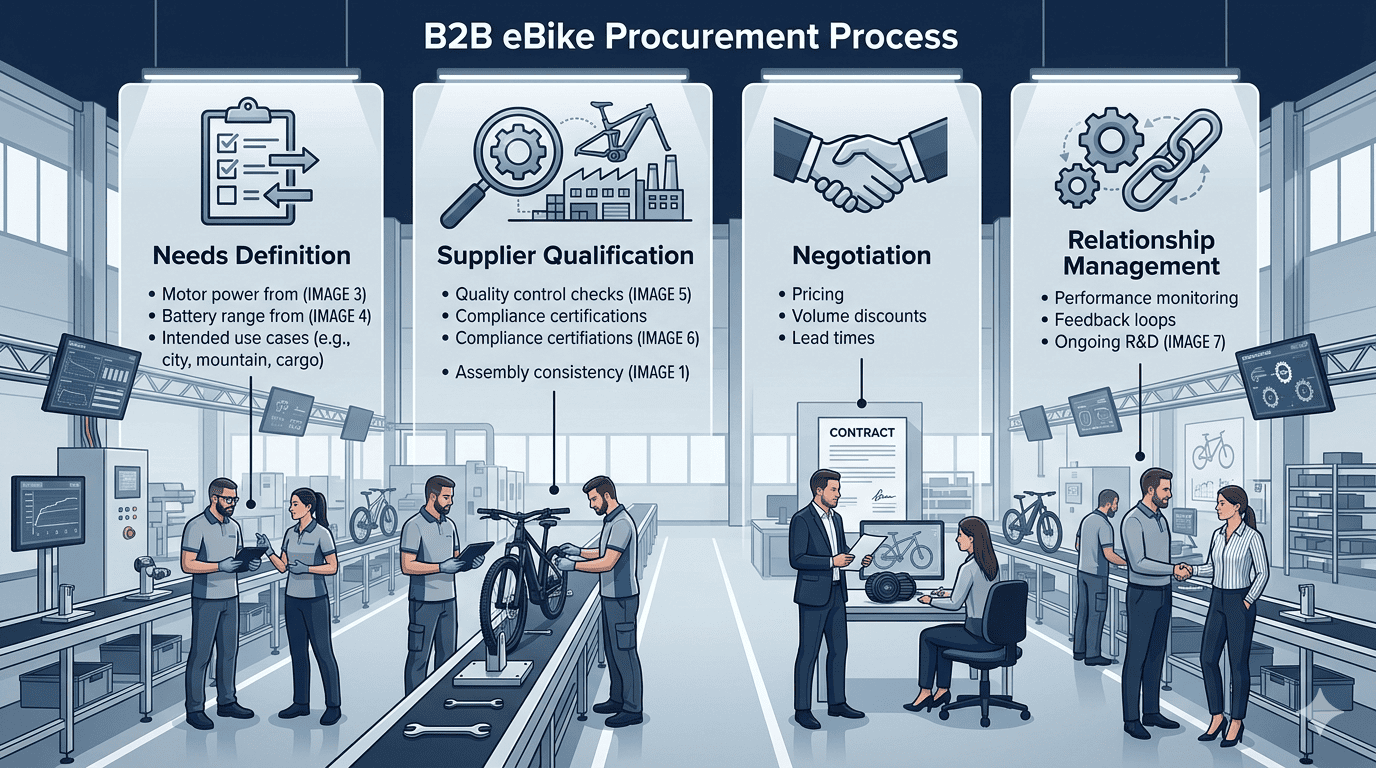
I've spent 15 years manufacturing eBikes and holding buyer meetings where procurement managers realize—halfway through our conversation—that they asked the wrong question. This guide walks you through the actual decision sequence that prevents wasted time, misaligned quotes, and supplier mismatches.
Why Do Most Buyers Skip Needs Definition and Jump to Price Inquiry?
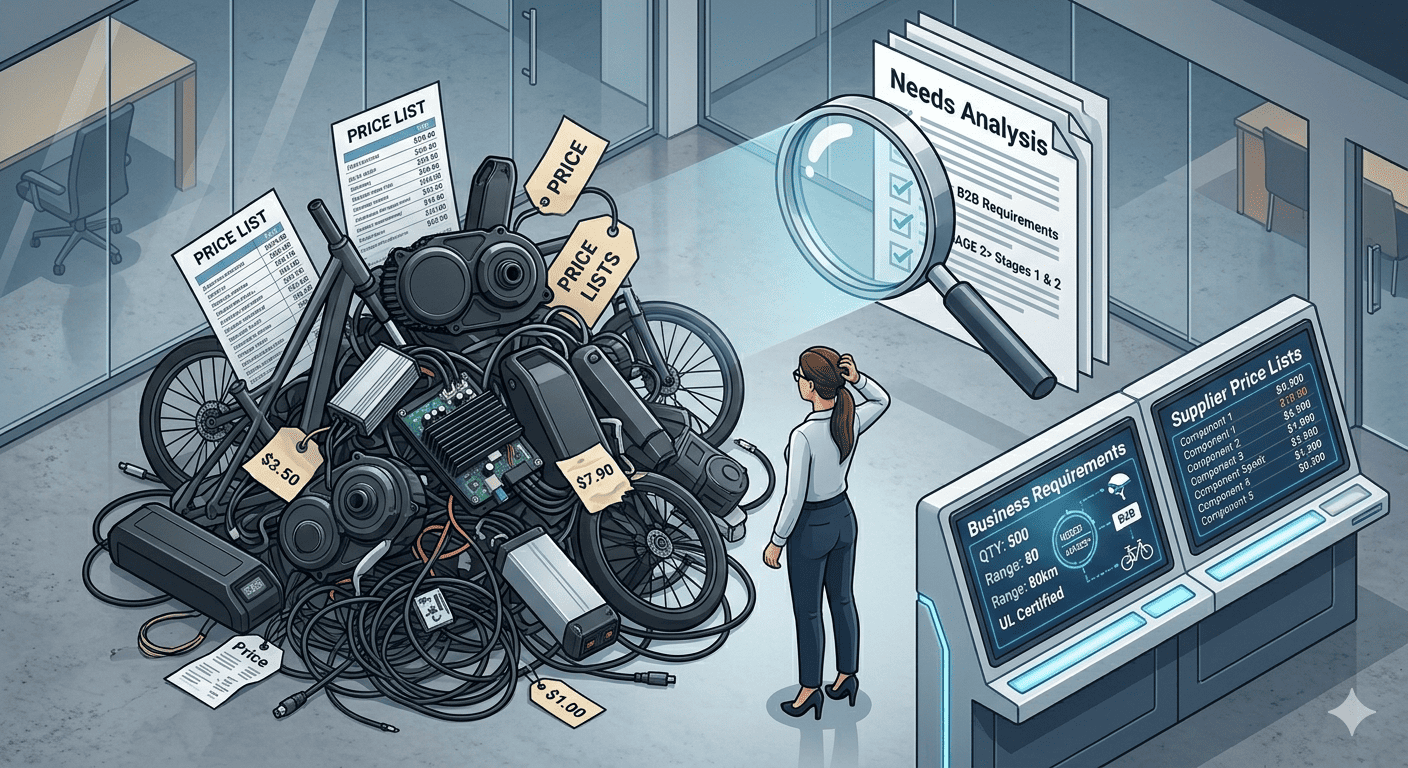
Buyers treat procurement as a transaction when it's actually a risk-reduction process. I see this pattern every week: someone emails "Send me your catalog and price list" without explaining their business model, volume commitment, or operational constraints.
Buyers skip needs definition because they assume all suppliers offer identical products at different prices.2 In reality, every supplier has capacity limits, certification gaps, and customization boundaries that make them suitable for specific buyer types—not all buyers.
What Happens When Buyers Skip This Step?
I worked with a European brand owner who requested quotes from eight suppliers simultaneously. His email said "I need city eBikes, what's your best price?" Six suppliers quoted €400-600 per unit. He chose the cheapest.
Three months later, he returned to us. The "cheap" supplier couldn't meet his delivery timeline because their production line was allocated to a larger client. He lost his retail season launch window because he never asked "What is your current production capacity and lead time for new clients?"
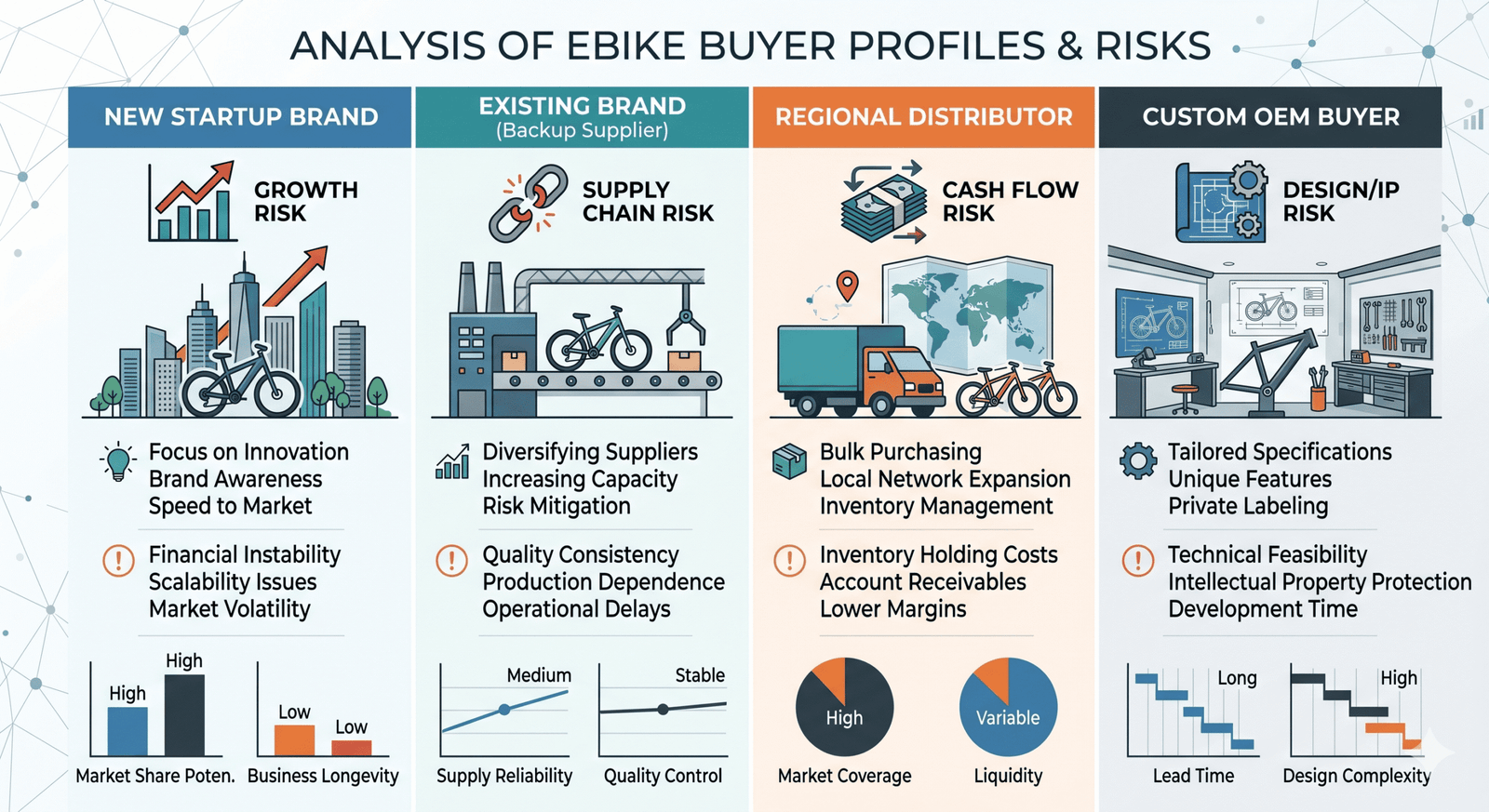
This failure pattern repeats across four buyer types:
| Buyer Type | Hidden Risk They Miss | What They Should Ask First |
|---|---|---|
| New brand owners | Supplier capability gaps (Can they handle small initial orders and scale later?) | "What is your MOQ for first orders, and can you accommodate volume increases within 6 months?" |
| Existing brands seeking second suppliers | Supply chain disruption (Will switching cause quality inconsistency or delivery delays?) | "Do you maintain consistent component suppliers, and what is your quality control process?" |
| Regional distributors | Cash flow and inventory risk (Can they manage payment terms and stock levels?) | "What payment terms do you offer for first-time distributors, and what is your reorder lead time?" |
| Custom OEM buyers | Customization capacity limits (Can they actually modify designs or just swap logos?) | "What customization depth can you support—frame geometry, motor specs, or only color/branding?" |
How Should Buyers Define Needs Before Contacting Suppliers?
I tell buyers to answer three questions before sending any inquiry. First, what is your real constraint—is it MOQ, lead time, quality certification, payment terms, or customization capacity? Most buyers say "price," but price means nothing without context.
A distributor once told me "I need cheap eBikes." I asked "What is your target retail price, expected order volume, and acceptable lead time?" He wanted to retail at €1,200, order 50 units initially, and needed delivery in 45 days. Cheap wasn't his constraint—fast turnaround for small volume was. That answer changed which suppliers could serve him.
Second, what does failure look like for your business model? New brands fear capability gaps—they need suppliers who can start small and scale. Existing brands fear supply disruption—they need consistent quality and delivery. Distributors fear cash flow risk—they need flexible payment terms. Custom buyers fear scope limitations—they need confirmed modification capacity.
Third, what evidence will prove a supplier can meet your needs? This isn't about trust; it's about verification. I keep production photos, certification documents, and client references ready because serious buyers ask for them. If a supplier can't show evidence, they can't deliver.
How Do Different Buyer Types Face Completely Different Hidden Risks?
New brand owners, second-source seekers, distributors, and custom buyers operate under different risk structures. I see procurement failures when buyers use generic evaluation criteria instead of risk-matched qualification methods.
Each buyer type must prioritize specific risk factors: new brands must verify scalability evidence, existing brands must confirm supply chain stability, distributors must validate cash flow terms, and custom buyers must test actual modification boundaries before committing.
What Risks Do New Brand Owners Actually Face?
New brand owners fear two things: suppliers who refuse small initial orders, and suppliers who can't scale when demand grows3. I worked with a startup founder who needed 30 units for a pilot launch. Most suppliers rejected him outright because our standard MOQ is 100 units.
We took his order because he showed a clear scaling plan—his pilot was funded, his retail partnerships were confirmed, and his second order would be 200 units within four months. I needed evidence that small today meant large tomorrow. He provided it.
The risk he faced wasn't price—it was capability gap. Could we handle his small start and rapid growth? I showed him our production schedule flexibility and client examples of brands we scaled with. He needed that evidence to decide.
New brand owners must ask: "Can you show me examples of clients you started small with and scaled? What was their order progression?" If a supplier can't answer with specifics, they don't have scaling experience.
What Risks Do Existing Brands Seeking Second Suppliers Face?
Existing brands switching suppliers fear supply chain disruption. I met a brand manager who wanted to add us as a second source because his current supplier had delivery delays. He didn't want to replace them—he wanted backup capacity.
His real question was: "Will your quality match my current supplier's, and can you deliver on short notice if my primary source fails?" Price wasn't his concern. Consistency was.
I showed him our quality control process, component supplier list, and delivery track record. He ordered a small test batch to compare against his existing stock. After confirming consistency, he split his orders between us and his original supplier.
Existing brands must verify: "Do you maintain consistent component suppliers? What is your quality variance across production batches? Can you provide samples that match my current specifications?" Supply chain stability matters more than cost savings.
What Risks Do Regional Distributors Actually Face?
Distributors face cash flow and inventory risk. I worked with a distributor who wanted to carry our eBikes but couldn't afford to pay upfront for 100 units. His business model required selling first, then restocking—not holding inventory.
His question wasn't "What's your price?"—it was "What payment terms can you offer for initial orders, and how fast can you restock after I sell through?" Cash flow timing mattered more than unit cost4.
We offered 30% deposit, 70% before shipment for his first order, and confirmed our reorder lead time was 21 days for stock models. He could manage that cash flow cycle. He couldn't manage 100% prepayment with 60-day lead times.
Distributors must ask: "What payment terms do you offer first-time buyers? What is your reorder lead time for standard models? Can you provide evidence of your delivery consistency?" Cash flow alignment prevents inventory traps.
What Risks Do Custom OEM Buyers Actually Face?
Custom buyers fear scope limitation. I met a buyer who wanted "custom eBikes" but couldn't explain what that meant. Did he need frame geometry changes, motor specification adjustments, or just logo placement?
I asked "What customization depth do you need—can you show me sketches or specs for your modifications?" He wanted a longer wheelbase for cargo capacity but didn't have engineering drawings. That's a frame redesign, not a simple modification.
I explained our customization boundaries: we can adjust component selection, color schemes, and branding without mold changes, but frame geometry redesign requires minimum 500-unit orders and mold cost sharing5. He didn't have that volume or budget.
Custom buyers must verify: "What customization level can you actually support without mold changes? Can you show examples of custom projects you've completed? What are the real MOQ and cost implications?" Many suppliers claim "full customization" but mean "we can change the logo."
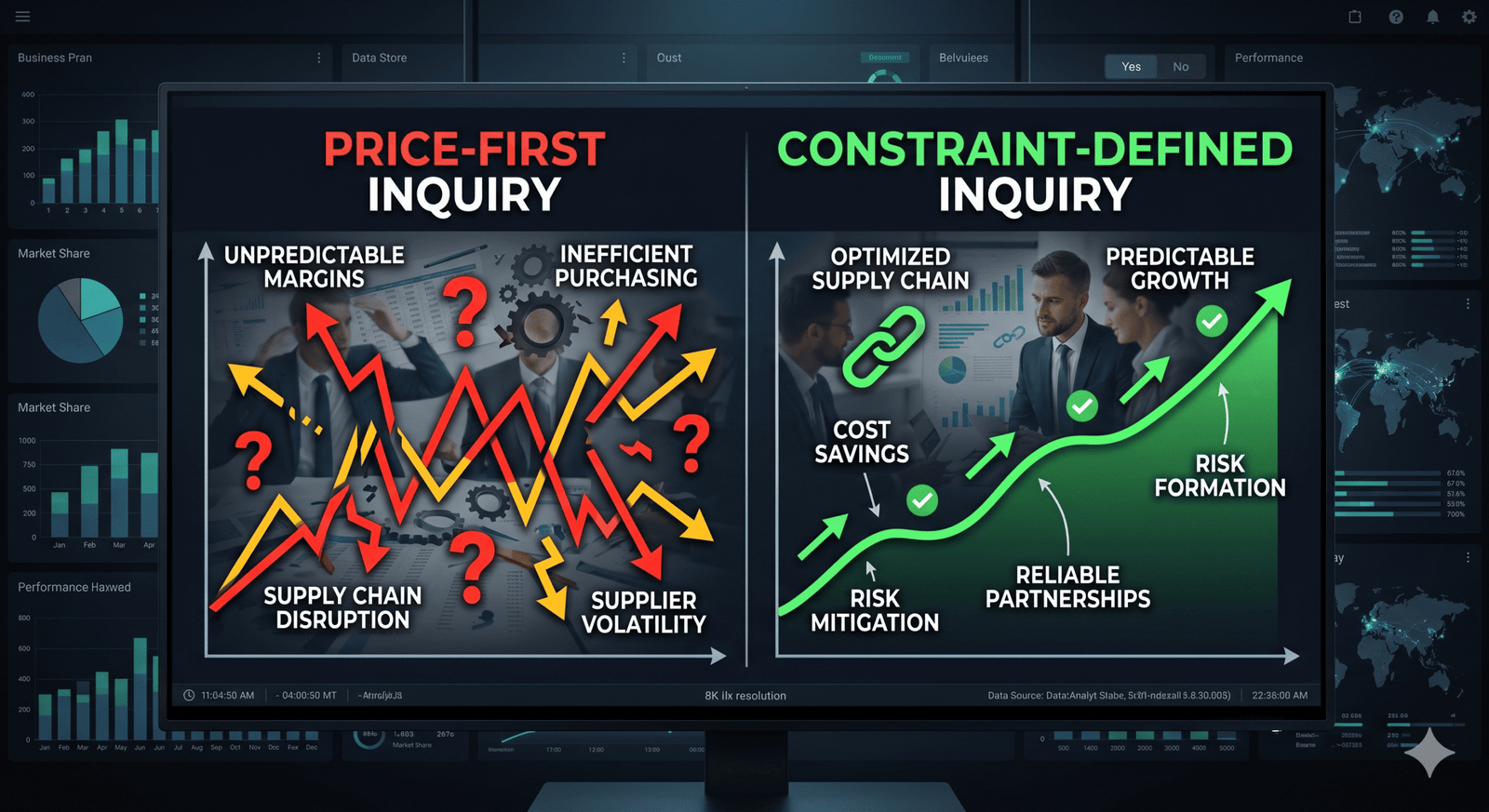
Why Does Asking Price Before Defining Constraints Create False Comparisons?
Buyers who request quotes without context receive incomparable numbers that waste both sides' time. I send quotes every day that buyers can't use because they didn't tell me their actual constraints.
Price-first inquiries generate misleading comparisons because unit cost depends on order volume, customization depth, payment terms, and delivery timeline—variables that change the final cost by 30-50%6. Buyers must specify constraints before requesting quotes to receive comparable proposals.
What Information Gaps Make Quotes Incomparable?
I received three quote requests last week with identical wording: "Please quote your 250W city eBike." I sent three different prices: €420, €480, and €520 per unit. All were correct—and incomparable.
The €420 quote assumed 500-unit orders, 60-day lead time, 100% prepayment, and standard specifications. The €480 quote assumed 100-unit orders, 45-day lead time, 30/70 payment terms, and minor branding customization. The €520 quote assumed 50-unit orders, 30-day lead time, custom color schemes, and branded packaging.
Buyers who compare these numbers see a 24% price difference and assume I'm price gouging. They're actually comparing three different service levels. That's not a pricing problem—it's a specification problem.
I now refuse to quote without constraint definition. I ask buyers: "What is your target order volume? What lead time do you need? What payment terms can you manage? What customization level do you require?" Only then can I provide a meaningful number.
How Should Buyers Request Comparable Quotes?
I worked with a distributor who learned this lesson the hard way. He requested quotes from five suppliers, received prices ranging from €380 to €550, and chose the cheapest. The €380 quote required 1,000-unit MOQ, 90-day lead time, and full prepayment—terms he couldn't meet.
He came back and asked "How should I request quotes?" I told him to specify every constraint upfront: "I need 250W city eBikes, initial order 100 units, reorder capacity every 45 days, 30/70 payment terms, EN15194 certification7 required, custom branding on frame and packaging. What is your unit price and total cost including shipping to Hamburg?"
That specification generates comparable quotes because every supplier responds to identical requirements. Price differences then reflect actual capability gaps, not hidden assumption mismatches.
Buyers must include these elements in every quote request:
| Element | Why It Matters | Example Specification |
|---|---|---|
| Order volume | Affects unit cost and MOQ feasibility | "Initial order 100 units, expected reorders 200 units quarterly" |
| Lead time requirement | Determines production slot availability | "Need delivery within 45 days of order confirmation" |
| Payment terms | Impacts supplier risk and pricing | "Can manage 30% deposit, 70% before shipment" |
| Customization depth | Changes cost structure significantly | "Need custom color and logo, standard frame geometry" |
| Certification requirements | Limits eligible suppliers | "Must hold EN15194 and CE certification8" |
| Delivery location | Affects logistics costs | "CIF Hamburg, Germany" |
What Happens When Buyers Compare Misaligned Quotes?
I watched a brand owner spend three months in quote-revision loops because he didn't specify constraints. He requested quotes, suppliers responded with different assumptions, he asked for revisions, suppliers adjusted, and the cycle repeated.
After six rounds of revisions, he still didn't have comparable quotes because he kept changing requirements. "Can you lower the price?" meant "Can you increase MOQ or extend lead time?"—but he didn't say that explicitly.
I finally told him: "Write down your actual constraints—the ones you cannot change. Then request quotes based on those fixed requirements. Stop asking for cheaper prices without specifying what you're willing to trade." He defined his constraints, requested new quotes, and made a decision within two weeks.
Quote-revision loops signal that buyers haven't clarified their own needs. Suppliers can't quote accurately when requirements keep shifting.
How Should Buyers Verify Supplier Qualification Beyond Price Comparison?
Supplier qualification isn't about choosing the cheapest—it's about verifying production evidence, checking certification validity, and confirming capacity-timeline alignment. I see buyers skip verification and pay for it later.
Effective supplier qualification requires three verification steps: requesting production evidence (factory photos, client references, output capacity), confirming certification validity (viewing original documents, checking issuing authority), and testing capacity alignment (comparing stated lead times against actual production schedules).
What Production Evidence Should Buyers Request?
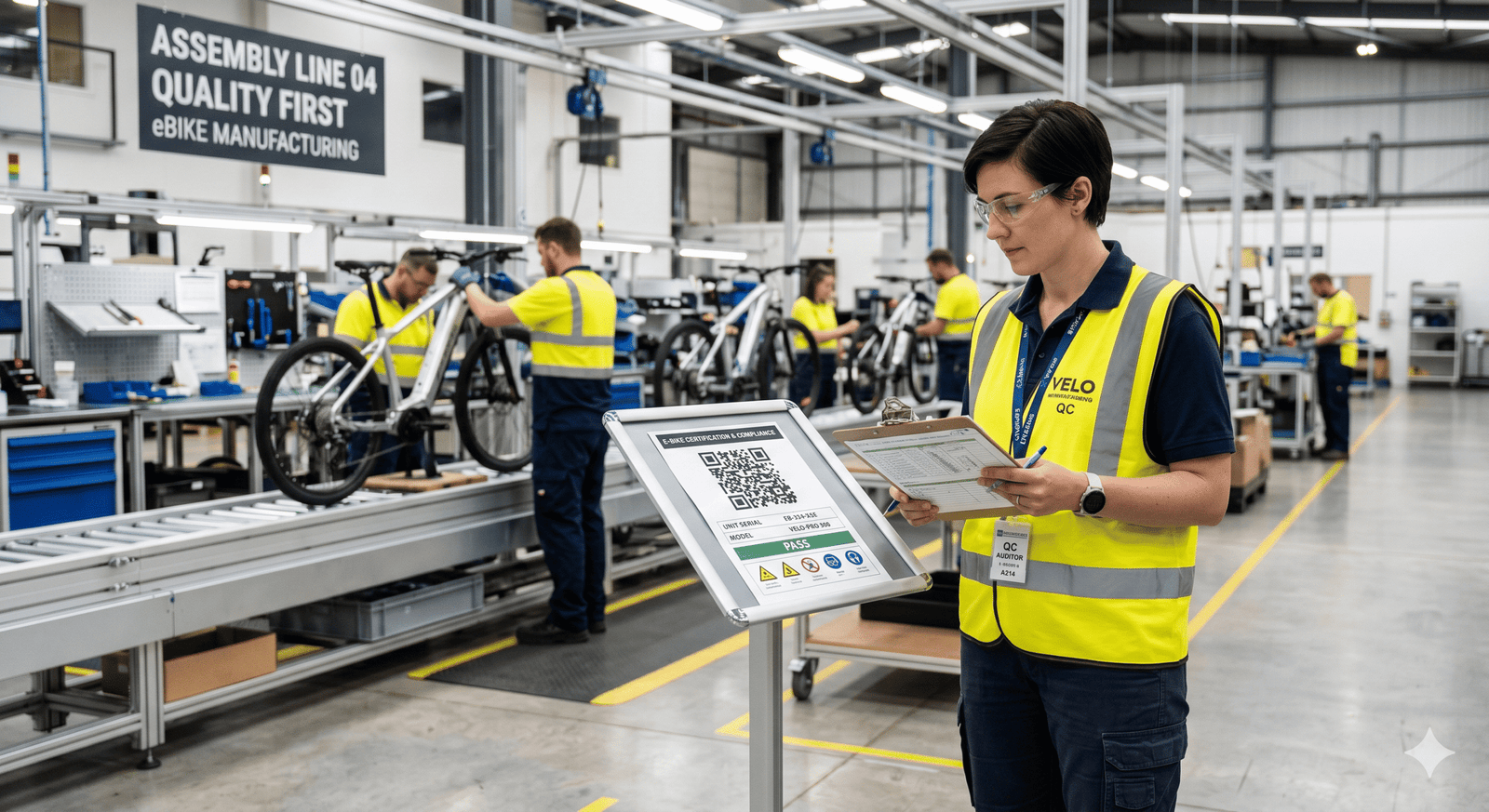
Buyers should ask for proof that suppliers can actually manufacture what they claim. I keep factory floor photos, assembly line videos, and client reference contacts ready because serious buyers verify before committing.
A distributor once asked me: "How do I know you actually make eBikes?" Fair question—some "manufacturers" are just trading companies. I showed him photos of our assembly lines, introduced him to our production manager via video call, and provided contact information for three current clients he could interview.
He called two references. Both confirmed we delivered on time and maintained quality consistency. That verification took him two hours and saved him from potential supplier fraud.
Buyers must request:
- Factory floor photos showing actual production (not stock images)
- Assembly line videos demonstrating process capability
- Client references with permission to contact directly
- Production capacity numbers with evidence (monthly output records)
If a supplier refuses to provide evidence, they can't verify their claims. Walk away.
How Should Buyers Verify Certification Validity?
Certification verification prevents costly compliance failures. I hold ISO9001 and BSCI certifications9, but I've met buyers who never asked to see the actual documents—they just believed suppliers who claimed certification.
One buyer told me his previous supplier "had CE certification" but couldn't provide the certificate when customs officials requested it. His shipment was held at the port for three weeks while he scrambled to find a certified supplier. He lost his retail season and paid storage fees.
Now he verifies every certification before ordering. He asks: "Can you show me your original certification documents? What is the issuing authority and validity period? Can I verify the certificate number with the issuing organization?"
I send him scanned copies of our certificates, show him the issuing authority contact information, and confirm validity dates. He can verify independently if he wants. Most buyers don't bother—but knowing they can builds trust.
Buyers should verify:
- Original certification documents (not edited copies)
- Issuing authority name and contact information
- Certificate number and validity period
- Scope of certification (what products it covers)
Some suppliers show expired certificates or certificates that don't cover the products you're buying10. Always check validity dates and scope.
How Can Buyers Confirm Capacity-Timeline Alignment?
Stated lead times mean nothing if suppliers can't actually deliver. I tell buyers my lead time for new clients is 45 days for 100-unit orders—but I also show them my current production schedule so they can see I have available capacity.
A brand owner asked me: "How do I know you can really deliver in 45 days?" I showed him my production planning calendar, pointed to the slot allocated for new orders, and explained our component inventory levels. He could see the available capacity existed.
Some suppliers promise short lead times but their production lines are fully allocated to existing clients. They hope to squeeze in your order somehow—and fail. Buyers must ask: "Can you show me your current production schedule? What capacity do you have available for new orders? What are your component lead times?"
If a supplier can't show available capacity, their lead time promise is speculation, not commitment.
Buyers should verify:
- Current production schedule with available slots
- Component inventory levels for standard models
- Percentage of capacity already allocated vs. available
- Backup plans if production delays occur
I maintain 20% buffer capacity for unexpected orders and component delays11. Suppliers running at 100% capacity can't absorb disruptions—and disruptions always happen.
Conclusion
B2B eBike purchasing succeeds when buyers treat procurement as risk reduction, not transaction completion. Define your constraints before requesting quotes, verify supplier capability through evidence rather than claims, and align your risk profile with supplier strengths. Price matters—but only after you confirm suppliers can actually deliver what your business model requires.
"Supplier Risk Assessment Based on Best-Worst Method and K ...", https://www.mdpi.com/2071-1050/10/4/1066. Research on procurement best practices indicates that defining operational constraints and risk parameters before supplier engagement correlates with improved procurement outcomes, though specific studies on eBike purchasing are limited. Evidence role: expert_consensus; source type: research. Supports: that defining operational constraints and risk parameters before supplier engagement improves procurement outcomes. Scope note: though specific studies on eBike purchasing are limited ↩
"Marketing Strategies | Ag Decision Maker", https://www.extension.iastate.edu/agdm/wholefarm/html/c5-18.html. Studies in procurement behavior suggest that buyers frequently exhibit commodity perception bias, treating differentiated products as interchangeable based primarily on price, particularly in early procurement stages. Evidence role: general_support; source type: research. Supports: that buyers often treat differentiated products as commodities in procurement contexts. ↩
"Scaling Critical Suppliers in Domestic Supply Chains", https://www.federalregister.gov/documents/2026/05/01/2026-08554/scaling-critical-suppliers-in-domestic-supply-chains. Research on startup supply chain challenges documents that emerging brands frequently encounter barriers related to minimum order quantities and supplier willingness to accommodate growth trajectories, creating tension between initial capital constraints and future scaling needs. Evidence role: general_support; source type: research. Supports: that startups face supplier access challenges related to order volume requirements. ↩
"Cash Flow vs. Profit: What's the Difference? | HBS Online", https://online.hbs.edu/blog/post/cash-flow-vs-profit. Distribution channel research emphasizes that working capital management, including payment terms and inventory turnover, often represents a more critical constraint for distributors than unit cost margins, particularly for smaller distributors with limited capital access. Evidence role: expert_consensus; source type: research. Supports: that working capital management and payment terms significantly impact distributor viability. ↩
"How much does it cost to produce a carbon-fiber bicycle frame", https://www.physicsforums.com/threads/how-much-does-it-cost-to-produce-a-carbon-fiber-bicycle-frame.906507/. Manufacturing economics literature explains that products requiring custom tooling or molds incur substantial fixed costs that must be amortized across production volumes, typically necessitating minimum order quantities in the hundreds or thousands of units to achieve cost viability. Evidence role: mechanism; source type: research. Supports: that tooling and mold costs create high minimum order quantity requirements for custom manufacturing. ↩
"Economies of scale - Wikipedia", https://en.wikipedia.org/wiki/Economies_of_scale. Manufacturing economics research documents that order volume, customization level, and payment terms can create substantial cost variations in B2B contexts, with economies of scale effects commonly ranging from 20-60% depending on industry and product complexity. Evidence role: statistic; source type: research. Supports: that order variables significantly impact final manufacturing costs. Scope note: with economies of scale effects commonly ranging from 20-60% depending on industry and product complexity ↩
"Electric bicycle laws - Wikipedia", https://en.wikipedia.org/wiki/Electric_bicycle_laws. EN15194 is the European standard specifying safety requirements and test methods for electrically power assisted cycles (EPACs), covering aspects including electrical safety, mechanical safety, and electromagnetic compatibility. Evidence role: definition; source type: government. Supports: that EN15194 is the European standard for electrically power assisted cycles. ↩
"CE marking - Wikipedia", https://en.wikipedia.org/wiki/CE_marking. CE marking (Conformité Européenne) is a mandatory conformity marking for products sold within the European Economic Area, indicating that products comply with EU safety, health, and environmental protection legislation, including requirements for electric bicycles. Evidence role: definition; source type: government. Supports: that CE marking indicates conformity with EU safety, health, and environmental protection standards. ↩
"ISO 9000 family - Wikipedia", https://en.wikipedia.org/wiki/ISO_9000_family. ISO9001 is an international standard for quality management systems published by the International Organization for Standardization, while BSCI (Business Social Compliance Initiative) is a supply chain management system that supports companies in improving working conditions in their supply chains. Evidence role: definition; source type: institution. Supports: that ISO9001 and BSCI represent quality management and social compliance standards respectively. ↩
"[PDF] PROCUREMENT FRAUD HANDBOOK", https://www.gsaig.gov/sites/default/files/misc-reports/ProcurementFraudHandbook_0.pdf. Supply chain compliance research documents instances of certification misrepresentation, including expired certificates, fraudulent documentation, and scope misalignment, particularly in international procurement contexts where verification mechanisms may be limited. Evidence role: general_support; source type: research. Supports: that certification misrepresentation occurs in international supply chains. ↩
"Industrial Production and Capacity Utilization - Federal Reserve Board", https://www.federalreserve.gov/releases/g17/capnotes.htm. Operations management research supports maintaining buffer capacity in production systems to absorb demand variability and supply disruptions, with optimal capacity utilization typically recommended at 80-90% to balance efficiency with flexibility, though specific percentages vary by industry. Evidence role: expert_consensus; source type: research. Supports: that maintaining buffer capacity improves production system resilience. Scope note: though specific percentages vary by industry ↩