
leading paragraph: Are procurement mistakes costing you time and money? Unclear rules lead to bad buys and quality issues1. A solid Standard Operating Procedure (SOP) is the fix you've been looking for.
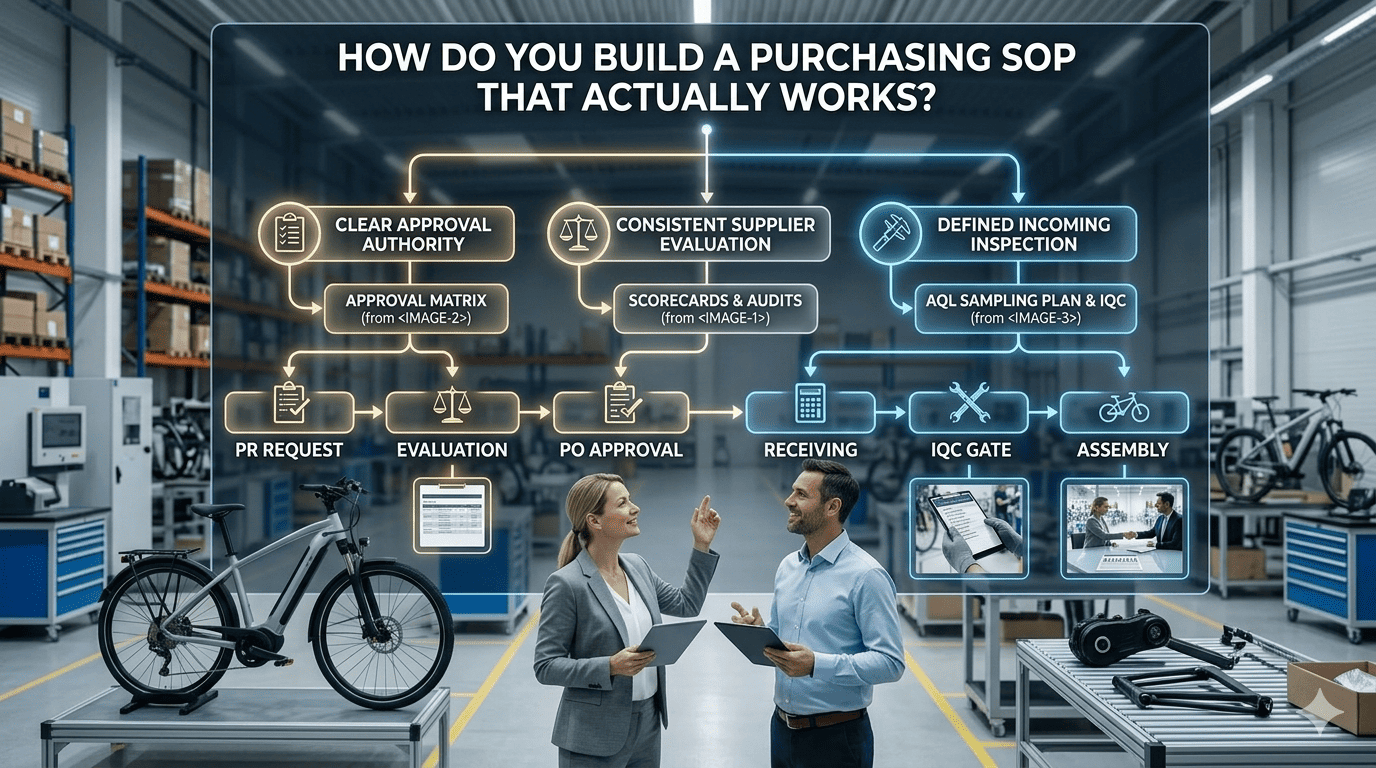
snippet paragraph: To build a purchasing SOP, focus on three areas: clear approval authority, consistent supplier evaluation, and defined incoming inspection criteria. Create a decision framework, not just a document, by setting specific rules for who can approve what, how to score suppliers, and how to check incoming goods.

Transition Paragraph: Over my 15 years in eBike manufacturing, I've seen how a weak purchasing process creates chaos. We've fixed these exact problems in our ISO-certified factory2, turning messy operations into a smooth, controlled system. It wasn't about writing more rules; it was about writing the right rules. Let's break down how you can build an SOP that prevents problems before they start, not just document them after they happen.
How Do You Define Clear Approval Authority in Your SOP?
leading paragraph: Are purchase orders stuck waiting for a signature? Or worse, are unauthorized purchases slipping through? This bottleneck or lack of control creates delays and financial risks for your business.
snippet paragraph: Define clear approval authority by creating a simple decision matrix. This matrix should specify who can approve purchases based on the total cost, the type of material, and the supplier's risk level. This stops delays and prevents unauthorized spending, making the process fast and secure.

Dive deeper Paragraph: In our early days, we treated approval as just a signature on a form. This led to two big problems. Either our general manager became a bottleneck, signing off on every box of screws, or junior buyers ordered critical components without proper oversight. The solution was an Approval Authority Matrix3. This isn't a complex flowchart; it's a simple table that acts as a control gate. It sets clear rules. For example, any purchase under $500 for standard materials from an A-rated supplier can be approved by the buyer. But a purchase over $10,000 for a critical component like a battery requires approval from the Supply Chain Manager and the CEO. We define these thresholds based on three factors:
| Factor | Description | Example (eBike Factory) |
|---|---|---|
| Monetary Value | The total cost of the purchase order. | <$1,000: Buyer; $1,001-$5,000: SC Manager; >$5,001: CEO |
| Material Risk Level | Is it a critical component or a standard part? | Critical (Frames, Motors): Requires senior approval. Standard (Fasteners): Buyer approval. |
| Supplier Rating | Is the supplier new/untested or a trusted partner? | New/C-rated Supplier: Requires senior review. A-rated Supplier: Broader buyer authority. |
This matrix empowers your team to act decisively within clear boundaries and ensures high-stakes decisions get the attention they deserve. It's a living part of the SOP, not just a placeholder.
How Should You Evaluate Suppliers Consistently?
leading paragraph: Do you choose suppliers based on the lowest price, only to face quality nightmares later? Inconsistent supplier selection leads to unreliable products and damaged reputations. It's a costly mistake.
snippet paragraph: Evaluate suppliers consistently by using a scorecard that separates "what to measure" from "how to score." For critical parts, score factory audits, quality systems, and sample tests. For standard parts, focus more on price and lead time. This ensures you choose the right partner for the right product.

Dive deeper Paragraph: Relying only on price or personal relationships is a trap. We learned this the hard way when a batch of low-cost motors failed our load tests, causing massive rework and delays. The problem wasn't just the supplier; it was our selection process. We now use a structured supplier evaluation system that differentiates between critical and standard parts. The key is to have separate scorecards. You wouldn't judge a frame manufacturer the same way you judge a packaging supplier.
For critical components (batteries, frames, controllers), our evaluation is intense.
- Factory Audit (40%): We physically visit. We check their ISO certifications, production line controls, and social compliance (BSCI4).
- Technical & Quality Capability (30%): Can they meet our specs? We require a Production Part Approval Process (PPAP)5 and review their internal quality control data.
- Commercial (30%): Price, lead time, and payment terms are still important, but they don't lead the decision.
For standard materials (fasteners, wiring, packaging), the focus shifts.
- Commercial (60%): Price and lead time are the primary drivers.
- Quality (30%): Do they have basic quality certifications? Can they provide a Certificate of Conformance6 with each shipment?
- Service (10%): How responsive and reliable are they?
We also include red-flag criteria. For instance, any supplier who fails a key safety requirement during an audit or provides a sample that doesn't meet our minimum performance standard is disqualified, regardless of price. This system makes our decisions objective and defends our product quality from the very first step.
How Do You Set Incoming Inspection Standards That Prevent Defects?
leading paragraph: Are quality problems only discovered on the assembly line or, even worse, by your customers? Finding defects late is expensive7 and damages your brand. You need to catch them sooner.
snippet paragraph: Set effective incoming inspection standards by writing measurable acceptance criteria directly into your purchasing SOP. Specify what to check, how to test it, and how many units to inspect based on the material's importance and the supplier's performance history. This catches defects upon arrival.

Dive deeper Paragraph: Your quality manual is for broad principles; your purchasing SOP is for direct action. Incoming inspection criteria must be in the SOP so the purchasing and quality teams are perfectly aligned. We once had motor quality issues because our incoming inspection only checked for cosmetic damage, not performance. The motors looked fine, but they failed under load. This was a classic "discovered too late" problem. Now, our SOP contains a specific Incoming Quality Control (IQC) section for each major component. It clarifies what to check and how to check it. For example, for an eBike battery pack, the criteria are clear:
| Inspection Point | Method | Acceptance Criteria |
|---|---|---|
| Visual Check | Visual Inspection | No dents, scratches, or loose connectors. Labeling is correct. |
| Voltage Test | Multimeter | Voltage must be within the specified range (e.g., 36.5V ± 0.5V). |
| Capacity Sample Test | Charge/Discharge Tester | AQL sample8 must meet 98% of rated capacity9. |
We also link the inspection level to the supplier's rating. For a new supplier or one with a recent quality issue, we might implement 100% inspection for a critical dimension. For a trusted, A-rated supplier, we use a standard statistical sampling plan (AQL)10. By putting these measurable, actionable rules in the purchasing SOP, we empower our IQC team to be a gatekeeper, preventing bad parts from ever entering our inventory.
How Can You Create a Template That Adapts to Your Needs?
leading paragraph: Are you struggling with a one-size-fits-all SOP template that doesn't fit your business? A generic document creates confusion and fails to address the unique risks of different purchases.
snippet paragraph: Create an adaptable template by building a core SOP and then using appendices or marked sections for specific procurement types. Have a standard process for all purchases, but detail unique requirements for critical components, raw materials, and services separately. This provides both consistency and flexibility.

Dive deeper Paragraph: A single, rigid SOP for all purchasing is ineffective. Procuring custom eBike frames is vastly different from buying office supplies. The goal is to create a core framework that applies to everything, with specific modules you can plug in based on what you're buying. This makes the SOP a truly useful tool for your team. Below is a standard template structure we use. The power of this template is in its annotations—it tells you how and why to adjust each section. You're not just filling in blanks; you are building a decision-making guide tailored to your factory's real-world needs. For a small to medium-sized manufacturer, this approach is manageable and doesn't require a team of consultants to implement. It focuses on the three pain points we've discussed: approval, supplier selection, and inspection.
Standard Purchasing SOP Template
(Note: Adapt sections marked with an asterisk () based on procurement type)*
| Section | Content / Instructions |
|---|---|
| 1.0 Purpose | To define the standardized process for procuring all goods and services. |
| 2.0 Scope | This procedure applies to all personnel involved in the procurement process. |
| 3.0 Purchase Requisition | All purchases must begin with a Purchase Requisition Form detailing item, quantity, specs, and required date. |
| **4.0 Approval Authority*** | Refer to the Approval Authority Matrix (Appendix A). Matrix thresholds must be set based on monetary value, material risk, and supplier rating. |
| **5.0 Supplier Selection*** | For New/Critical Items: Follow the Critical Supplier Evaluation Scorecard (Appendix B). Requires factory audit, sample testing, etc. For Standard/Repeat Items: Select from the Approved Supplier List (ASL). Price, lead time, and past performance are key. |
| 6.0 Purchase Order | Issue a PO to the selected supplier. PO must include item descriptions, quantities, prices, delivery dates, and reference to our Terms & Conditions. |
| **7.0 Incoming Inspection*** | All incoming goods must be inspected per the IQC Guidelines (Appendix C). Guidelines must specify: sampling plan (AQL or 100%), dimensions/parameters to check, and testing methods for critical vs. standard parts. |
| 8.0 Goods Receipt & Invoicing | Record receipt in the inventory system. Finance processes the invoice upon confirmation of successful receipt and inspection. |
| 9.0 Record Keeping | All PRs, POs, inspection reports, and invoices must be digitally archived for 7 years11. |
| Appendices | A: Approval Matrix; B: Supplier Scorecards; C: IQC Guidelines |
This structure ensures consistency while building in the necessary flexibility to handle the different risks associated with different types of purchases.
Conclusion
A great purchasing SOP is a dynamic decision framework, not a static compliance document12. It turns operational risks into clear, controllable steps for your team.
"Effects of procurement practices on quality of medical device or ...", https://pmc.ncbi.nlm.nih.gov/articles/PMC4977867/. Research in supply chain management indicates that standardized procurement procedures reduce purchasing errors and improve quality outcomes, though the magnitude of improvement varies by industry and organizational context. Evidence role: general_support; source type: research. Supports: that unclear or inconsistent procurement procedures correlate with increased purchasing errors and quality issues. Scope note: Studies typically measure correlation rather than direct causation, and results vary across different organizational contexts ↩
"International Organization for Standardization - Wikipedia", https://en.wikipedia.org/wiki/International_Organization_for_Standardization. ISO 9001 is the international standard for quality management systems, requiring organizations to demonstrate consistent ability to provide products meeting customer and regulatory requirements through documented processes and continuous improvement. Evidence role: definition; source type: institution. Supports: what ISO certification entails for manufacturing quality management systems. ↩
"Obtain a Delegation of Procurement Authority - GSA", https://www.gsa.gov/buy-through-us/products-and-services/professional-services/buy-services/oasis-plus/buyers-guide/obtain-a-delegation-of-procurement-authority. Approval authority matrices are documented in procurement management literature as internal control mechanisms that define spending limits and authorization levels, though specific threshold structures vary by organization size and risk tolerance. Evidence role: general_support; source type: education. Supports: that approval authority matrices are recognized tools in procurement control systems. Scope note: The optimal structure and thresholds are organization-specific rather than universally standardized ↩
"amfori BSCI Certification & BSCI Audit Services | TÜV SÜD", https://www.tuvsud.com/en-us/services/auditing-and-system-certification/amfori-business-social-compliance-initiative. The Business Social Compliance Initiative (BSCI) is a European business-driven initiative that supports companies in improving working conditions in their global supply chains through a common code of conduct and audit system. Evidence role: definition; source type: institution. Supports: what BSCI represents in supply chain social compliance. ↩
"Production part approval process - Wikipedia", https://en.wikipedia.org/wiki/Production_part_approval_process. The Production Part Approval Process (PPAP) is a standardized methodology developed by the Automotive Industry Action Group (AIAG) requiring suppliers to demonstrate that manufacturing processes can consistently produce parts meeting engineering design specifications, though it has been adopted beyond automotive sectors. Evidence role: definition; source type: institution. Supports: what PPAP is and its role in quality validation. Scope note: While originating in automotive manufacturing, application rigor varies when adapted to other industries ↩
"Difference Between Certificate Of Compliance And Conformance", https://us.arrk.com/difference-between-certificate-of-compliance-and-conformance/. A Certificate of Conformance is a supplier-issued document certifying that delivered products meet specified requirements and standards, serving as quality assurance documentation in procurement processes, though the legal weight and verification requirements vary by industry and jurisdiction. Evidence role: definition; source type: education. Supports: what a Certificate of Conformance represents in quality management. Scope note: The document's reliability depends on supplier integrity and may require third-party verification for critical applications ↩
"Quality Control in Manufacturing: Why Prevention Beats Inspection ...", https://baysourceglobal.com/quality-control-manufacturing-prevention-beats-inspection/. Quality management research documents that defect correction costs typically increase by factors of 10 or more at each subsequent production stage, from design through field failure, supporting the economic rationale for early detection systems. Evidence role: general_support; source type: research. Supports: that defect detection costs increase substantially at later production stages. Scope note: The specific cost multipliers vary significantly by industry, product complexity, and defect type ↩
"[PDF] ISO 2859-1 - UNT Chemistry Department", https://chemistry.unt.edu/~tgolden/courses/iso2859-1.pdf. Acceptable Quality Limit (AQL) sampling is a statistical method defined in ISO 2859 standards that determines the maximum number of defective units considered acceptable in a random sample, allowing inspection decisions without testing entire lots. Evidence role: definition; source type: institution. Supports: what AQL sampling represents in quality inspection. ↩
"Challenges and opportunities for high-quality battery production at ...", https://pmc.ncbi.nlm.nih.gov/articles/PMC11725600/. Battery industry standards and manufacturer specifications typically establish initial capacity acceptance criteria between 95-100% of rated capacity for new cells, with specific thresholds varying by chemistry, application, and manufacturer tolerances. Evidence role: general_support; source type: institution. Supports: that capacity thresholds in the 95-100% range are used in battery quality acceptance. Scope note: The 98% threshold is within typical ranges but represents a business decision rather than a universal standard ↩
"6.1.1. How did Statistical Quality Control Begin?", https://www.itl.nist.gov/div898/handbook/pmc/section1/pmc11.htm. Quality control literature establishes that statistical sampling plans are more cost-effective than 100% inspection when process capability is demonstrated and inspection costs are significant, though this assumes stable supplier processes and appropriate sample sizes. Evidence role: general_support; source type: education. Supports: that statistical sampling plans offer economic advantages over 100% inspection under certain conditions. Scope note: Effectiveness depends on supplier process stability, defect criticality, and inspection cost structures ↩
"Procurement Records Retention Policy - Columbia University Policies", https://universitypolicies.columbia.edu/content/procurement-records-retention-policy. Business record retention requirements vary by jurisdiction and document type, with tax authorities and commercial regulations commonly requiring 5-10 year retention periods for financial and procurement documents, though specific requirements depend on applicable laws and industry regulations. Evidence role: general_support; source type: government. Supports: that multi-year retention periods for procurement records align with regulatory and business requirements. Scope note: The seven-year period may not satisfy all jurisdictions or industries; organizations must verify applicable legal requirements ↩
"An overview of clinical decision support systems: benefits, risks, and ...", https://pmc.ncbi.nlm.nih.gov/articles/PMC7005290/. Organizational management literature distinguishes between compliance-focused procedures and decision-enabling frameworks, with research suggesting that SOPs incorporating decision criteria and contextual guidance improve operational outcomes compared to purely prescriptive documentation. Evidence role: expert_consensus; source type: education. Supports: that effective SOPs incorporate decision-making guidance beyond basic compliance requirements. Scope note: The optimal balance between prescription and flexibility varies by organizational context and process criticality ↩