
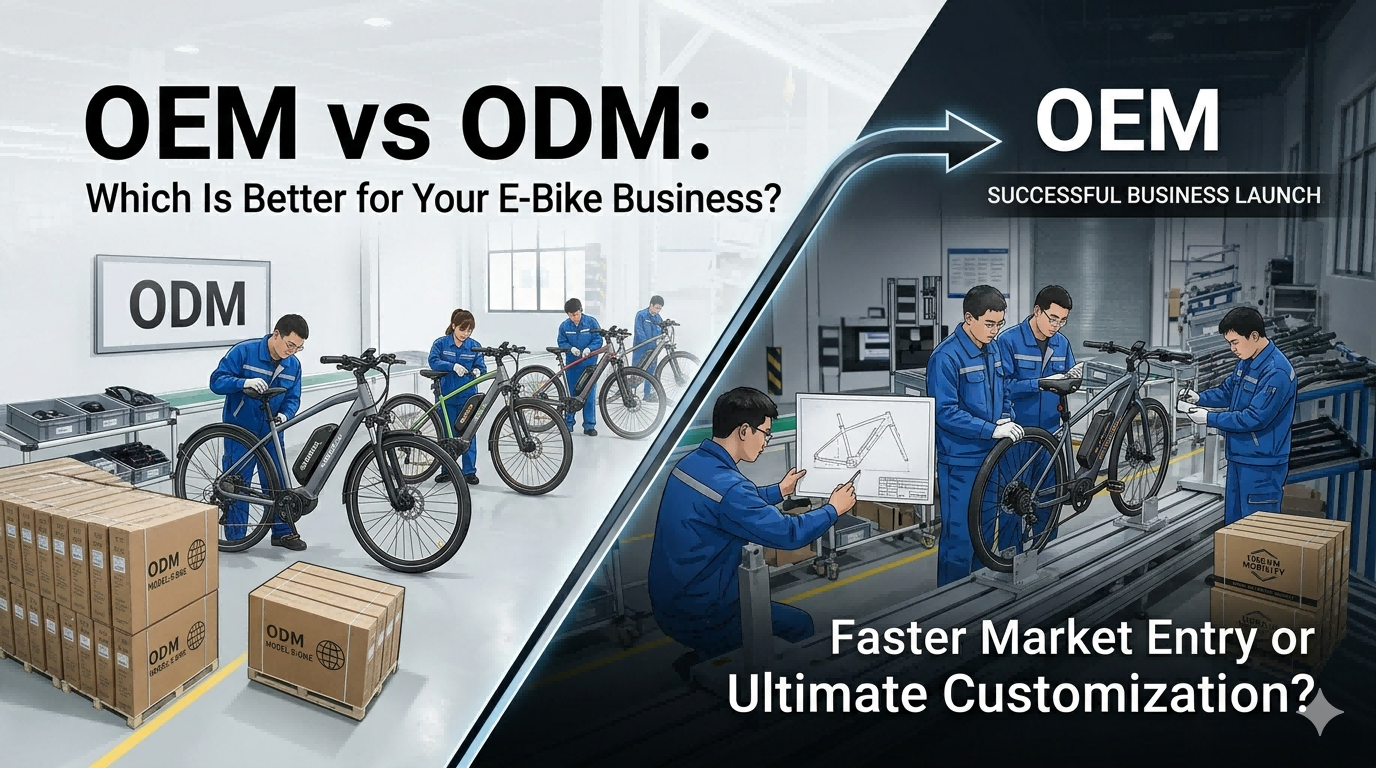
Struggling to decide between OEM and ODM for your new e-bike brand? This choice is critical and can easily make or break your entire launch. Let's get it right.
Choosing between OEM and ODM isn't about features; it's about matching your budget, timeline, and order volume to the right production model. For most new brands, ODM offers a faster, more affordable market entry. OEM is better for established brands with more capital and unique design needs.
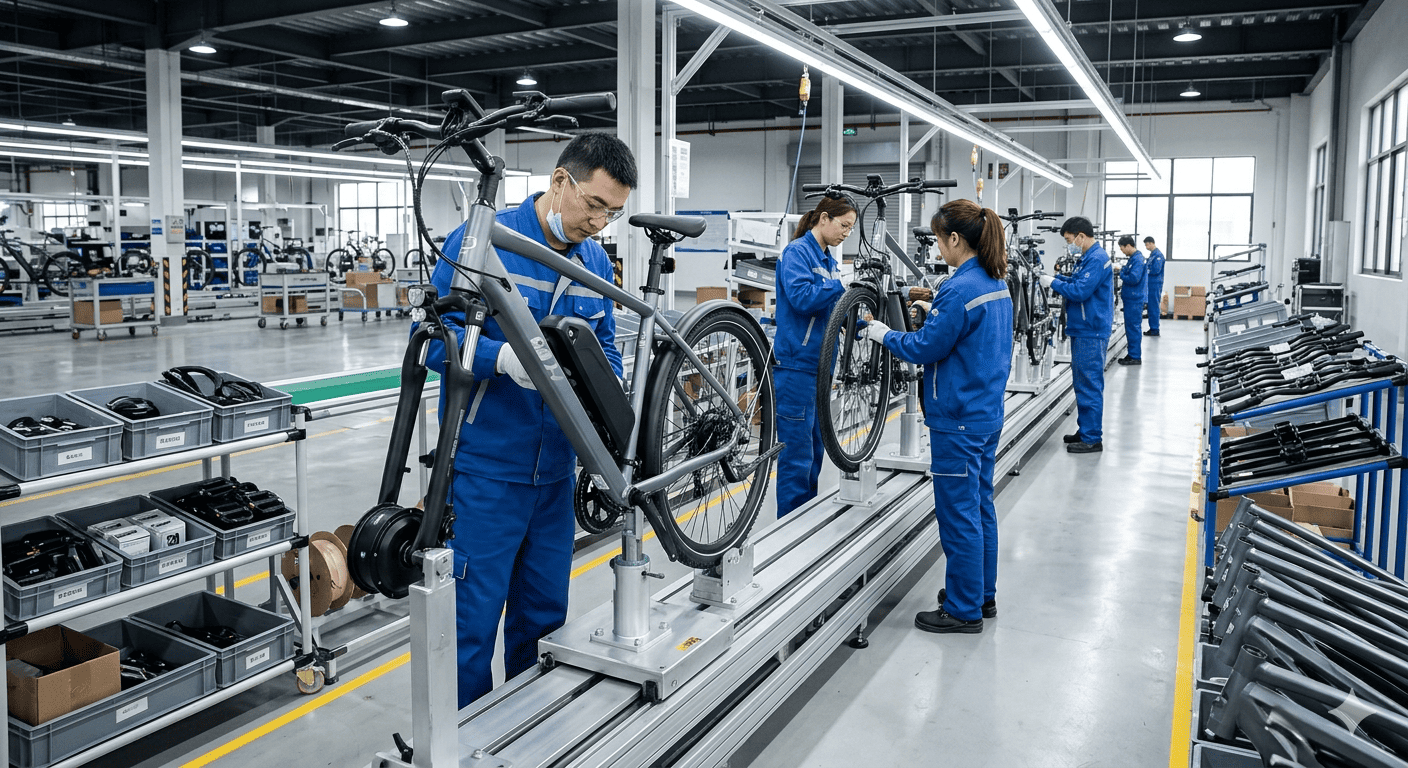
I talk to new brand founders every single day. They come to our factory with incredible passion and a clear vision for their e-bike. But they almost always get stuck on this one question: OEM or ODM? It sounds like a technical manufacturing choice, but it's really a business strategy decision. Making the wrong call here can trap your capital and kill your timeline before you even start. Let's walk through the real-world factors so you can make the smart choice for your business and avoid these common, costly mistakes.
Does OEM Really Give You More Customization?
Are you worried that choosing ODM means you’ll just be selling a generic bike? You might think OEM is the only way to build a truly unique brand. This is a very common and expensive assumption.
ODM allows for significant customization1. You can change branding, colors, and select key components like batteries, motors, and brakes on a pre-existing frame. OEM is only required if you need to change the actual frame geometry, which demands expensive and time-consuming new molds.
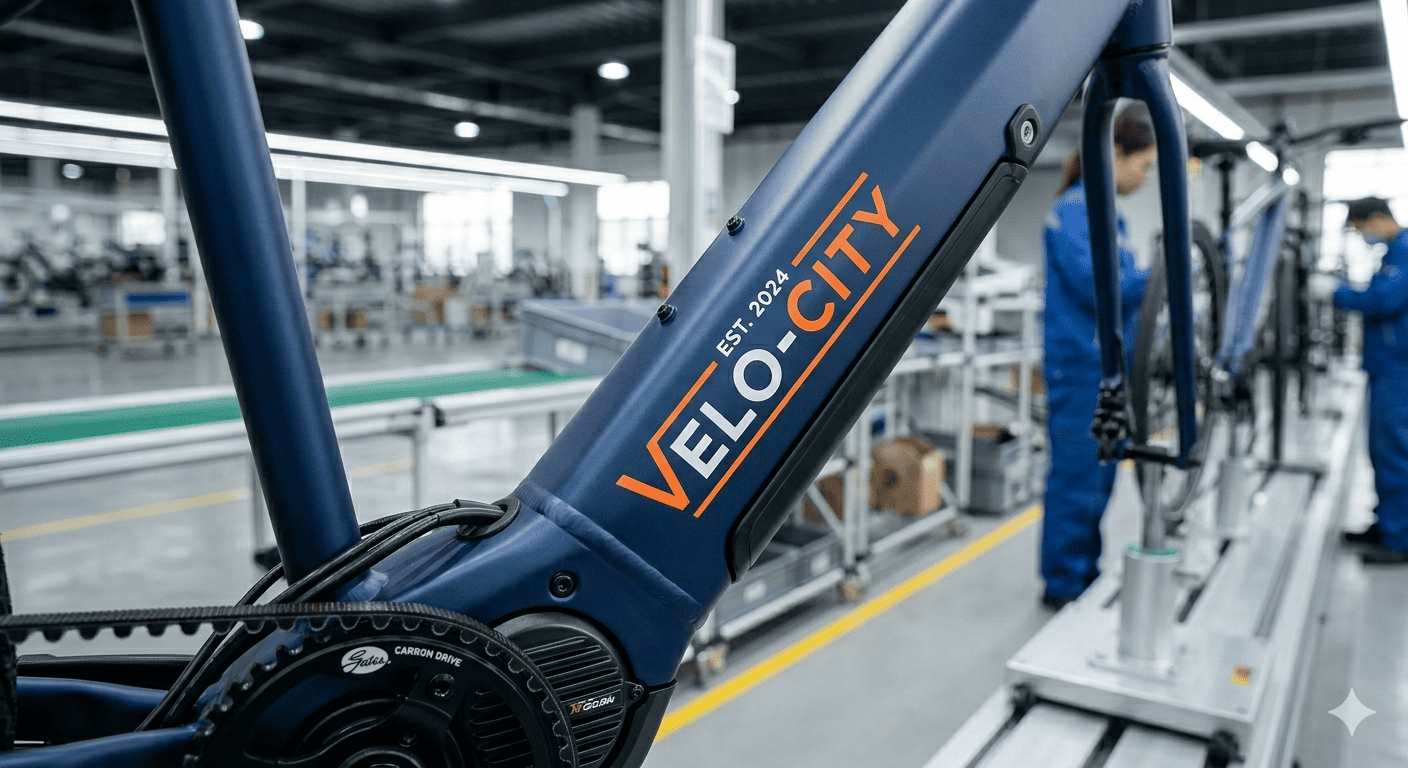
In my 15 years of experience, this is the biggest point of confusion for new buyers. They believe ODM means "off-the-shelf" with zero changes, and OEM means "build whatever you want." The reality is much simpler. The main difference is the bike frame. If you are happy to use one of our existing, proven frame designs, you are in the ODM world. This doesn't mean your bike will look like everyone else's. You still have control over the most important elements that define your brand's performance and style. We can work together to select the perfect motor, battery capacity, display, and braking system. You choose the exact paint color and apply your own unique decals and branding.
OEM is only necessary when you want a frame shape that doesn't exist yet%%%FOOTNOTE_REF2%%%. This could be for a unique aesthetic or a specific technical requirement, like a new type of suspension. [Creating a new frame requires us to build new molds, which is a significant investment in both time and money](https://en.wikipedia.org/wiki/Molding(process))3. For a new brand, you have to ask: is a slightly different tube shape worth thousands of dollars and an extra three months of waiting?
| Feature | ODM (Original Design Manufacturing) | OEM (Original Equipment Manufacturing) |
|---|---|---|
| Frame | Use existing, factory-designed frame | Requires new, custom-designed frame |
| Components | Fully customizable (motor, battery, brakes, etc.) | Fully customizable (motor, battery, brakes, etc.) |
| Branding | Fully customizable (paint color, logos, decals) | Fully customizable (paint color, logos, decals) |
| Initial Cost | Low (no mold fees) | High (requires mold investment) |
| Best For | New brands, quick market entry, budget-conscious | Established brands, unique frame requirements |
How Does Minimum Order Quantity Affect Your Price?
Are you planning to start small with a test batch of e-bikes? Be careful. The minimum order quantity (MOQ) for an OEM project can make your unit cost explode and price you out of the market.
OEM often requires a high Minimum Order Quantity (MOQ)4 to absorb the costs of tooling and production setup. In our experience, a small OEM order of 50-200 units can be 40-60% more expensive per bike5 than a standard ODM order. ODM is designed for cost-efficiency at lower volumes.
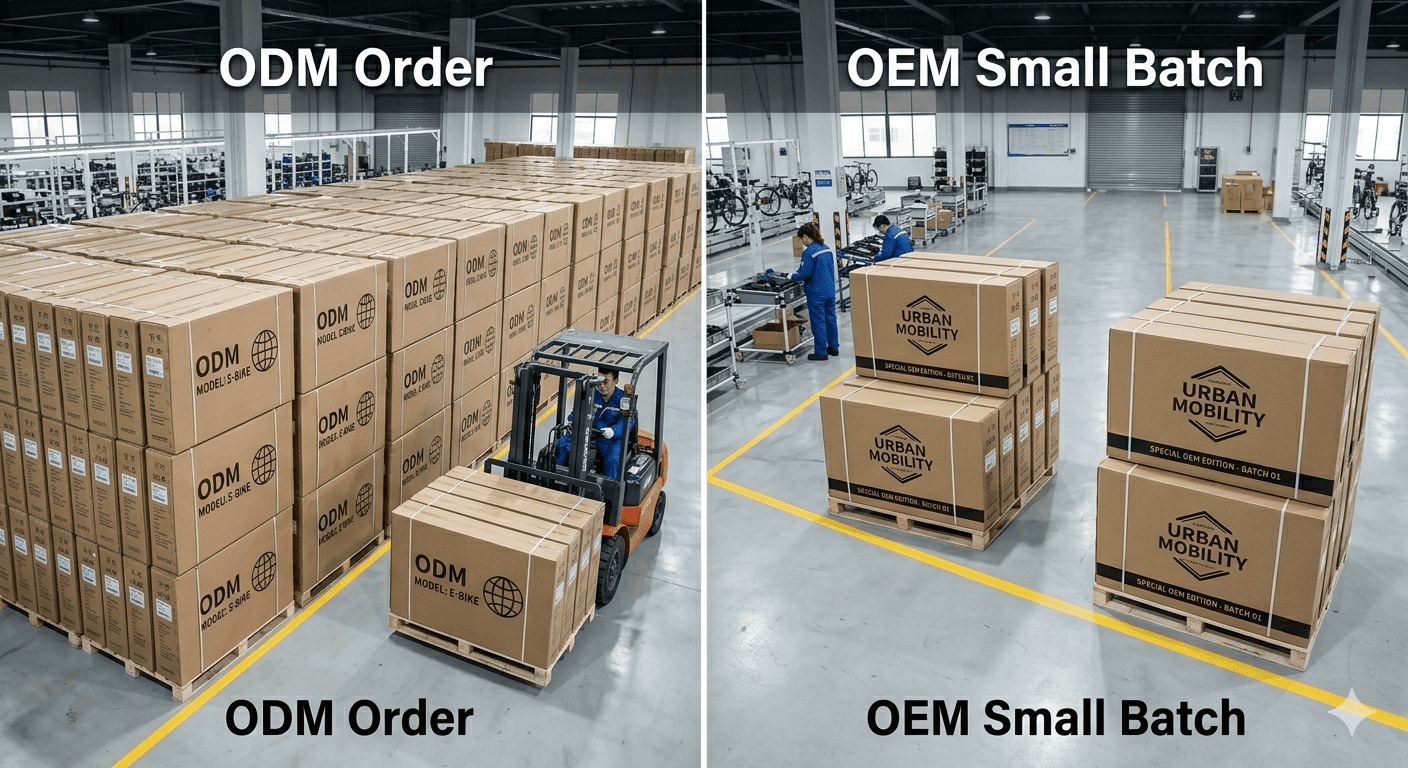
Let's look at this from a manufacturer's point of view. Setting up a production line for a brand-new frame has fixed costs6. We have to create the tooling, configure the machines, and train the assembly team. To make this process economical, we need to spread that cost over a large number of units. If you only order a small batch, that fixed cost gets divided among fewer bikes, making each one much more expensive. With ODM, the process is already established. The tooling exists, and our team is familiar with the frame. We can produce smaller batches much more efficiently.
A common scenario we see is a startup with a budget of around $80,000 choosing OEM. They invest heavily in a new mold, leaving little cash for a large first order. This leads to a painful choice. Forcing a small OEM order of 100 units can push the per-unit cost up dramatically. An e-bike that would cost $800 per unit via ODM might suddenly cost $1,200 or more via OEM at that low volume. This either crushes your profit margin or forces you to set a retail price that isn't competitive.
| Cost Factor | ODM (100-unit order) | OEM (100-unit order) |
|---|---|---|
| Base Unit Cost | $800 | $850 |
| Mold/Tooling Fee | $0 | $10,000 |
| Amortized Mold Cost | $0 | $100 ($10,000 / 100 units) |
| Final Cost Per Unit | $800 | $950 (or more) |
Note: These are illustrative numbers to show the concept.
Can Your Timeline Afford an OEM Production Schedule?
Are you racing to launch your e-bikes for the busy spring or summer season? Choosing OEM could mean you receive your inventory after the season is already over. A delayed launch kills momentum and sales.
ODM production is fast, often taking only 30-45 days from order confirmation to shipment7 because the frame and supply chain are already in place. OEM, especially with a new mold, typically requires 90-120 days for design, tooling, testing, and production8. This delay can cause you to miss key selling seasons.
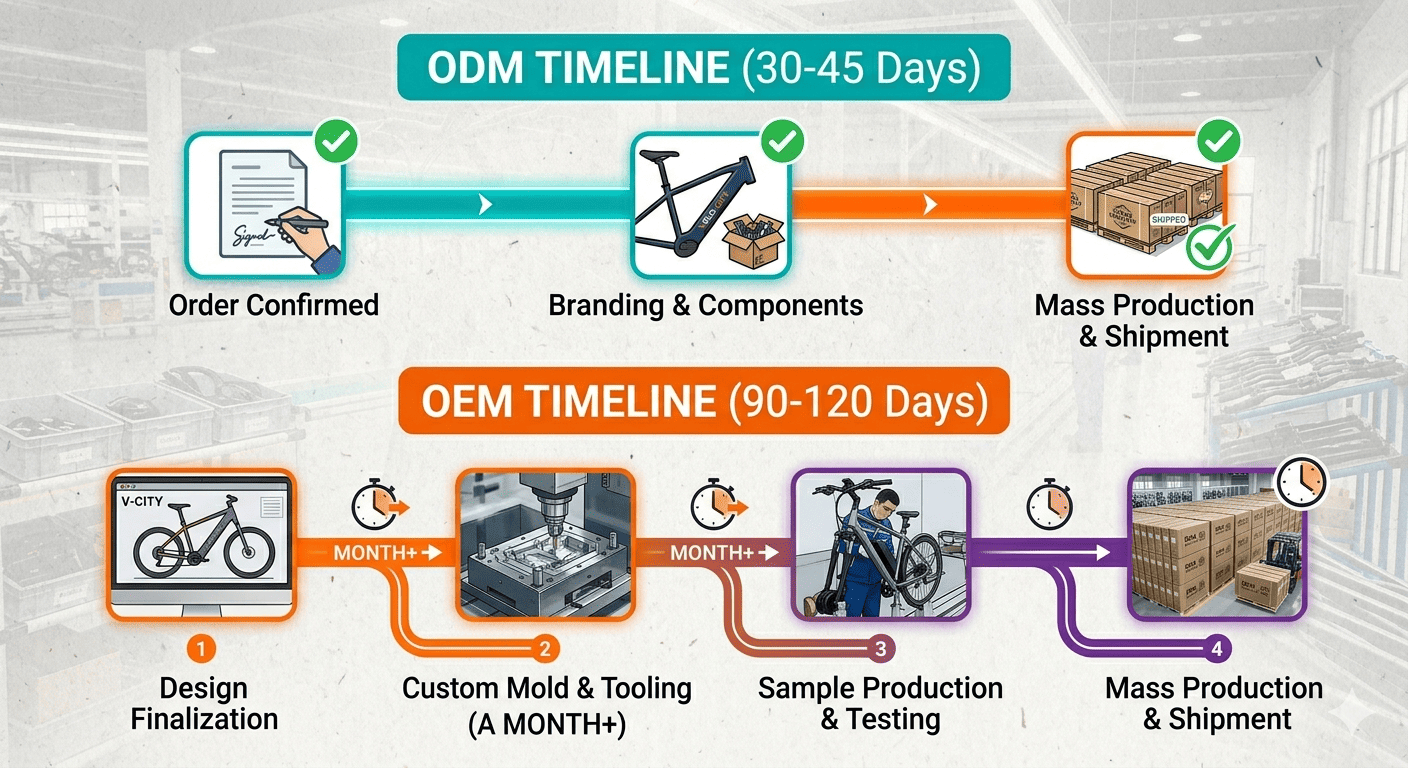
Speed to market is a massive advantage for any new business9. Getting your product in front of customers and generating cash flow is priority number one10. The production timeline is a non-negotiable part of this equation. An ODM project is straightforward because the complex parts are already solved. We confirm your component and branding choices, and then the bikes go into our standard production queue11.
An OEM project is a multi-stage process that cannot be rushed. First, we have to finalize the engineering drawings for your custom frame. Then, we have to create the physical molds, which alone can take a month or more12. After that, we produce the first samples, which you must test and approve. Only after you sign off on the sample can we begin mass production. We've seen brands plan for a May launch, finalize an OEM order in January, and not receive their shipment until August. They completely missed the peak of the riding season. For a new company, that's a devastating blow.
| Production Stage | ODM Timeline | OEM Timeline (with new mold) |
|---|---|---|
| Design & Confirmation | 1-2 Weeks | 2-4 Weeks |
| Mold & Tooling | N/A | 4-6 Weeks |
| Sample Production & Test | N/A | 2-3 Weeks |
| Mass Production | 4-5 Weeks | 4-5 Weeks |
| Total Estimated Time | 30-45 Days | 90-120 Days |
Conclusion
Your choice between OEM and ODM is a strategic one. It depends on your capital, timeline, and volume. For most new brands, ODM is the smarter path to a fast, affordable launch.
"Original design manufacturer - Wikipedia", https://en.wikipedia.org/wiki/Original_design_manufacturer. ODM (Original Design Manufacturing) arrangements typically allow buyers to customize branding, colors, and select components while using the manufacturer's existing product designs and tooling, distinguishing it from fully custom OEM production. Evidence role: definition; source type: encyclopedia. Supports: the general definition and scope of customization available in ODM manufacturing arrangements. Scope note: General manufacturing definition may not specifically address e-bike industry practices ↩
"Original equipment manufacturer - Wikipedia", https://en.wikipedia.org/wiki/Original_equipment_manufacturer. OEM manufacturing is characterized by the creation of custom tooling and molds to produce products according to buyer specifications, whereas ODM uses existing designs and manufacturing infrastructure. Evidence role: definition; source type: education. Supports: the technical distinction that OEM manufacturing involves custom tooling and molds for unique product designs. Scope note: General manufacturing principle rather than e-bike-specific validation ↩
"Molding (process) - Wikipedia", https://en.wikipedia.org/wiki/Molding_(process). Custom tooling and mold fabrication in manufacturing typically requires substantial upfront capital investment and lead time, often representing one of the largest fixed costs in new product development. Evidence role: general_support; source type: education. Supports: that custom mold and tooling creation represents a significant capital investment in manufacturing. Scope note: General manufacturing principle rather than bicycle-specific cost data ↩
"Minimum Order Quantities (MOQ): Wholesale Practices for ... - JOOR", https://www.joor.com/insights/minimum-order-quantities-moq. Minimum Order Quantity (MOQ) is the smallest number of units a manufacturer will produce in a single production run, established to ensure fixed setup and production costs can be economically distributed across sufficient volume. Evidence role: definition; source type: encyclopedia. Supports: the definition and economic rationale for minimum order quantities in manufacturing. ↩
"Economies of scale - Wikipedia", https://en.wikipedia.org/wiki/Economies_of_scale. In manufacturing economics, fixed costs such as tooling and setup are amortized across production volume; smaller production runs result in substantially higher per-unit costs as these fixed expenses are distributed among fewer units. Evidence role: mechanism; source type: education. Supports: the economic principle that fixed tooling costs significantly increase per-unit costs in small production runs. Scope note: Supports the general mechanism but does not validate the specific 40-60% figure claimed ↩
"Managerial Costs | Ag Decision Maker", https://www.extension.iastate.edu/agdm/wholefarm/html/c5-209.html. Manufacturing economics distinguishes between fixed costs (expenses that remain constant regardless of production volume, such as tooling, setup, and equipment) and variable costs (expenses that scale with units produced), with fixed costs requiring amortization across production runs. Evidence role: mechanism; source type: education. Supports: the economic principle that manufacturing involves fixed costs independent of production volume. ↩
"ODM Meaning Explained: Definition, Examples & ODM vs OEM (2026)", https://qoblex.com/blog/what-does-odm-mean-complete-guide-to-original-design-manufacturing/. ODM manufacturing arrangements typically feature shorter production lead times compared to OEM because manufacturers utilize pre-existing designs, established supply chains, and proven production processes. Evidence role: general_support; source type: other. Supports: that ODM manufacturing generally offers shorter lead times due to use of existing designs and established production processes. Scope note: General principle rather than validation of the specific 30-45 day timeframe claimed ↩
"A Beginner's Guide to OEM Tools | SW - Shield Works", https://shieldworksmfg.com/a-beginners-guide-to-oem-tools/. Custom manufacturing projects requiring new tooling typically involve multiple sequential phases—design finalization, tool fabrication, sample production, testing, and mass production—each adding to total project duration. Evidence role: general_support; source type: education. Supports: that custom manufacturing with new tooling involves sequential stages including design, tooling fabrication, sampling, and production that extend total lead time. Scope note: Describes the general process but does not validate the specific 90-120 day timeframe ↩
"Market research and competitive analysis | U.S. Small Business ...", https://www.sba.gov/business-guide/plan-your-business/market-research-competitive-analysis. Business strategy research identifies time-to-market as a significant competitive factor, particularly for new entrants, as faster product launches enable earlier revenue generation, market feedback, and competitive positioning. Evidence role: expert_consensus; source type: paper. Supports: that time-to-market is recognized as a critical success factor in new product launches. Scope note: General business principle rather than e-bike industry-specific research ↩
"Cash flow management and its effect on firm performance - PMC - NIH", https://pmc.ncbi.nlm.nih.gov/articles/PMC10281586/. Entrepreneurship research consistently identifies cash flow management as a critical success factor for new ventures, with inadequate cash flow cited as a leading cause of early-stage business failure. Evidence role: expert_consensus; source type: education. Supports: that cash flow management is critical for startup survival and success. ↩
"[PDF] Multi-Job Production Systems: Definition, Problems, Analysis, and ...", https://web.eecs.umich.edu/~smm/publications/MJP/MJPfull.pdf. Standardized manufacturing processes enable more efficient production scheduling, as products using existing designs and tooling can be integrated into established production workflows with minimal setup time or process modification. Evidence role: mechanism; source type: education. Supports: that standardized production processes allow for more efficient scheduling and resource allocation in manufacturing. ↩
"How long does it take to get an injection molded part made? - Orbit", https://orbit-kb.mit.edu/hc/en-us/articles/206442713-How-long-does-it-take-to-get-an-injection-molded-part-made-. Mold and tooling fabrication in manufacturing involves precision machining, material processing, and quality verification, typically requiring several weeks to months depending on complexity and specifications. Evidence role: general_support; source type: education. Supports: that mold and tooling fabrication is a time-intensive process in manufacturing. Scope note: General principle rather than validation of the specific 'month or more' timeframe ↩