
-71.png)
In-depth analysis of 2026 electric scooter market trends in Europe and North America, providing importers, wholesalers, and OEM/ODM buyers with core market insights, latest regulatory updates, and practical procurement guidelines.
Introduction
The global electric scooter market is expected to reach $37.13 billion in 2026, with a compound annual growth rate of 9.2%, where the European and North American markets combined account for 40% of global demand. For suppliers, distributors, and procurement teams operating both electric bicycles and electric scooters, this market holds tremendous growth opportunities—but success hinges on precisely grasping rapidly changing regulatory environments, shifting consumer preferences, and emerging supply chain challenges.
This guide comprehensively breaks down core trends in the 2026 European and North American electric scooter markets, providing B2B buyers with actionable product portfolio optimization, compliance assurance, and procurement strategy recommendations, while helping your independent site acquire high-quality Google organic search traffic and precise procurement visitors.
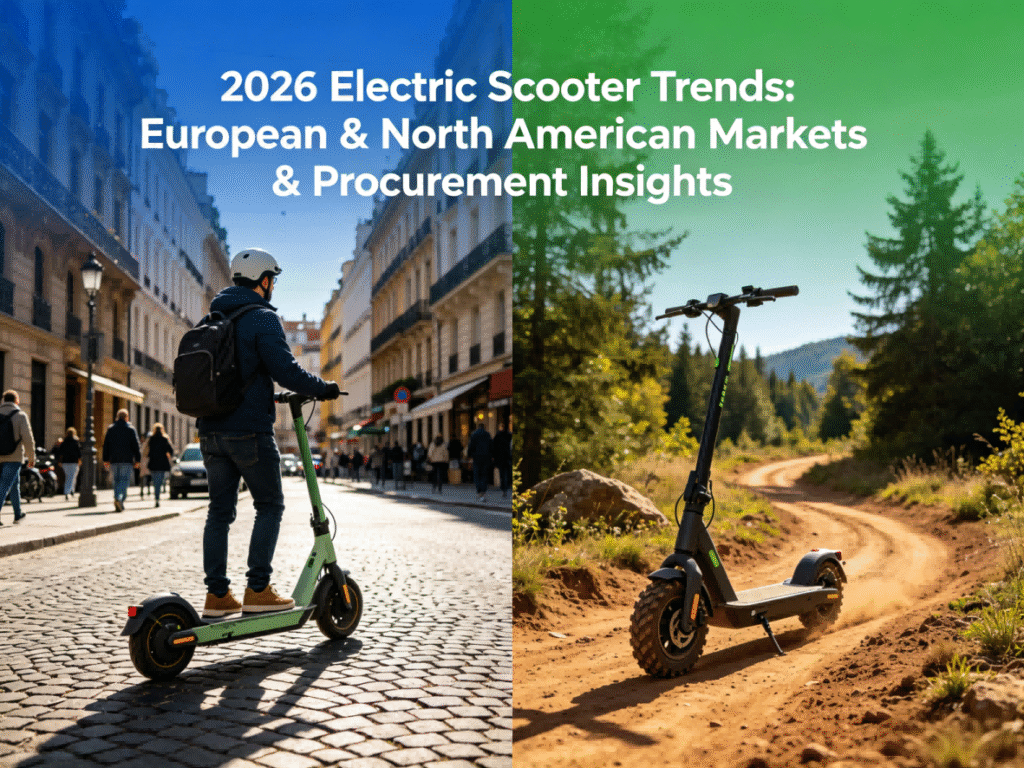
1. 2026 European & North American Electric Scooter Market Landscape: Europe vs. North America
1.1 European Market: Policy-Driven Mature High-Value Market
Europe remains the world’s most mature and highest-priced electric scooter market, with Germany, France, Italy, and Spain as the four core consumer countries.
- Market Size: €8.2 billion in 2026, with a compound annual growth rate of 7.8%
- Core Growth Drivers:
- Government policy support for sustainable urban mobility
- Continuous expansion of dedicated bicycle and scooter lanes
- Deep integration with public transportation systems
- Rising fuel prices and worsening urban congestion
- Market Structure: 65% individual purchases, 35% shared mobility fleets
Important Note: 2026 is a critical year for comprehensive regulatory tightening in Europe, which will fundamentally reshape product requirements and procurement strategies.
1.2 North American Market: Faster Growth, Strong Demand for High-Power Models
The North American market is growing significantly faster than Europe, with a compound annual growth rate of 12.3% in 2026.
- Market Size: $7.4 billion in 2026
- Core Growth Drivers:
- Strong outdoor recreation culture
- High acceptance of high-power models
- Explosive growth in last-mile delivery demand
- Accelerating urbanization and worsening traffic congestion
- Market Characteristics: Higher average selling prices, particularly strong demand for off-road and high-performance models
2. 2026 Regulatory Updates: Biggest Challenge for Importers
Compliance has become the top priority for electric scooter importers, with both Europe and North America implementing significant regulatory changes in 2026.
2.1 EU and European Countries Regulatory Updates
Multiple European countries will implement stricter regulations effective in 2026:
- Italy (Effective May 16, 2026): Mandatory requirement for all electric scooters to install “mini license plates” linked to owner’s tax number, mandatory insurance purchase, all riders must wear helmets
- Austria (Effective May 1, 2026): Riders under 16 must wear helmets, blood alcohol content limit reduced to 0.5‰
- Slovenia: Minimum riding age increased from 12 to 15 years
- Belgium: New mandatory lighting and reflective device requirements
- EU-wide: EN 17128 safety standard now mandatory for all electric scooters sold in the EU
Core European Market Compliance Requirements:
- Maximum power: 250W
- Maximum speed: 25km/h
- Most countries prohibit pure throttle drive (pedal-assist only)
- EN 17128 certification
- CE marking
- Battery UN 38.3 certification
2.2 North American Regulatory Updates
The United States and Canada are also strengthening safety standards:
- United States:
- UL 2272 battery safety certification becoming mandatory in more states including New York, California, Texas
- CPSC (Consumer Product Safety Commission) enforcement significantly enhanced
- Three-tier classification system remains unchanged (Class 1: 20mph pedal-assist; Class 2: 20mph throttle; Class 3: 28mph pedal-assist)
- Canada:
- Similar three-tier classification system to the US
- Must comply with Transport Canada safety standards
- Significant variations in specific regulations across provinces
Key Procurement Tip: Non-compliant products face border seizure, hefty fines, or even product recalls. Always independently verify supplier certification credentials before placing orders.
[Image suggestion: Compliance checklist infographic]
Visual checklist clearly listing all mandatory certification requirements for EU and US markets
3. 2026 Electric Scooter Product Trends: Categories Most Watched by Buyers
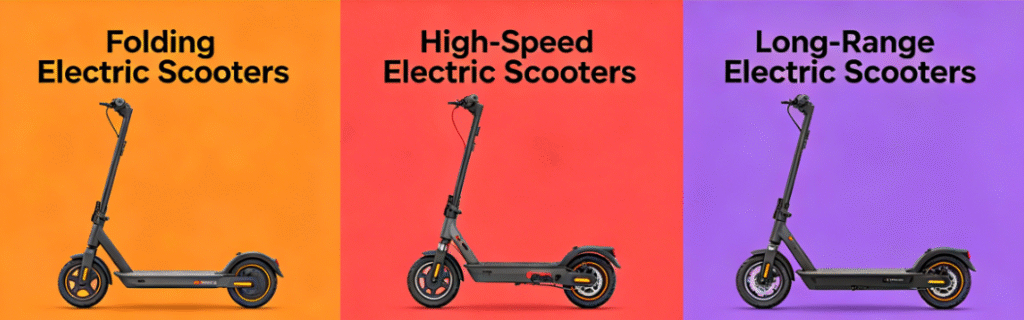
3.1 Five Best-Selling Product Categories
The following are core electric scooter types driving sales growth in 2026:
- Premium Commuter Scooters (Highest Sales Volume)
- Range: 40-60km per charge
- Core Features: Folding design, integrated lighting, suspension system, smartphone connectivity
- Price Range: $500-1,200
- Hot Markets: Europe and North America-wide
- Off-Road All-Terrain Scooters (Fastest Growth)
- Core Features: Fat tires, dual motors, full suspension, high ground clearance
- Power: 500W-2000W (compliant in North America only)
- Price Range: $800-2,500
- Hot Markets: United States, Canada, and Nordic countries
- Compact Folding Scooters
- Weight: Under 15kg
- Core Advantage: Ultra-compact design, easy to carry on public transportation
- Price Range: $300-700
- Hot Markets: Dense European metropolitan areas
- Seated Electric Scooters
- Core Features: Comfortable seat, large wheels, higher stability
- Application Scenarios: Long-distance commuting, delivery services
- Price Range: $600-1,500
- Hot Markets: Europe and North America-wide, particularly strong commercial demand
- High-Performance “Super Scooters”
- Power: 2000W+
- Speed: 50km/h+
- Price Range: $2,000-5,000
- Hot Markets: North America and select Western European countries
3.2 Market-Shaping Technology Trends
The following features have become industry standards in 2026:
- Battery Technology:
- 48V lithium batteries universally adopted
- Fast charging (2-3 hours to 80%) mainstream
- Swappable battery systems rapidly expanding in commercial applications
- Upgraded Battery Management Systems (BMS) enhancing safety and lifespan
- Safety Features:
- Dual disc brakes with ABS
- Full LED lighting systems (front, rear, side lights)
- Reflective material applications
- Electronic stability control systems
- Smart Features:
- GPS positioning and anti-theft systems
- Smartphone APP connectivity
- Riding data monitoring
- OTA (Over-The-Air) firmware updates
- Design Trends:
- Lightweight aluminum alloy frames
- Europe prefers minimalist, clean aesthetic design
- North America prefers rugged, robust off-road style
- Ergonomic optimization enhancing long-distance riding comfort
4. European vs. North American Market Preference Differences: Precision Adaptation Wins Orders
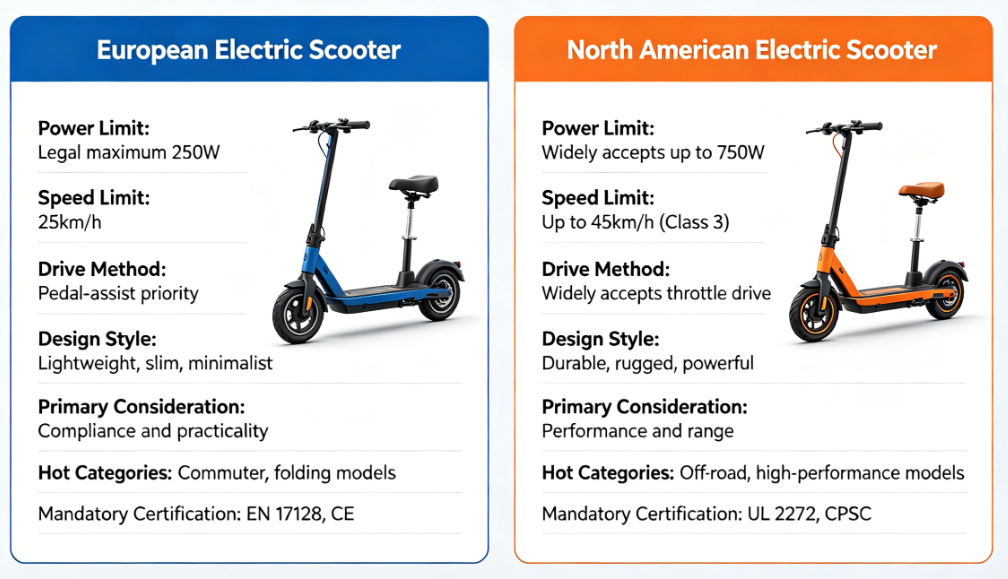
Deep understanding of the following differences is key to successfully entering target markets:
| Product Dimension | European Electric Scooter Core Focus | North American Electric Scooter Core Focus |
|---|---|---|
| Power Limit | Legal maximum 250W | Widely accepts up to 750W |
| Speed Limit | 25km/h | Up to 45km/h (Class 3) |
| Drive Method | Pedal-assist priority | Widely accepts throttle drive |
| Design Style | Lightweight, slim, minimalist | Durable, rugged, powerful |
| Primary Consideration | Compliance and practicality | Performance and range |
| Hot Categories | Commuter, folding models | Off-road, high-performance models |
| Mandatory Certification | EN 17128, CE | UL 2272, CPSC |
5. 2026 Procurement Hotspots & Supply Chain Insights
5.1 Global Major Production Bases
- China (Core Supply Country):
- Occupies 85% of global production share
- Most complete supply chain ecosystem
- Covers full price range from entry-level to premium
- Strong OEM/ODM customization capabilities
- Core industrial clusters: Shenzhen, Zhejiang, Jiangsu
- Vietnam & Thailand (Emerging Alternative Production Locations):
- Enjoy tariff advantages for exports to US and Europe
- Production capacity continuously expanding
- Suitable for mid-to-low-end product manufacturing
- Supply chain maturity lower than China
- European Local Production:
- Smaller scale but growing rapidly
- Shorter delivery times, more convenient logistics
- Higher production costs
- Focus on premium and customized products
5.2 2026 Supplier Selection Core Criteria
When evaluating suppliers, prioritize the following factors:
- Certification Expertise:
- Successful experience with EN 17128 and UL 2272 certifications
- Ability to provide all complete documentation required for customs clearance
- Quality Control Capability:
- ISO 9001 quality management system certification
- Internal testing laboratory
- Strict end-to-end quality control
- Comprehensive warranty terms
- Production Capacity & Flexibility:
- Ability to handle both small and large volume orders
- Reasonable delivery cycles (30-45 days for standard models)
- Support for customization and OEM/ODM projects
- After-Sales Support:
- Adequate spare parts supply
- Professional technical support
- Comprehensive warranty service
- Product training for your team
5.3 Procurement Peak Seasons & Inventory Planning
- Core Procurement Peak Season: Q1 to Q2 (January-May)
- Retailers stock up for summer riding season
- Shared mobility fleets expand before peak demand
- Secondary Peak Season: Q4 (October-November)
- Holiday season sales preparation
- Preparation for next year’s spring sales
- MOQ Reference:
- Entry-level: 100-500 units
- Mid-range: 50-200 units
- Premium: 20-100 units
6. 2026 Procurement Strategy & Risk Control
6.1 Recommended Product Portfolio Configuration
- Volume Stable Models: Premium commuter scooters (50-60% of inventory)
- High-Profit Growth Models: Off-road all-terrain scooters (20-25% of inventory)
- Niche Opportunity Models: Compact folding and seated scooters (15-20% of inventory)
- Recommend Avoiding: Unbranded, safety and compliance questionable low-cost inferior products
6.2 Risk Mitigation Strategies
- Compliance First:
- Independently verify authenticity of all certification documents
- Request test reports and send samples for testing
- Choose suppliers specializing in your target markets
- Supply Chain Diversification:
- Maintain relationships with 2-3 core suppliers
- Consider procurement model combining Chinese and Southeast Asian production locations
- Establish safety stock in advance for peak seasons
- Quality Assurance:
- Execute strict pre-shipment inspection
- Random sampling and testing from each batch
- Clearly specify quality standards and liability in contracts
- Market Dynamics Monitoring:
- Continuously track regulatory policy changes
- Monitor consumer trends and competitor dynamics
- Adjust product portfolio based on sales data
Conclusion
The 2026 European and North American electric scooter markets will continue to provide considerable growth opportunities for importers and wholesalers. However, the industry is rapidly maturing, and the era of relying solely on low-price competition is over.
2026 Core Success Factors:
- Compliance is an unbreachable bottom line, with requirements continuously increasing
- Consumers are willing to pay premiums for quality, safety, and advanced features
- Regional preference differences are becoming increasingly pronounced, requiring targeted product strategies
- China remains the global core manufacturing base, but supply chain diversification is worth considering