
Every month, I receive the same question from at least five different buyers: "Should I go to Europe or the US first?" They expect me to compare market sizes or profit margins. But after 15 years manufacturing eBikes, I learned the hard way that this question misses the point entirely. The real issue is not which market is bigger—it is whether your current product can legally enter that market before your sales window closes.
The right market for you is not the one with the highest growth rate—it is the one where your product can pass certification without expensive redesigns, and where you have time to build the necessary channel relationships before peak season hits. Most buyers choose based on market potential, then discover their SKU fails compliance testing or arrives after demand drops.
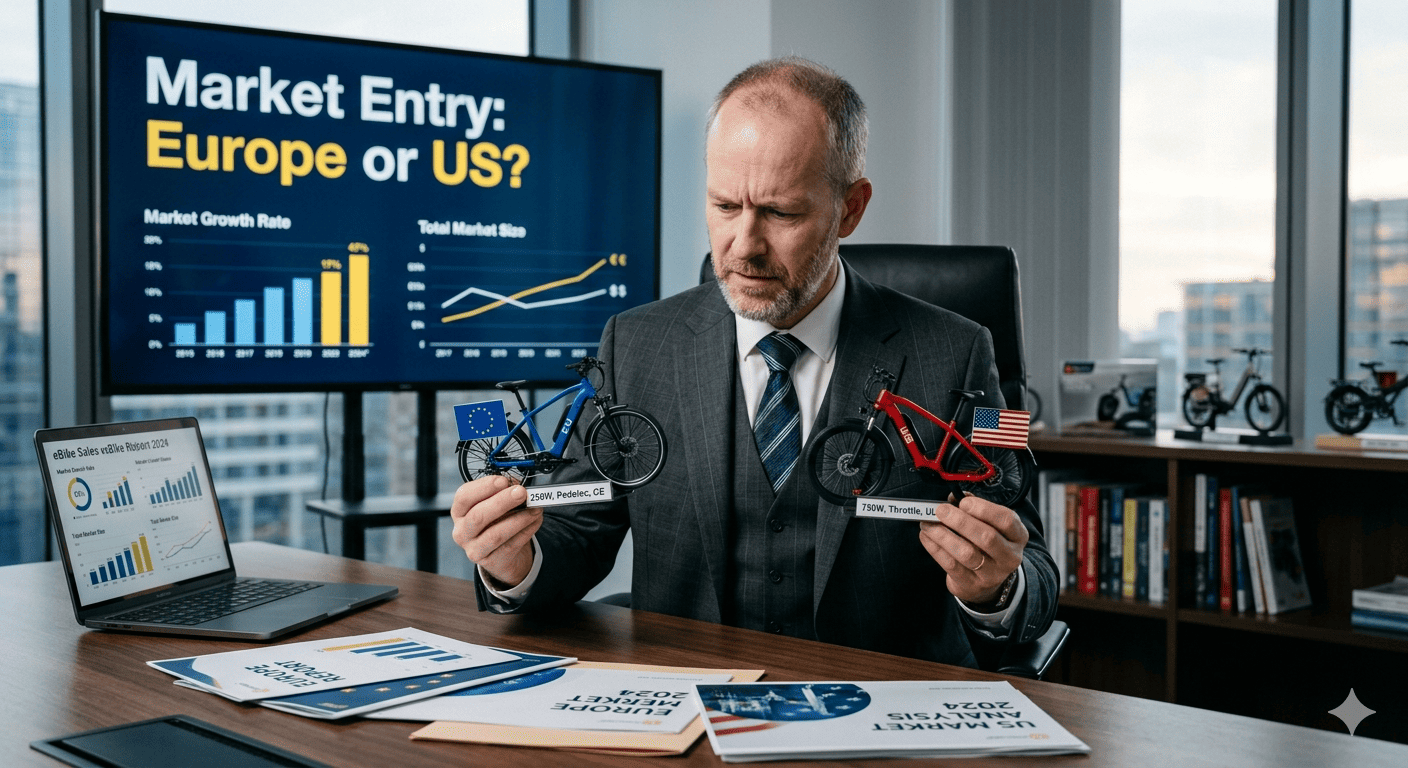
I have watched buyers invest in samples, book freight, and line up distributors—only to find out their 750W throttle eBike cannot be sold legally in the EU. Or their 250W pedelec sits in a US warehouse because retailers expected Class 3 speed capability. The market comparison matters less than the product-regulation fit.
What Do Buyers Misunderstand About Regulatory Differences?
Most buyers assume regulations are just paperwork. They see "CE marking" or "UL certification" as line items on a checklist. But I have seen entire product lines fail because buyers did not understand how power limits, speed caps, and throttle legality force physical redesigns—not just documentation changes.
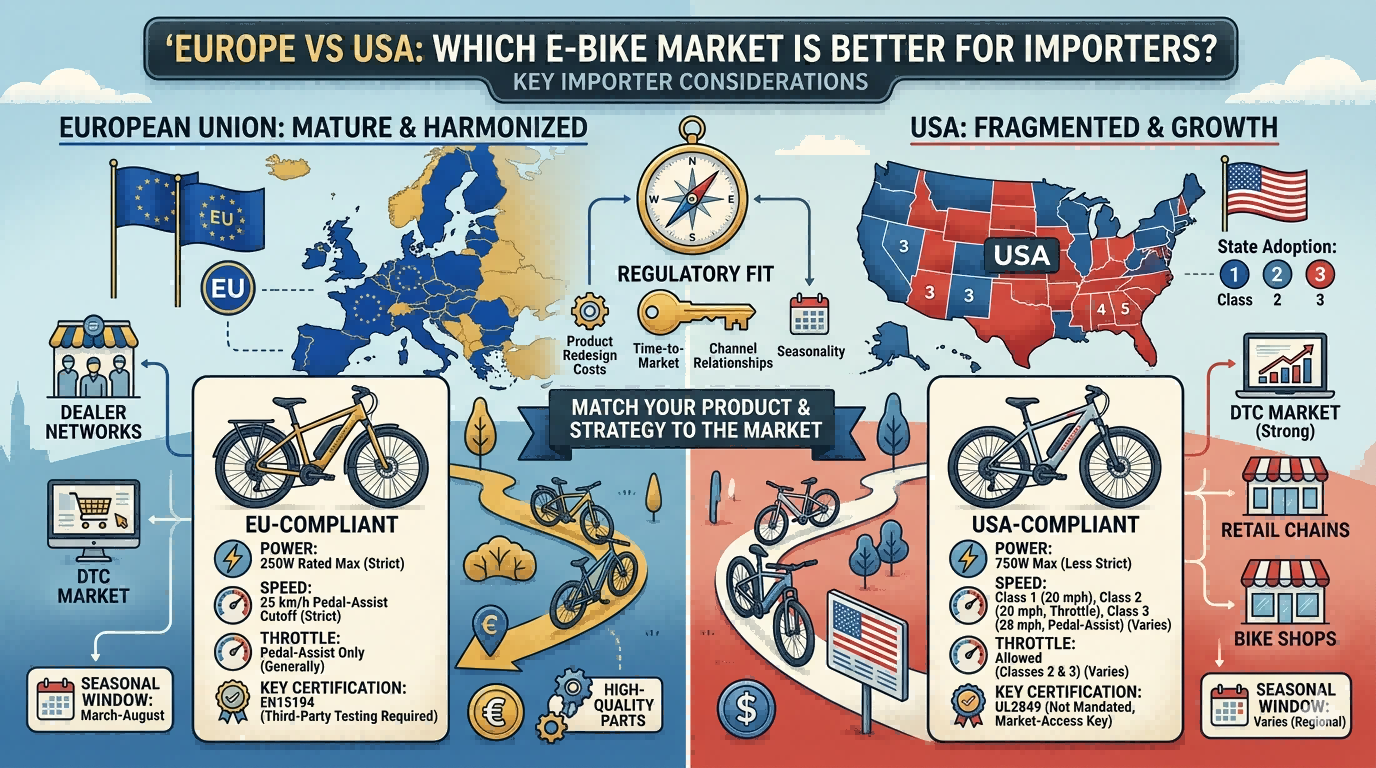
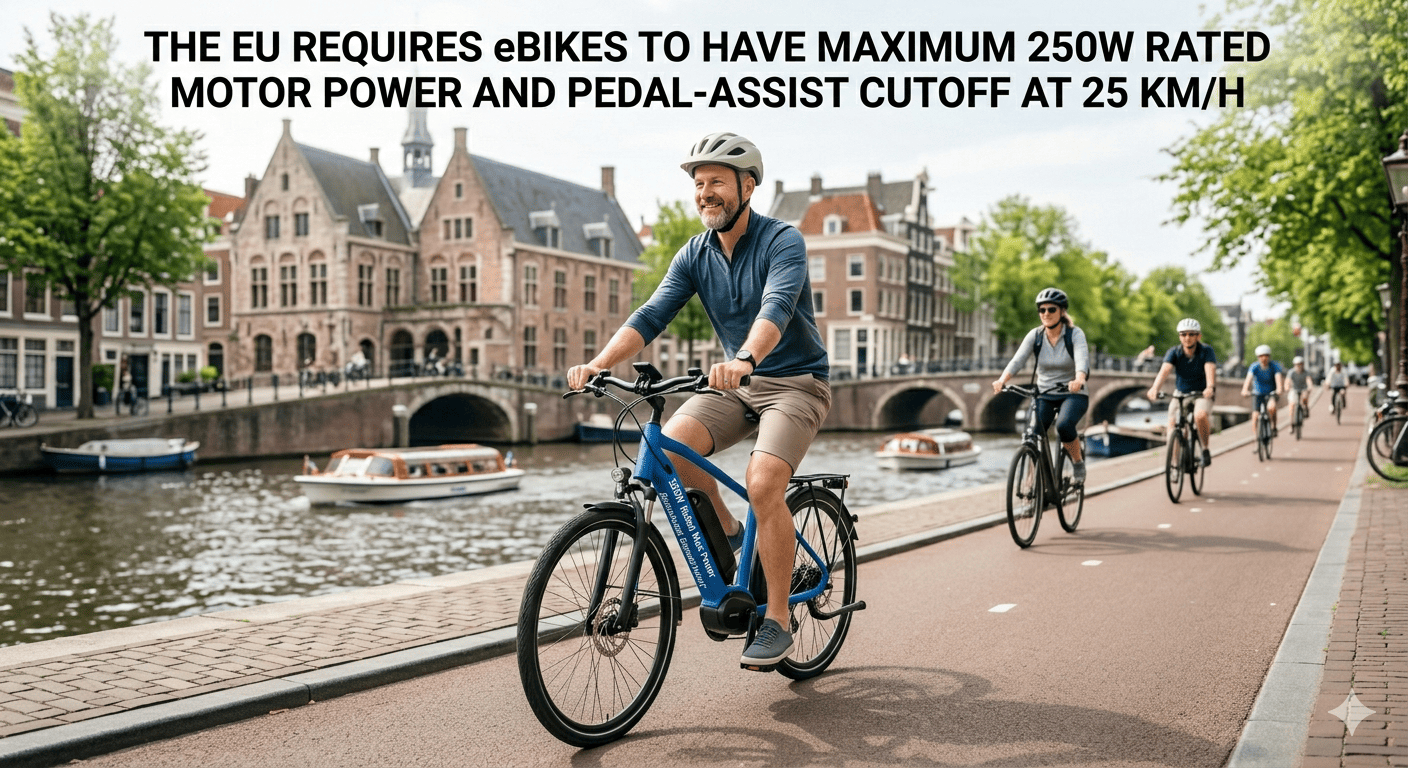
The EU requires eBikes to have maximum 250W rated motor power and pedal-assist cutoff at 25 km/h1. The US defines three classes with different power and speed rules2, and allows throttle operation in most states. Your product specs must match the legal definition in your target market, or you cannot sell it at all.
One buyer contacted me with a 500W rear-hub eBike designed for US Class 2. He wanted to enter Germany first because he heard "Europeans pay more for quality bikes." When I explained that his motor exceeded EU power limits, he asked if we could "just label it as 250W." I told him that EN15194 compliance testing measures actual power output under load3—not what the label says. Changing the label costs nothing, but redesigning the motor system costs thousands of dollars per SKU and adds 8-12 weeks to production timelines.
The US allows 750W motors for Class 2 and Class 3 eBikes in most states. But this does not mean your 750W product is automatically compliant. Some states have additional restrictions. And if your eBike has a throttle that works above 20 mph, it may be classified as a motor vehicle requiring registration in certain jurisdictions.
Here is what buyers need to verify before choosing a market:
| Specification | EU Requirement | US Class 1 | US Class 2 | US Class 3 |
|---|---|---|---|---|
| Motor Power | 250W rated max | 750W max | 750W max | 750W max |
| Speed Limit | 25 km/h (15.5 mph) | 20 mph | 20 mph | 28 mph |
| Throttle Allowed | No (pedal-assist only) | No | Yes (up to 20 mph) | No |
| Where Restricted | Bike paths, cycle lanes | Varies by state/city | Varies by state/city | Often banned from bike paths |
I have seen buyers lose three months of peak season because they assumed their product "mostly complies" with a market. There is no such thing as mostly compliant. Either your product passes the legal definition and certification tests, or it cannot be sold through legitimate channels.
How Do Certification Timelines Affect Your Market Entry?
Buyers often ask me which certification is "easier." I cannot answer that question, because certifications are not easy or hard—they have different costs, timelines, and testing requirements. What I can tell you is this: choosing a market without understanding certification lead times is like booking a flight without checking if you have a passport.
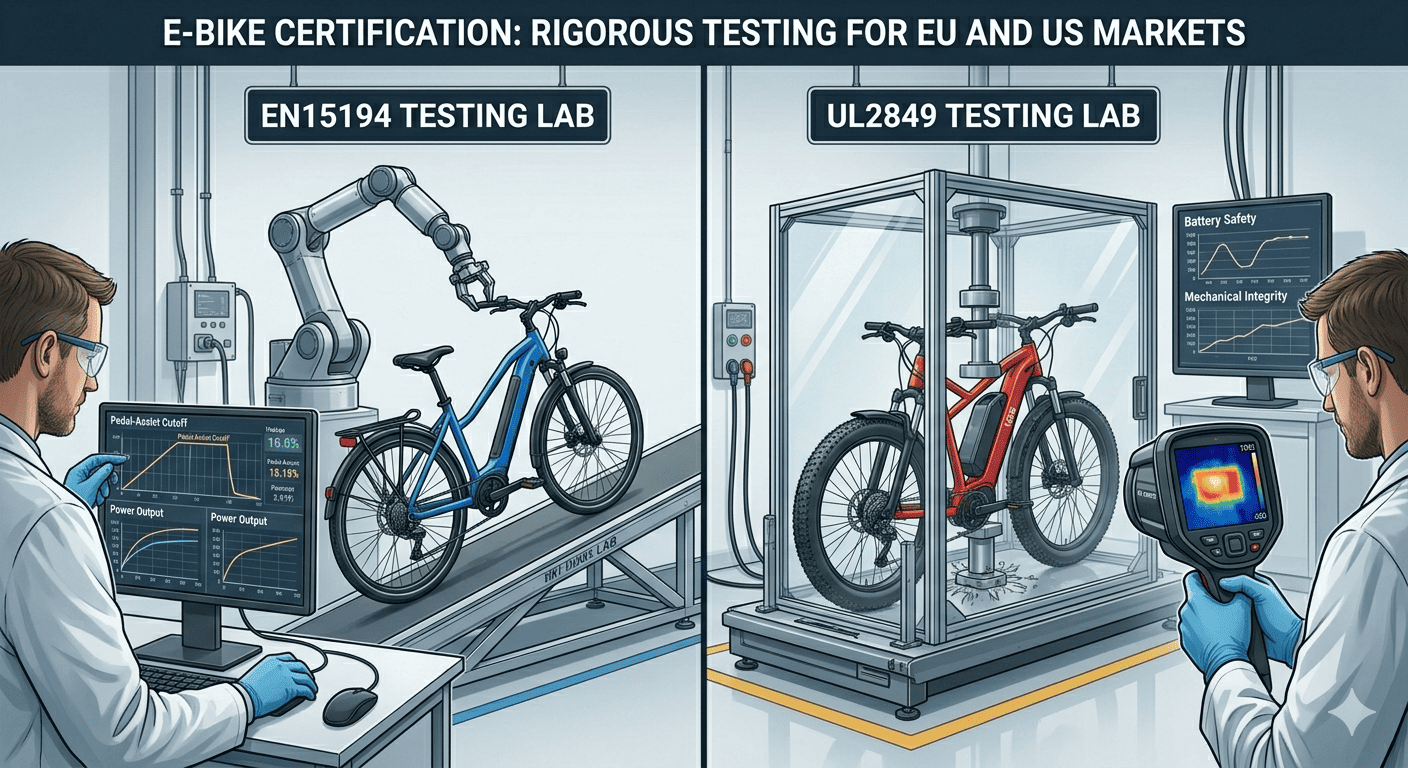
EN15194 certification for the EU typically takes 8-12 weeks once you submit samples4, assuming no failures. UL2849 certification for the US can take 10-16 weeks depending on the testing lab's queue5. Both require product samples, technical files, and factory documentation. If your samples fail any test, you restart the clock after making design changes.
I worked with one buyer who chose Europe because he believed CE marking was "self-certification" and would be faster than UL testing. He was partially right—CE marking does allow manufacturer self-declaration for some products. But eBikes fall under the Machinery Directive and EN15194 standard, which requires third-party testing6 of electrical safety, mechanical strength, and EMC emissions. His samples failed the EMC test twice because his controller generated radio frequency interference above allowed limits. Each failure added four weeks for redesign and retesting. By the time he received certification, it was October—past the EU spring-summer sales peak.
The US market has a different challenge. UL2849 is a safety standard covering battery systems, electrical components, and mechanical integrity7. But UL certification is not federally required for eBike sales—it is a market-access requirement. Major retailers like REI, Costco, and Target will not carry eBikes without UL certification8. Online platforms like Amazon strongly prefer it. So while you can technically sell in the US without UL certification through small retailers or DTC channels, you cut off most high-volume distribution options.
Here is what I tell buyers who ask about certification timelines:
-
For EU entry: Budget 10-14 weeks from sample submission to receiving your CE technical file and test reports. Add 4-6 weeks if you need design changes after initial testing. Do not start this process in February if you want to sell in May.
-
For US entry: Budget 12-18 weeks for UL2849 if you are a first-time applicant. Labs prioritize repeat customers. If you have never worked with UL before, expect longer queue times. Also budget for factory inspections if you want to use the UL mark on your product labels.
-
For both markets: Understand that your motor supplier's certifications do not automatically transfer to your complete eBike. The final product needs its own certification. I have seen buyers assume that using a "CE certified motor" means their whole bike is CE compliant. That is not how it works.
The timeline difference between certifications is not huge—but the seasonal timing can destroy your business case. If you are a new entrant, you probably have limited cash flow. Missing peak season by two months can mean carrying inventory through low-demand periods, or liquidating stock at a loss.
Why Does Channel Structure Matter More Than Market Size?
Buyers love talking about market size statistics. They show me reports saying "EU eBike sales reached X million units9" or "US market growing at Y percent annually." Then they ask which market they should enter. I always answer with a question: "Do you have relationships with dealers, or are you selling direct-to-consumer?"
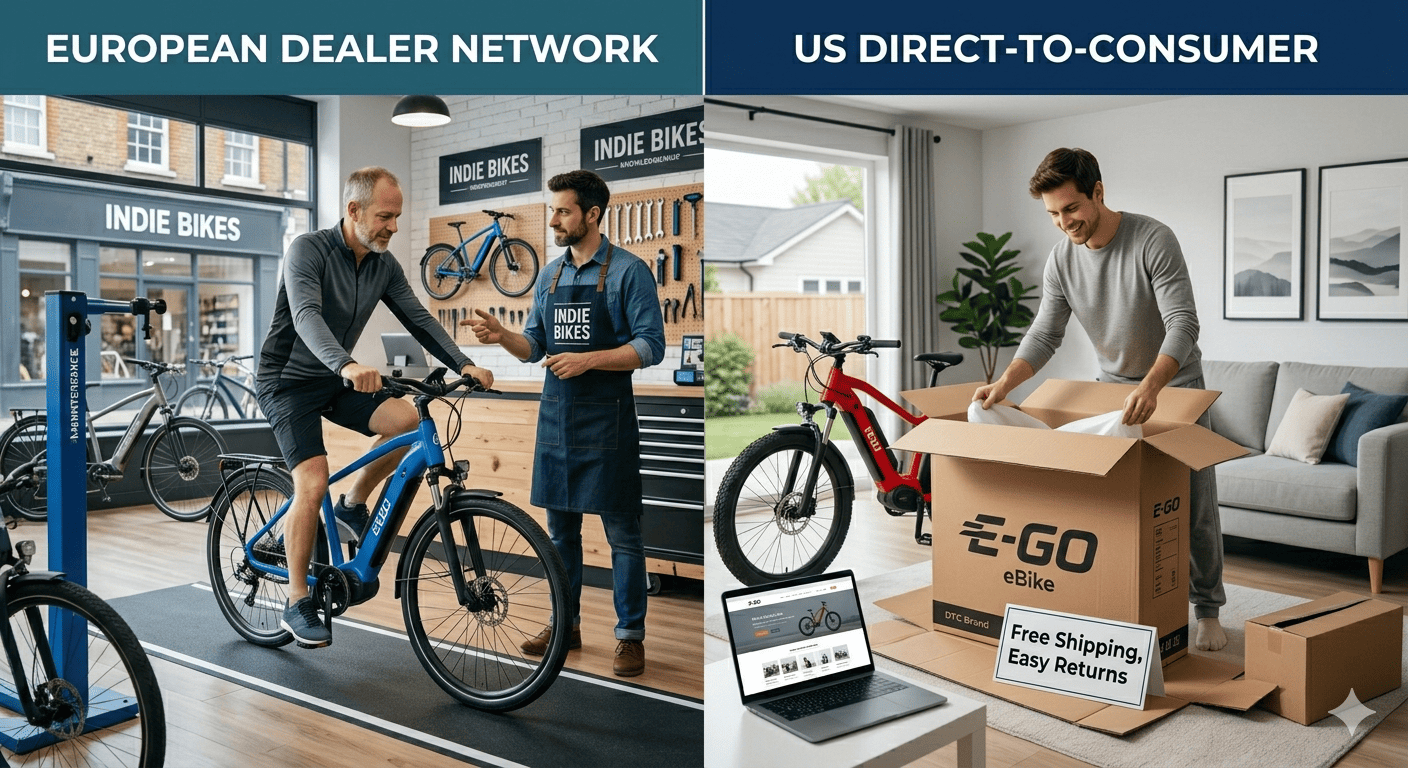
Europe has a mature dealer network where consumers expect in-person test rides, after-sales service, and local warranty support. The US has a mix of independent bike shops, outdoor retail chains, and fast-growing DTC brands. Your channel readiness determines whether you can actually reach customers, regardless of total market size.
I worked with one buyer who chose the EU market because the total addressable market looked larger in the industry reports he read. He had a good product—350Wh battery, Shimano components, competitive pricing. But he had no existing dealer relationships in Europe. He expected to attend one trade show, collect business cards, and start receiving orders.
What actually happened: European dealers asked about his service network, spare parts inventory, and warranty claim process. They wanted to know if he had a regional warehouse. They asked which other dealers in their area already carried his brand, because they did not want to compete on the same street with another shop selling identical models. He could not answer these questions. After six months, he had signed two small dealers who ordered 10 units each for testing. His container held 200 units.
The US market has different challenges. Big-box retailers like Costco or Dick's Sporting Goods can move high volumes, but they require UL certification, product liability insurance with specific coverage limits10, and often ask for exclusive SKUs to avoid price comparison. Independent bike shops want high margins and expect you to protect their territory from online undercutting11. DTC brands bypass these issues but require heavy investment in digital marketing, customer service infrastructure, and reverse logistics for returns.
Here is how I suggest buyers evaluate their channel readiness:
For EU Market Entry
- Do you have contacts with distributors who already serve multiple dealers in your target countries?
- Can you provide multilingual user manuals, warranty cards, and customer service in local languages?
- Are you prepared to ship spare parts (batteries, controllers, displays) to a regional warehouse for dealer access?
- Do you understand that dealers expect 6-12 months of relationship building before placing significant orders?
For US Market Entry
- If targeting retail chains: Do you have UL2849 certification, $5-10M product liability insurance, and ability to produce exclusive SKUs?
- If targeting bike shops: Can you offer protected territories and margins above 35% while staying price-competitive with online brands?
- If going DTC: Do you have budget for paid advertising, website development, and customer support handling assembly questions and warranty claims?
The mistake I see repeatedly is buyers choosing a market based on size, then discovering they lack the infrastructure to access customers. Market size tells you the ceiling. Channel readiness tells you whether you can reach it.
What Question Should Buyers Ask Before Choosing a Market?
After handling hundreds of buyer inquiries from both markets, I now start every conversation with the same question: "Show me your product specs, and tell me your timeline." Most buyers want to discuss pricing, order quantities, or customization options. But none of that matters if their product cannot legally enter their chosen market, or if they miss the sales window.
The first question is not "Which market is bigger?" It is "Does my current product require redesign for Market A or Market B, and can I afford the time and cost to make those changes before peak season?"
I had a buyer contact me in January with a 750W throttle eBike designed for the US market. He wanted to know if he should "also do Europe" with the same product. I asked him if he was prepared to change the motor to 250W, remove the throttle entirely, add pedal-assist sensors, and reprogram the controller to cut power at 25 km/h. He said "How much does that cost?" I told him it would require new controller programming, different motor winding, and likely a new display unit—roughly $180-220 per unit in additional costs, plus 8-10 weeks for redesign and testing12. He went quiet. Then he asked if we could "just make it switchable between markets." I explained that switchable power modes do not make a product legally compliant in both markets—because the EU tests the maximum possible output, not what mode it is set to at time of sale.
This happens constantly. Buyers see two large markets and assume they can serve both with one product. But regulatory definitions force you to choose. Your product is either EU-compliant or US-compliant, and making it work for both usually means developing two separate SKUs with different bills of materials.
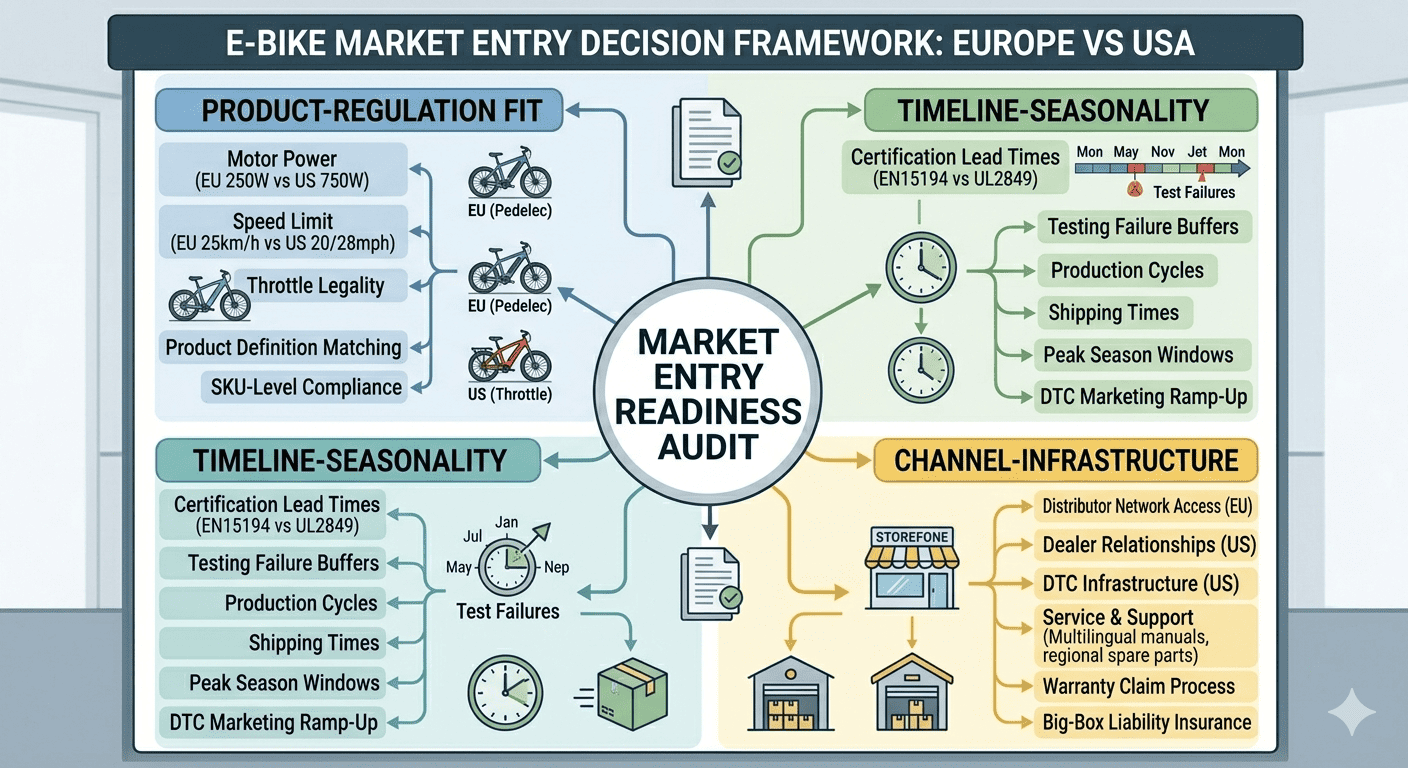
Here is the readiness audit I walk buyers through:
Product-Regulation Fit Questions
- What is your motor's rated power output (not peak power, but continuous rated power)?
- What is your eBike's maximum assisted speed with pedal input?
- Does your eBike have a throttle, and can it operate without pedaling?
- Which market's legal definition does your current design already match?
Timeline-Seasonality Questions
- When do you need products delivered to your warehouse or distribution center?
- Have you accounted for certification testing timelines in your production schedule?
- If your samples fail initial testing, do you have buffer time for design changes and retesting?
- Does your cash flow support carrying inventory through off-season if you miss peak demand?
Channel-Infrastructure Questions
- Do you have existing relationships in your target market, or are you starting from zero?
- How long will it take you to establish distribution agreements or build a DTC customer base?
- Can you support warranty claims, returns, and service requests in your target market?
The buyers who succeed are not the ones who pick "the better market"—they are the ones who match their current capabilities to market requirements. If your product already meets US Class 2 specifications, you have UL certification in progress, and you have connections with US retailers, then the US is your better market—even if EU market size statistics look attractive. If your product is 250W pedelec-only, you already have EN15194 testing completed, and you have a distributor contact in Germany, then Europe is your path of least resistance.
Conclusion
The Europe vs USA question is not about comparing market potential—it is about matching your product, timeline, and channel readiness to regulatory realities. Choose the market where you can enter legally, quickly, and with the right distribution infrastructure already in place.
"Electric bicycle laws - Wikipedia", https://en.wikipedia.org/wiki/Electric_bicycle_laws. The European standard EN15194 defines electrically power assisted cycles (EPACs) as bicycles with pedal assistance that cuts off at 25 km/h and motors rated at maximum 250W continuous power, establishing the regulatory framework for eBike classification across EU member states. Evidence role: definition; source type: government. Supports: the EU's legal power and speed limits for electric bicycles. Scope note: Implementation may vary by member state despite harmonized standards ↩
"Electric Bicycles (E-Bikes) on Federal Lands - Congress.gov", https://www.congress.gov/crs-product/IF12459. The three-class eBike system, adopted by most US states, categorizes electric bicycles by motor power (750W maximum), speed limits (20-28 mph), and throttle capability, providing a standardized framework for state-level regulation. Evidence role: definition; source type: government. Supports: the three-class eBike classification system used in US state legislation. Scope note: Not all states have adopted this classification system uniformly ↩
"[PDF] Summary of Electric and Non- Powered Bicycle Standards", https://www.cpsc.gov/s3fs-public/Electric-and-Non-Powered-Bicycle-Standards-Summary-Report.pdf?VersionId=rZGs9tSONCKqT8AEaJJMZd_S1nDJpKEW. EN15194 certification includes testing protocols that measure continuous rated power output under specified load conditions, ensuring that motor power claims reflect actual performance rather than nominal ratings. Evidence role: mechanism; source type: education. Supports: how EN15194 testing verifies motor power output. ↩
"E-Bike Certification Requirements: UL 2849 & EN 15194 Guide - PXID", https://www.pxid.com/news/e-bike-certification-requirements-ul-2849-en-15194-guide/. Testing laboratories report that EN15194 certification typically requires 8-16 weeks from sample submission to report issuance, depending on laboratory capacity and whether products pass initial testing without requiring modifications. Evidence role: general_support; source type: institution. Supports: typical duration of EN15194 certification testing. Scope note: Timeline varies significantly based on testing lab workload and product complexity ↩
"E-Bikes Certification: Evaluating and Testing to UL 2849 | UL Solutions", https://www.ul.com/services/e-bikes-certificationevaluating-and-testing-ul-2849. UL2849 certification for electric bicycle systems typically requires 10-20 weeks from initial application to certification completion, with duration dependent on testing queue, product complexity, and whether samples pass initial evaluation. Evidence role: general_support; source type: institution. Supports: typical duration for UL2849 certification. Scope note: Timeline estimates vary based on laboratory capacity and applicant preparedness ↩
"[PDF] Summary of Electric and Non- Powered Bicycle Standards", https://www.cpsc.gov/s3fs-public/Electric-and-Non-Powered-Bicycle-Standards-Summary-Report.pdf?VersionId=rZGs9tSONCKqT8AEaJJMZd_S1nDJpKEW. Electric bicycles falling under the EU Machinery Directive 2006/42/EC must demonstrate conformity with harmonized standards such as EN15194, typically requiring third-party testing for electrical safety, mechanical integrity, and electromagnetic compatibility before CE marking. Evidence role: definition; source type: government. Supports: the requirement for third-party testing of eBikes under EU regulations. ↩
"E-Bikes Certification: Evaluating and Testing to UL 2849 | UL Solutions", https://www.ul.com/services/e-bikes-certificationevaluating-and-testing-ul-2849. UL2849, the Standard for Electrical Systems for eBikes, establishes safety requirements for battery systems, electrical drive components, charging systems, and mechanical integrity, addressing fire, electrical shock, and mechanical hazards specific to electric bicycles. Evidence role: definition; source type: institution. Supports: the scope of UL2849 safety standard. ↩
"[PDF] Policy Brief on Designing and Evaluating Electric Bicycle Incentive ...", https://wsdot.wa.gov/sites/default/files/2024-06/Designing-Evaluating-Electric-Bicycle-Incentive-Programs-Policy-Brief-June2024.pdf. Major US retail chains increasingly require UL2849 or equivalent safety certification for electric bicycles as part of their product safety and liability risk management policies, though specific requirements vary by retailer. Evidence role: general_support; source type: other. Supports: major retailers' preference for UL-certified eBikes. Scope note: Based on industry practice rather than publicly documented universal policy ↩
"Europe Bicycle Market 2025: E-Bike Growth Driving €26.5Bn Recovery", https://www.kenresearch.com/articles/europe-bicycle-industry-shift-ebikes-growth. Industry research indicates that European eBike sales have grown substantially over the past decade, with annual sales exceeding 5 million units in recent years, though exact figures vary by source and methodology. Evidence role: statistic; source type: research. Supports: European eBike market sales volumes. Scope note: Market data varies significantly across research firms and reporting periods ↩
"Costco Wholesale Basic Supplier Agreement, dated ... - SEC.gov", https://www.sec.gov/Archives/edgar/data/1940372/000149315222028154/ex10-6.htm. Major retail chains typically require suppliers to maintain product liability insurance with coverage ranging from $2 million to $10 million or more, with specific limits varying by retailer, product category, and risk assessment. Evidence role: general_support; source type: other. Supports: insurance requirements for suppliers to major retailers. Scope note: Specific requirements are typically confidential vendor agreements ↩
"Does anyone know the profit margins of a bike dealer? - Reddit", https://www.reddit.com/r/mountainbiking/comments/1dgkx40/does_anyone_know_the_profit_margins_of_a_bike/. Independent bicycle retailers typically expect wholesale margins of 35-40% and increasingly request territorial protection or minimum advertised pricing policies to compete with direct-to-consumer brands, though practices vary widely across the industry. Evidence role: general_support; source type: other. Supports: typical margin and territory expectations of independent bicycle dealers. Scope note: Based on industry norms rather than standardized requirements ↩
"Considering and Authorizing Reasonable Modification Requests for ...", https://www.blm.gov/policy/ib-2023-050. Industry sources indicate that modifying eBike motor systems for different regulatory markets typically adds $150-250 per unit in component and engineering costs, with redesign and validation requiring 6-12 weeks depending on complexity. Evidence role: general_support; source type: other. Supports: typical costs and timelines for eBike motor system modifications. Scope note: Costs vary significantly based on specific modifications required and production volume ↩