
Tired of chasing e-bike trends that don't sell? You see flashy designs at shows, but wonder what customers actually buy. We have the data to show you what works.
The most significant e-bike design trends are not flashy gadgets but practical improvements. Think integrated batteries1 for clean lines, versatile fat tires for utility, and robust frames built for specific regional needs. These are the designs actually moving from prototype to mass production.
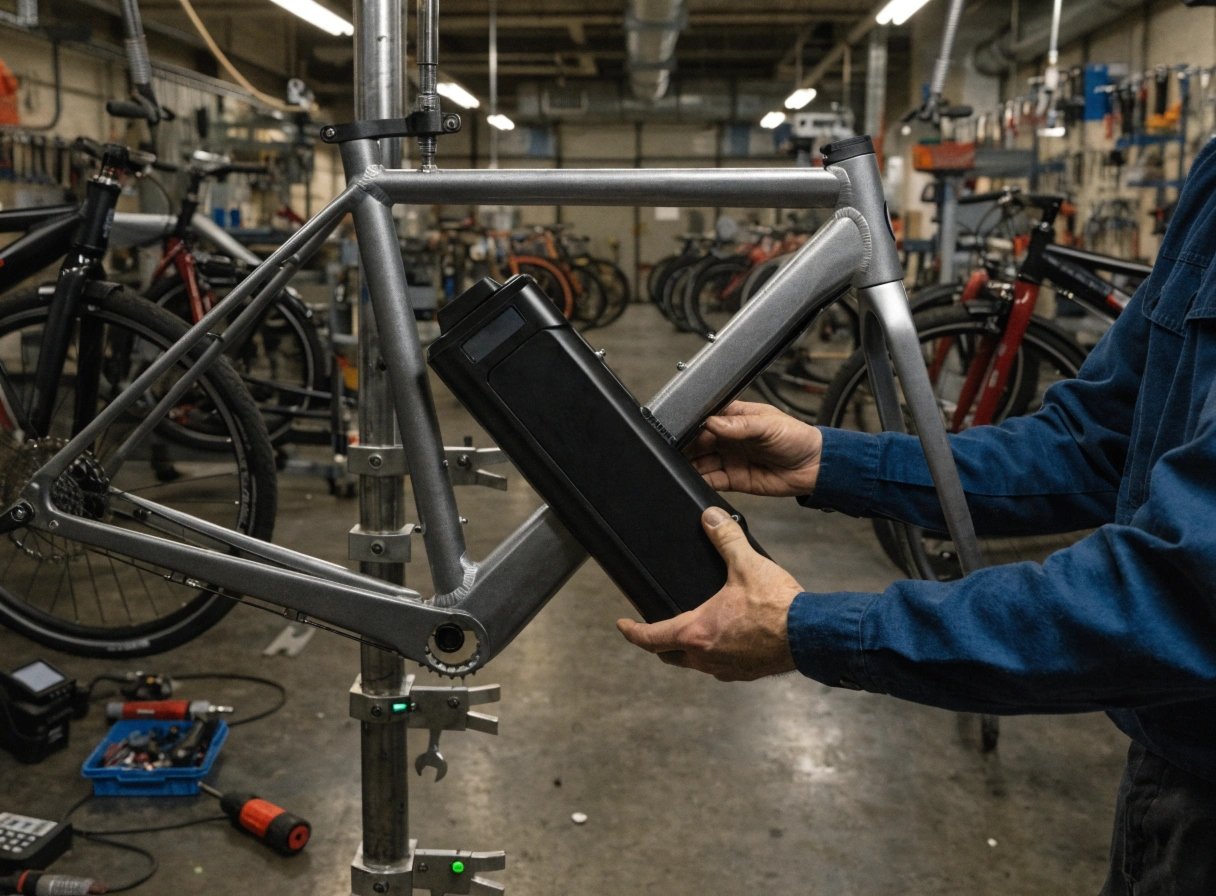
I've been in e-bike manufacturing for over 15 years. I see the difference between what's shown at Eurobike and what fills a 40-foot container. Many brands waste money on hype. I want to help you make smarter procurement decisions. Let’s look at the real data behind the trends that are actually leading to purchase orders.
Are Integrated Batteries and Clean Aesthetics Still the Top Priority?
Want that sleek, non-e-bike look? But worried about the complexity and cost? We see this request daily and know the real trade-offs involved in achieving that seamless design.
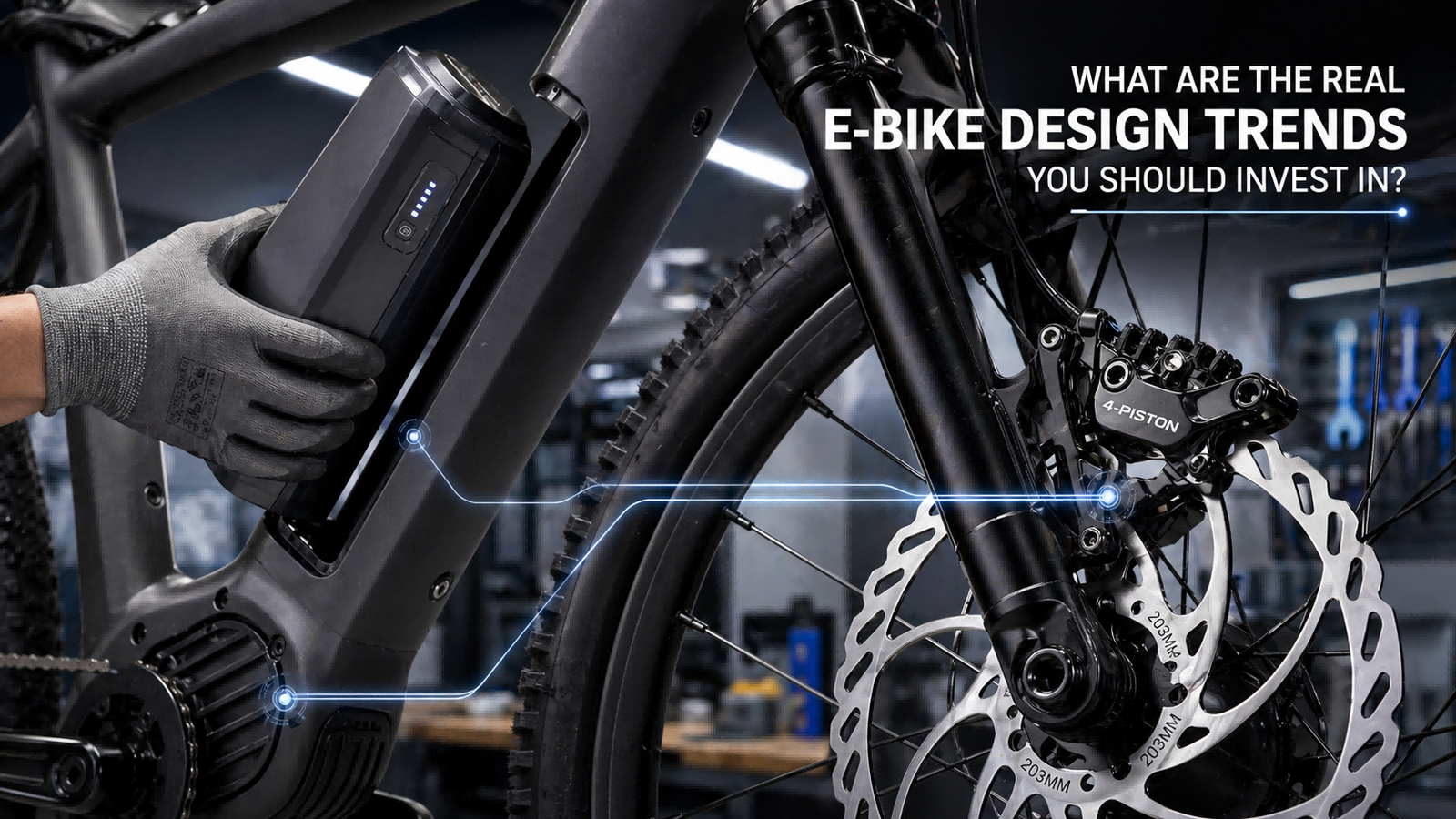
Yes, integrated batteries remain a top trend in our orders, especially for European city and trekking models. Buyers prioritize a clean, traditional bicycle look. This design choice impacts frame engineering, weight distribution, and serviceability2, which are key considerations for production.
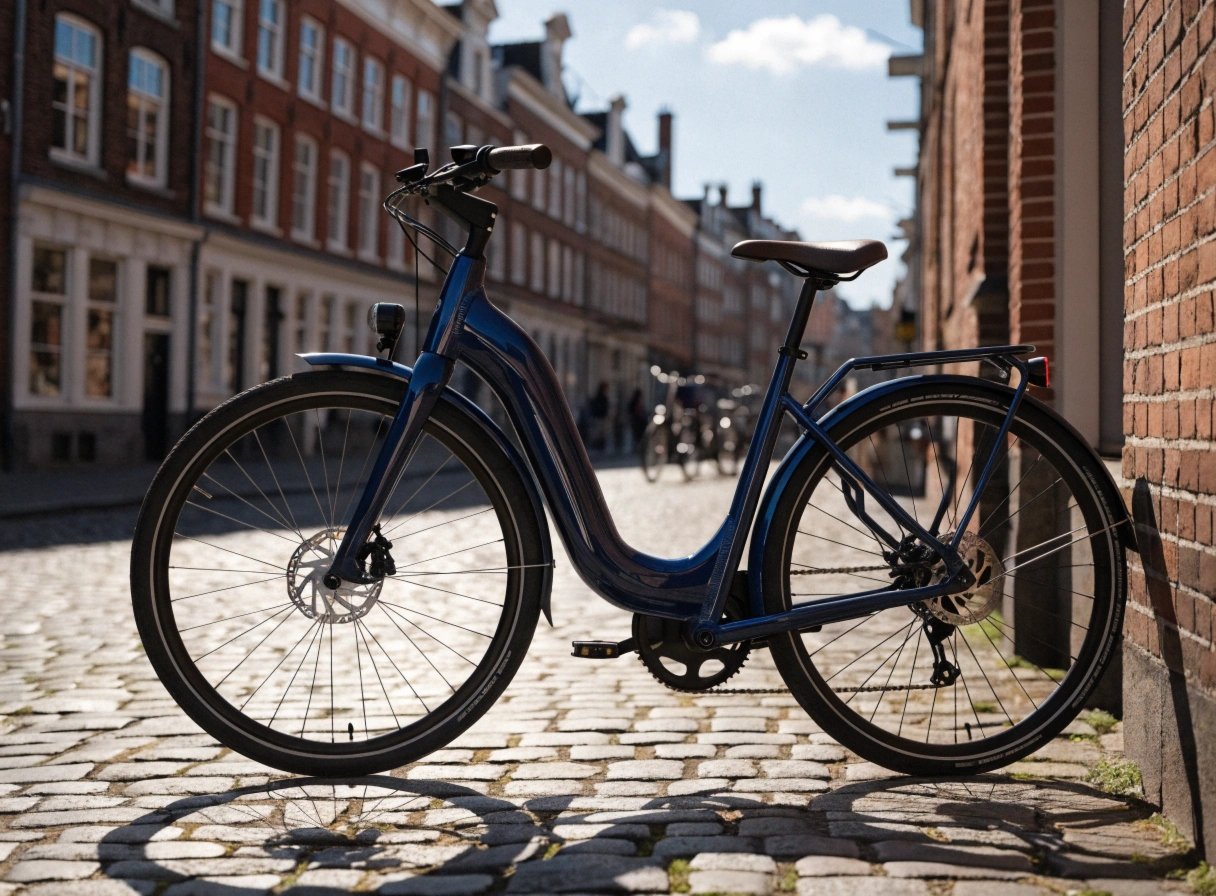
The demand for a clean aesthetic is not just hype; it's a major driver in our production queue. In our order data from the past two years, over 70% of city and trekking e-bike models specified a fully integrated down-tube battery. When clients ask us to develop a bike with this feature, our first conversation is always about the frame mold. Creating a new, fully integrated design requires a significant investment in tooling3 before a single bike is made. This is a critical financial decision for any brand. We have to be honest about the trade-offs between a unique design and a faster, more affordable market entry.
Tooling vs. Timeline
A custom mold for an integrated frame is a major expense. We tell our clients to budget for this upfront. It also adds months to the development timeline4. If speed to market is your priority, using an existing "open-mold" frame can be a much smarter choice.
Serviceability Concerns
An integrated battery looks great, but it can be harder for a customer or a bike shop to service5. This is a key point for your distributors and dealers. We work closely with our clients to engineer accessible battery compartments. The goal is to get the clean look without compromising the frame's strength or creating a maintenance headache down the line.
| Feature | Integrated Battery | External/Semi-Integrated Battery |
|---|---|---|
| Aesthetics | Clean, sleek, "non-e-bike" look | More visible, can look bulky |
| Tooling Cost | High (new frame mold required) | Low (can use existing frames) |
| Serviceability | More complex to access/replace | Easy to remove and service |
| Weight Balance | Often better, lower center of gravity6 | Can be higher, affecting handling |
How Do Regional Demands Shape E-Bike Design Orders?
Designing a "global" e-bike sounds smart, right? But it often fails. A bike that sells well in Berlin might not even be legal on trails in California7.
Regional demands are everything. Our order data shows a clear split. European clients overwhelmingly order lightweight, EN 15194-compliant city e-bikes. North American clients prioritize power, longer range, and rugged designs like fat-tire e-bikes.
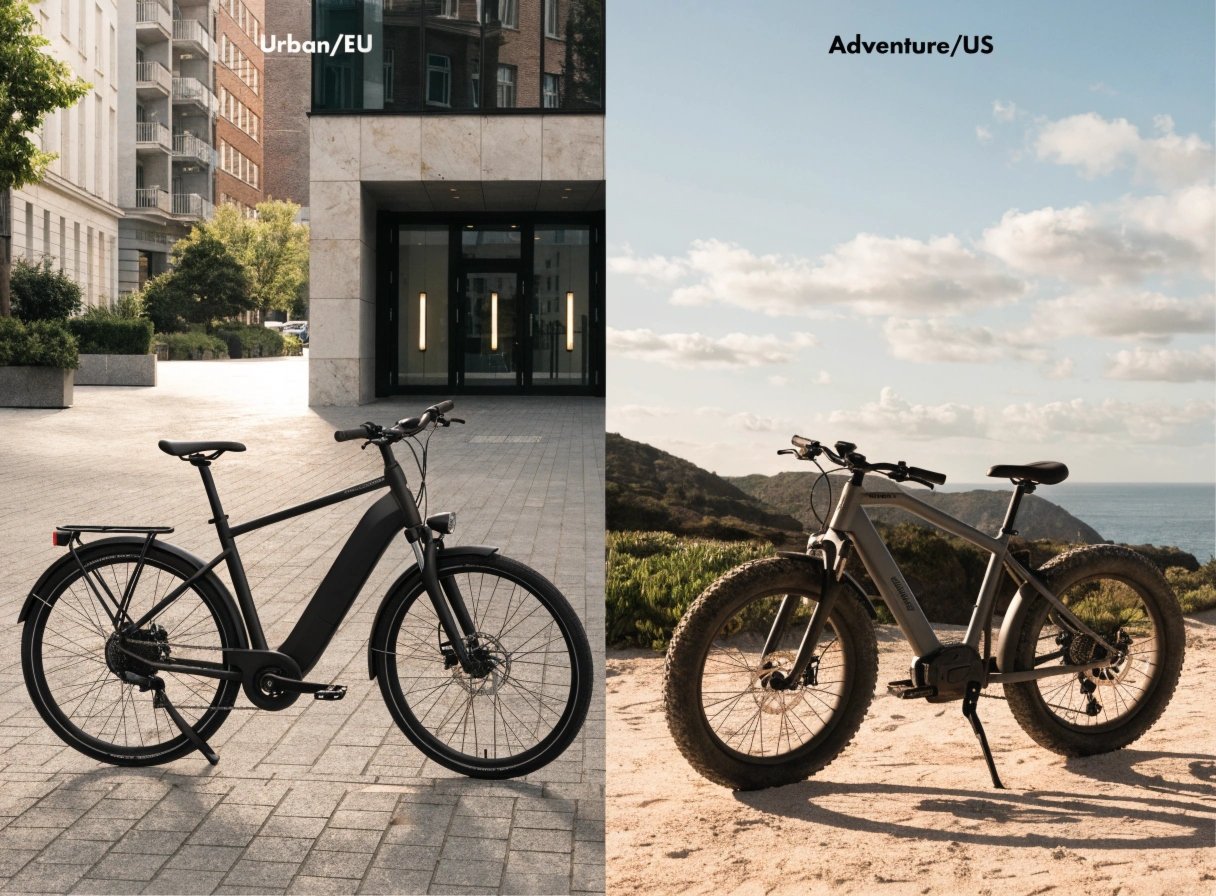
This is one of the biggest mistakes I see brands make. They see a "hot trend" online and try to apply it to every market. It simply doesn't work. The regulations, culture, and what riders expect from their bike are too different. A one-size-fits-all approach is a recipe for a warehouse full of unsold inventory. We always start a new project by asking, "Where are you selling this bike?" The answer changes everything about the design, components, and certification requirements. We build bikes for specific markets because that is what sells.
The European Focus: Compliance and Commuting
Most of our European orders are for Pedelecs. This means a 250W motor with assistance limited to 25 km/h8. The design focus is on lightweight frames for easy carrying and compliance with the EN 15194 standard9. Features like pannier racks, fenders, and built-in lights are not add-ons; they are standard requests. The look is clean and practical for navigating city streets.
The North American Focus: Power and Versatility
In contrast, our North American orders often specify 500W or 750W motors10. Battery capacity is a huge selling point, and we frequently get requests for 720Wh or even larger packs for extended range. Fat tires are incredibly popular for their ability to handle pavement, gravel, and trails. The design is more rugged, and UL 2849 certification11 for the electronics system is now the mandatory safety standard we advise all clients to pursue.
| Design Priority | European Market | North American Market |
|---|---|---|
| Motor Power | 250W (Standard) | 500W - 750W (Common) |
| Battery Focus | Integration & Efficiency | Total Capacity & Range |
| Top Feature | Lightweight & EN 15194 Certified | Fat Tires & High Torque |
| Primary Use | Urban Commuting / Trekking | Recreation / All-Terrain Utility |
What Are the Hidden Costs of Adopting New Smart Features?
You see e-bikes with GPS tracking and app integration at shows. It looks impressive. But is the high cost and development time worth it for your customers?
Smart features often have a poor return on investment for mass-market e-bikes. While they generate media buzz, our order data shows they are rarely requested in volume. The costs in hardware, software, and maintenance often outweigh the consumer benefit.
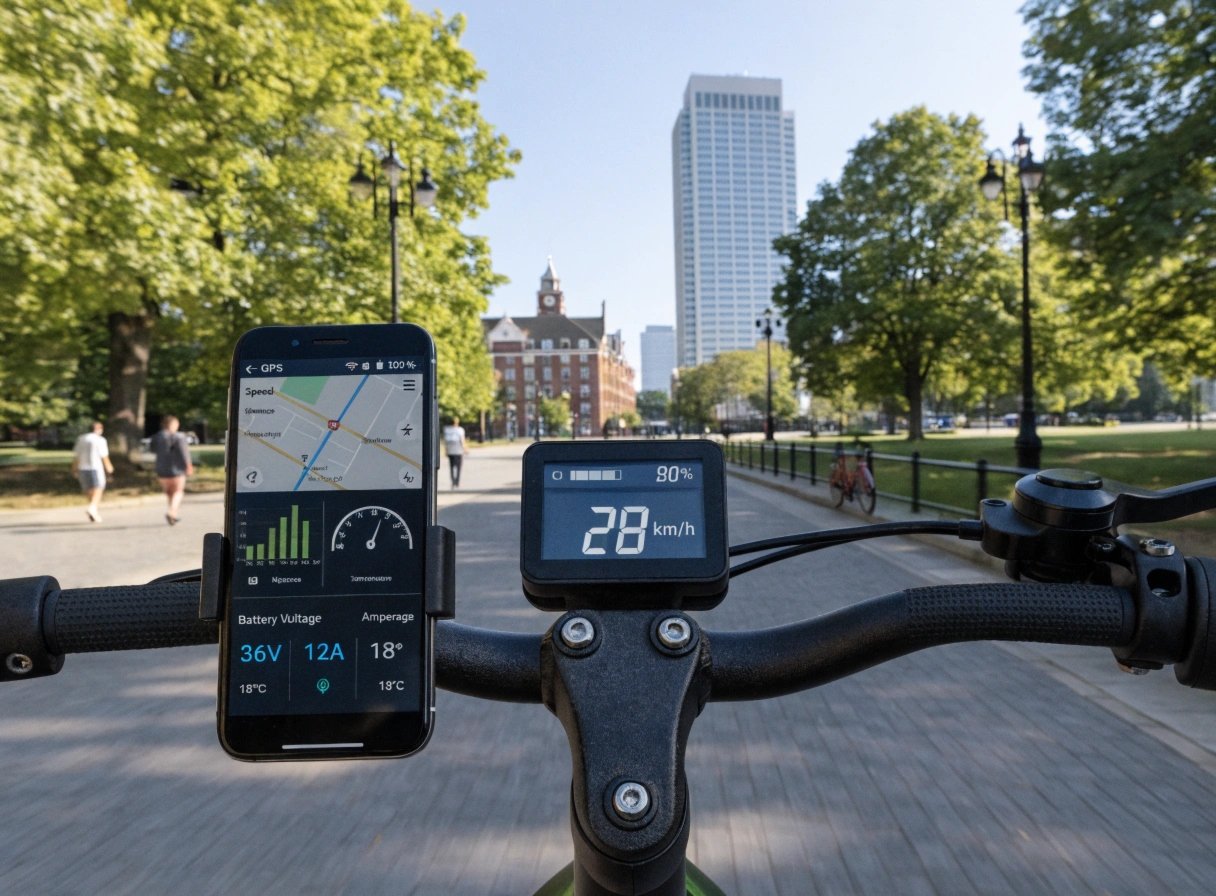
Every year, we get inquiries about "the next big thing" in smart technology. This includes GPS anti-theft, automatic electronic shifting, and integrated fitness tracking. When clients ask us to develop these features, the first question we raise is about the Bill of Materials (BOM) and the plan for long-term support. A flashy feature is useless if it adds too much cost or becomes a technical support nightmare for the brand. We've learned that reliability is far more important to the end customer than a long list of tech features.
The BOM Impact
Adding a cellular and GPS module adds a significant cost to each bike. This component also requires its own certifications, like FCC in the US or CE RED in Europe12, which adds time and expense to the project. This cost gets passed to the consumer. It often pushes the bike into a higher price bracket where it competes with more established brands, making it a tough sell.
The Software Nightmare
This is the hidden cost that many brands forget. Who develops the app? Who maintains it and pushes updates? Who pays for the server costs for the GPS tracking data? These are not one-time manufacturing costs. They are ongoing operational expenses. For most brands, it’s a huge headache they are not prepared for. In our experience, less than 5% of initial inquiries for advanced smart features move forward to a production order after we walk them through these realities.
| Smart Feature | The Hype (Trade Show Pitch) | The Reality (Production Orders) |
|---|---|---|
| Integrated GPS | "Never lose your bike again!" | High unit cost, requires data plan, rarely ordered. |
| Automatic Shifting | "The bike thinks for you!" | Complex, expensive, adds maintenance failure points. |
| Custom App Control | "Full control from your phone!" | High development & maintenance cost, low adoption. |
| Simple LCD Display | "Boring" but effective. | Standard on >95% of our orders. Reliable & cheap. |
Conclusion
Successful e-bike design is not about chasing every new trend. It's about matching proven, manufacturable designs to the right market. Focus on what really sells, not just what's new.
"How I built an electric bicycle | Paul M. Rady Mechanical Engineering", https://www.colorado.edu/mechanical/2021/06/01/how-i-built-electric-bicycle. The cited source explains that e-bike batteries may be mounted externally or integrated into the frame, and that integration is commonly associated with cleaner appearance and packaging constraints. Evidence role: definition; source type: education. Supports: Integrated batteries are a recognized e-bike design approach associated with cleaner aesthetics and packaging trade-offs.. Scope note: This supports the design rationale for integration, not the article’s proprietary claim about order volume. ↩
"Design and Fabrication of Electric Bike with Sliding Frame", https://www.academia.edu/70252832/Design_and_Fabrication_of_Electric_Bike_with_Sliding_Frame. The cited source describes how the location and packaging of an e-bike battery affect vehicle mass distribution, frame structure, and maintenance access. Evidence role: mechanism; source type: paper. Supports: Integrating a battery into an e-bike frame affects engineering design, weight distribution, and serviceability.. Scope note: The source can substantiate the engineering mechanisms, but it may not evaluate every commercial frame design. ↩
"[PDF] Cost-Benefit Assessment of Additive Manufacturing for Injection Molds", https://docs.nlr.gov/docs/fy26osti/93799.pdf. The cited source explains that custom frame or composite/metal part production commonly requires dedicated tooling or molds, creating substantial upfront cost before serial production. Evidence role: mechanism; source type: education. Supports: A new fully integrated e-bike frame design can require substantial upfront tooling investment.. Scope note: The source supports the general manufacturing economics of custom tooling rather than a specific dollar amount for this factory. ↩
"Why Focusing on Lead Time—Not Just Efficiency—Drives Success", https://interpro.wisc.edu/lead-time-drives-manufacturing-success/. The cited source notes that product development involving new tooling typically adds design validation, tooling fabrication, testing, and production ramp-up stages to the schedule. Evidence role: mechanism; source type: education. Supports: Using a new custom mold can lengthen the development timeline for an e-bike frame.. Scope note: The source supports the general timeline effect of new tooling; actual lead times vary by supplier, material, and certification requirements. ↩
"[PDF] Design for Maintenance - NASA Technical Reports Server", https://ntrs.nasa.gov/api/citations/20240004739/downloads/Design%20for%20Maintenance%20DoD%20HFE%20TAG%2076%20041724.pdf. The cited source discusses how component integration can improve packaging or aesthetics while reducing accessibility for inspection, removal, or repair. Evidence role: mechanism; source type: paper. Supports: An integrated e-bike battery can be more difficult to access or service than an external battery.. Scope note: This is contextual support for service-access trade-offs; serviceability depends on the exact battery compartment and frame design. ↩
"[PDF] bicycle dynamics", http://ruina.tam.cornell.edu/hplab/downloads/Bicycle_papers/Olsen1_Dyn.PDF. The cited source explains that lowering a vehicle’s center of mass generally affects stability and handling, and that battery placement is a key contributor to mass distribution in electric bicycles. Evidence role: mechanism; source type: paper. Supports: Placing an e-bike battery low in the frame can lower the center of gravity and influence handling.. Scope note: The source supports the handling principle; it does not prove that every integrated down-tube battery produces superior handling. ↩
"E-Bikes in CA State Parks", https://www.parks.ca.gov/?page_id=30521. The cited California government source explains that e-bike access depends on class, location, and land-manager rules, including restrictions that can differ between roads, bike paths, and natural-surface trails. Evidence role: case_reference; source type: government. Supports: A design legal or accepted in one market may face different trail-access rules in California.. Scope note: California rules vary by park, municipality, and trail manager, so the source supports variability rather than a universal statewide ban or permission. ↩
"Electric bicycle laws - Wikipedia", https://en.wikipedia.org/wiki/Electric_bicycle_laws. The cited European regulatory source identifies electrically assisted pedal cycles with continuous rated motor output not exceeding 250 W and assistance that cuts off at 25 km/h as a category treated differently from higher-power motor vehicles. Evidence role: definition; source type: government. Supports: European pedelec rules commonly use a 250 W motor limit and 25 km/h assistance cutoff.. Scope note: This supports the regulatory threshold; individual countries may impose additional equipment or road-use rules. ↩
"[PDF] Summary of Electric and Non- Powered Bicycle Standards", https://www.cpsc.gov/s3fs-public/Electric-and-Non-Powered-Bicycle-Standards-Summary-Report.pdf?VersionId=rZGs9tSONCKqT8AEaJJMZd_S1nDJpKEW. The cited standards or European harmonization source describes EN 15194 as the European standard covering electrically power-assisted cycles, including safety and performance-related requirements. Evidence role: definition; source type: institution. Supports: EN 15194 is the relevant European standard for electrically power-assisted cycles.. Scope note: Full standard text may be paywalled; public summaries can verify scope but not every technical requirement. ↩
"[PDF] Summary of Electric and Non- Powered Bicycle Standards", https://www.cpsc.gov/s3fs-public/Electric-and-Non-Powered-Bicycle-Standards-Summary-Report.pdf?VersionId=rZGs9tSONCKqT8AEaJJMZd_S1nDJpKEW. The cited U.S. regulatory source defines a low-speed electric bicycle using, among other criteria, an electric motor of less than 750 watts and a maximum motor-powered speed threshold. Evidence role: definition; source type: government. Supports: North American e-bike specifications commonly reference 500 W and 750 W motor categories because U.S. rules use a 750 W threshold.. Scope note: This supports the U.S. federal product-safety definition; state road-use classifications and Canadian provincial rules may differ. ↩
"Micromobility: E-Bikes, E-Scooters and Hoverboards", https://www.cpsc.gov/Safety-Education/Micromobility-E-Bikes-E-Scooters-and-Hoverboards. The cited source identifies UL 2849 as a safety standard for e-bike electrical systems, addressing the battery, charger, motor, and related electrical components; some jurisdictions reference third-party certification to such standards in fire-safety rules. Evidence role: expert_consensus; source type: institution. Supports: UL 2849 is a recognized e-bike electrical-system safety standard and may be required in some jurisdictions.. Scope note: UL 2849 is not universally mandatory across all North American jurisdictions, so it should be framed as a recognized or increasingly required safety benchmark rather than a blanket legal requirement. ↩
"Equipment Authorization – RF Device | Federal Communications ...", https://www.fcc.gov/oet/ea/rfdevice. The cited regulatory sources state that radio-frequency and wireless devices must meet applicable authorization requirements in the United States and Radio Equipment Directive requirements in the European Union before being placed on those markets. Evidence role: definition; source type: government. Supports: Adding cellular, GPS, Bluetooth, or other radio modules can trigger FCC or EU Radio Equipment Directive compliance obligations.. Scope note: The exact conformity route depends on the wireless module, frequency band, and whether pre-certified modules are used. ↩